Given circle is . We know that if the
equation is , then the center is and radius
is .
Thus, center of circle is and radius is
.
Radius of is . Radius of is
. Radius of is .
Thus, radii of the given circles are in A.P. with a common difference of .
The center will be and the radius will be
From
.
The center of the circle is and radius is .
Given circle is . Center is
and radius is .
Center is and radius is .
Given circle is . Center is and radius is .
Centers of the given circles are and . Area of the triangle
whose vertices are these three points is given by
.
Hence, the centers of the given circles are collinear.
Radii are and . Common
difference is , and hence, the given circles have radii in A.P.
Radii are and . Common difference is , and hence, the given circles have radii in A.P.
The line gives .
Substituting into the circle equation gives .
Multiplying through by gives .
Expanding gives .
Simplifying gives .
Solving for gives .
This simplifies to .
Thus, the two points of intersection correspond to and .
The length of the intercept cut by each circle on the line is .
For successive values of , the difference of intercepts is constant since and .
Therefore, the circles cut off equal intercepts on the given line.
Since point lies on the circle, therefore, radius .
Thus, equation of the circle would be .
Solving the equations of the diameters we obtain the center as .
Thus, equation of the circle is given by .
Since the line touches the circle, therefore, the perpendicular distance from center will give
radius.
Radius is .
Thus, equation of the circle is .
Solving the two equation we have . Now as .
The circle passes through , so the radius is
Thus, equation of the circle is .
Let the center be . Since it lies on the line
Equation of the circle would be . Putting the value of
from the above equation, we have
Since it passes through , therefore,
So the center is or .
Thus equation of circle is or i.e. or .
Since the circle touches the axes the center will lie on or .
Case I: When the center lies on the line .
Solving the two equations we get
The radius of the circle would be . Therefore, the equation of the circle is
.
Case II: When the center lies on the line .
Solving the two equations we get .
The radius of the circle will be . Hence, equation of the curcle is .
Radius of the first circle is so its center would be as it touches both
the coordinate axes.
Distance between the centers is . Hence, radius of the
second circle is
Hence, equation of the circle is
.
Half of intercept(chord) is . Perpendicualr distance from center to is
Thus, radius of the circle is .
Since the circle touches -axis at , therefore, the two circles will be in
first two quadrants. Let and be the centers of the circles in the first and
second quadrant respectively. Let be the intercept on -axis i.e. . Let be the perpendicular from on -axis.
and
Hence, equations of circles are and i.e
and .
and
Since these are normals, therefore, their point of intersection will be the center of the
circle. Solving gives us as the center of the circle.
Center of the given circle is and its radius is
Distance between centers is , which is greater than radius of the given circle.
Since the circle is just large enough to contain the given circle the radius of the required circle
is distance between the centers plus radius of the given circle i.e.
Thus, the equation is .
Let be the center of the circle in original position adn be the center of its new
position. Then and . Radius is .
Thus, equation of the circle in new position is
.
Equation of tangent to the circle at is given by
This line makes angle of with -axis. So initial position of the center
is and final position of the center is
Radius of the circle is
Thus, equation of the circle in final position is
.
Let be the center and the radius of the required circle, then
its equation is
. According to the questions
Since it touches we have
It also touches we have
Case I: and gives us
Thus,
Hence, center of the circle is and radius is
.
Case II: and gives us
Thus,
Case III: and gives us
Thus,
Hence, center of circle is and radius is
.
Case IV: and gives us
Thus, .
Let be the center of the circle and be its radius. According to
question
Solving these gives but it is given that
Putting in first and third one we get
Hence, equation of the circle is .
Equation of the circle is .
Equation of the circle is .
Given diameters are and . Solving we get .
Thus, equation of the circle is .
Given lines are and . Thus,
and
.
Let the radius of the circle is . Then equation will be .
Since it passes theough , therefore,
Thus, equation will be .
Given lines are and . From first . Putting in the second
Let the radius of the circle is , then the equation is
Since it passes through , we have .
Thus, equation of the circle is .
Given that the circle passes through and has center .
Let the raidus be , then equation of the circle is . Since it passes through
Thus, equation of the circle is .
Point of intersection of and is . The other
two lines are and .
Thus, .Putting in . So center is .
Let radius of the circle is . Then the equation of the circle is
Since it passes through , therefore, .
Thus, equation of the circle is .
Given that the radius is and center is at .
Thus, equation of the circle is .
Let the center be . Since it lies on the line , we have .
Because the circle passes through and , the distances from the
center to these points are equal. So .
Simplifying this gives . Using , we get , so
and .
Thus, the center is . The radius squared is .
Therefore, the equation of the circle is .
Let the center be with .
Since the circle passes through and , we equate distances .
Expanding and simplifying gives , which reduces to .
Now solve and .
Subtracting gives , so . Substitute into , so and .
Thus, the center is .
Now compute radius squared using .
So the equation of the circle is .
Center of given circle is and radius is .
Let required center be . Point lies on it
Collinearity gives
So
Substitute or
Reject , so center is .
Eqaution of the cicle is .
Perpendicular distance from the center to the tangent will be radius. Let it be .
Thus, equation of the circle is .
Since the circle is concentric with the circle , therefore,
center will be .
The circle touches the line , therefore, perpendicular distance from tangent
will be radius. Let it be .
.
Thus, the equation of the circle is .
Let be the center then .
The center is on normal perpendicular to give line. Hence slope will be . Also,
slope is .
Thus, .
Putting this in the equation of the circle
.
Thus, equation of the circles are and .
The two normals are and . Solving them .
This point of intersection of two normals give the center of the circle. Thus, the center is , and it is given that radius of the circle is . Hence, the equation is
.
Let the center of the circle be and radius be .
Since the circle touches the -axis at the point , the radius equals the
distance of the center from the -axis.
Hence .
Equation of the circle
The circle cuts an intercept on the -axis.
So the points where the circle meets the -axis satisfy .
Substituting
The length of the intercept on the -axis is
Hence, the radius is and the center is .
Therefore, the equation of the circle is .
The circle would be in any quadrant and center would be one of
and .
Thus, equation of the circle is .
Since the circle touches the -axis at origin, therefore, the -axis will be
normal. If is the radius then will be the center.
Since it passes through , therefore,
Thus, equation of the circle is .
Since the circle touches the -axis at origin, therefore, the -axis will be
normal. If is the radius then will be the center.
The circle touches the line , so perpendicular distance from the center
will be equal to the radius.
Thus, equation of the circles are and .
Given circle is . Thus, parametric equaiton is .
Let the center of the circle be and radius be .
The circle touches the line at the point .
Hence, the center lies on the line perpendicular to through .
Slope of is . Therefore the perpendicular slope is
.
Equation of the perpendicular line through
So the center satisfies
The radius equals the distance from the center to the line and also to the
line
Hence,
Using , we get
Substituting in the distance equation
Then
Radius
Therefore, the equation of the circle is .
Let the center be and radius be . Since the center lies on , therefore,
The circle touches the lines and
Hence, the distances from the center to both lines are equal.
Using
Radius
Therefore, the equation of the circle is .
Since the circle touches the coordinate axes and has a radius of units, therefore, its
center would be in first quadrant.
Given that is the line mirror, so the new center would be and the
equation of circle will be
.
Center of the circle is and radius is
.
Image of the center across this line is given by and
Here and .
Now
Also . Therefore and
Hence the image circle has center and radius .
Thereforem its equation is .
Center of the circle is and radius is . After one complete revolution
along -axis will make the new center as .
Thus, new equation is .
The center is and radius is . The center moves on the line , so any new center satisfies
Distance between old and new center is , so
Substitute
Thus two circles are possible. and
For equation of circle will be .
For equation of circle will be .
Let the circle pass through the origin and have center and radius .
Since it passes through
The length of chord cut by the circle on a line is where is
perpendicular distance from center to the line.
Given chord length is .
So
Now for line
Distance from is
So
Simplifying gives us (1)
Now for line . Distance is
So similarly
Simplifying gives (2)
From (1) and (2): and
Case I:
Case II:
Case III:
Case IV:
Radius: . So
Thus the circles are , and
.
Let
Taking plus sign
Now use the bisector of and ,
Substitute ot get
Hence the incenter is .
Let the raidus be . The center could be in any quadrant, and thus, center is .
Since the center lies on , therefore, .
Putting this is in gives us
.
The smaller circle is so its centre is and radius is
.
Let the radius of the larger circle be . The distance of the line from
the centre is
Chord length in a circle of radius at distance from the centre is
Hence, the chord lengths are and
Given intercept between the circles is
Therefore, the larger circle is .
The given circle is . So the centre is
and radius is .
For the point , the distance from the centre is
Since the point is exterior to the circle.
The maximum radius of a circle centered at containing the given circle is
Hence the required circle is .
, and
is acute, so the minimum enclosing circle of the centers is the circumcircle
,
where is circumcenter.
Since each given circle has radius , the required minimum radius is
Hence, the required circle is .
The diamter form of the circle is .
Putting for intercept on -axis, we have
Let and be the roots then and , then
.
So the intercept on -axis is .
One of the diagonals will have endpoints as and and the other will
have and .
Thus, the equation of the circle is .
The other diagonal will also give the same equation.
Equation of the circle will be .
Equation of the circle will be
So center will be and radius will be .
The intercepts are and on and axes. Thus, the
equation of the circle will be
.
The center of the circles are and . Thus, the equation of the
circle is
.
One of the diagonals will have endpoints as and . Thus equation of
the circle will be
. The other diagonal will also give the same equation.
The given lines form a rectangle since there are two pairs of parallel lines.
From and we get point .
From and we get point .
From and we get point .
From and we get point .
We take one diagonal and as diameter to get the equation of the
circle as
. The other diagonal will also give the same equation.
Let be the roots of then and
. Similarly, let be the roots of
then and .
Circle whose endpoints will be the diamter will be given by
Substituting the values from the equations obtained we have the equation as
Hence, center is and radius is .
The circle is given by . Let be the other
endpoint. Then the equation for the circle with the diameter is given by
Comparing coefficients of and we have and .
The given lines are and .
These form a rectangle since each pair is parallel and the two directions are perpendicular.
Take one pair of opposite vertices by solving with and with .
Let these points be and .
From symmetry we have and . So the equation of the circle
becomes .
Solving and gives and .
So
This simplifies to .
Hence, the equation of the circumcircle is .
Let the equation of the circle is whose center is , which lies on . Thus,
. Since the circle passes through and ,
therefore,
and . From these two equations we have
Thus, and and now it is
trivial to find the equation.
The line meets the axes at and . Let the
equation of the circle be .
Since it passes through origin, therefore, .
For the equation becomes and for the equation is . Thus, we have found the
equation of the circle as .
The given lines are and .
From and we get .
From and we get .
From and we get .
We take the general circle .
Substitute point and get .
Substitute point .
This gives so .
Substitute point .
This gives .
Multiply by to get so .
Thus, and .
Hence, the circle is .
Let the equation of the circle be . Since it passes through
and , therefore,
(1) and (2)
From these two equations we have (3)
Since the circle touches the line so perpendicular distance from center
would be radius. Thus,
[from (1)]
[Putting the value of from (3)]
Thus, equation of the circles are and .
Let the equation of the circle be , so the center is
and radius
Since the circle touches the -axis, therefore, (1)
Also, the circle touches [from (1)]
(2) and (3)
Also, given that the center lies on (4)
Thus, and , which lies in first
quadrant. Thus, .
Hence, the equation of the cirlce is .
Let the circle be . Substituting point gives
so .
Substituting point gives so .
Substituting point gives so .
From we get . From we get .
Substitute into .
This gives . So .
This simplifies to so . Then and .
Hence, the equation of the circle is .
Let the circle be .
Substituting point gives .
Substituting point gives so .
Substituting point gives so .
Hence, the equation of the circle is .
Let the circle be . Since it passes through the origin, we get
.
So the equation becomes .
Now we consider the intercept on the positive -axis. Putting gives which gives .
So the intercept points are and .
The length of the chord on the positive -axis is . Hence, so
.
Now we consider the intercept on the positive -axis. Putting gives which gives .
So the intercept points are and . The length of the chord on the
positive -axis is .
Hence, so . Therefore, the equation of the circle is .
The given lines are and .
From and we get .
From and we get .
From and we get .
Let the circle be circle .
Substituting point and get .
Substituting point gives so .
Substituting point gives so .
From we get .
Substituting into gives so .
Then . Hence, the equation of the circumcircle is .
The given sides of the triangle are and .
From and we get .
From and we get .
From and we get .
If the side lengths opposite are then the incenter is
and .
Length . Length . Length .
After simplification the incenter is .
Now find the radius which is the perpendicular distance from the incenter to any side.
Distance to is .
Hence, the equation of the incircle is .
Let the circle be . Since it passes through the origin, we get
.
So the equation becomes .
Now we consider the line which is .
The perpendicular distance from the center to this
line is
.
Since the circle cuts off a chord of length on this line, we use
. So .
Now . So .
Similarly for the line which is . Distance from center is
.
So .
Now subtract the two equations. This gives .
So either or . First case gives . Second case gives .
Now substitute each case. For we get .
Substitute into equation and solve to get and .
For we substitute and get and .
Hence the required circles are and .
Common chord of the circles is
Equation of such a circle is .
Its center is . If is diameter then
.
Thus, equation of the circle is .
Equation of any circle passing through the point of intersection of the given circle and the given
chord is .
Center of this circle is .
Since is the diameter of this circle the center will lie
on this line, therefore,
Thus, the equation of the circle becomes .
Clearly is the equation of a circle with center at origin and radius
.
Also line is the equation of the line which touches the circle
for all values for .
Let be the point of contact of the circle and the line. Clearly, given equation is the
equation of circles passing through the point of contact of the given circle and the given line. Any
two circles of this family touch each other at .
Equation of the line joining the points and is
Also equation of the circle with and as endpoints of the
diameter is .
Equation of any circle passing through the point of intersection of the above circle and line is
given by .
Putting gives , which is
the diameter form of the equation of the circle.
Equation of any circle through the point of intersection and of the line and
the circle is
.
Similarly for other pair of line and circle
If the two circles are the same then the points and will be concyclic.
Comparing coefficients
Thus, , and .
Eliminating and and writing in discriminant form we have
Equation of any circle possing through the points and is
given by
(1)
Let the fixed circle be (2)
Equation of the chord of intersection of circles (1) and (2) will be
(3)
Clearly this line passes through the point of intersection of two fixed lines and , which is a fixed point.
Given circle is (1)
Since and are tangents to the circle (1), therefore will be the
chord of contact of point , and hence, equaiton of will be
(2)
Equation of any circle through the point of intersection and of (1) and (2) is
(3)
Circle (3) will be circumcircle of if circle (3) passes through the point
i.e.
Hence, required circle is .
Given circles are (1) and (2) and given line is (3).
Equation of any circle passing through the point of intersection of circles (1) and (2) is
Its center is . Since it lies on the line
(3), therefore,
.
Thus, required equation is .
Let (1) and (2)
Now equation of common chord of the circles is (3)
Since cirlce (1) bisects the circumference of the circle (2), therefore, common chord will be the
diameter of the circle (2) and hence center will be of circle (2) will lie on
the line (3)
.
The given circles are and .
The family of circles passing through their points of intersection is .
So the required circle is .
This simplifies to .
.
Comparing with .
So , and
.
The radius condition is . After solving we get .
Then the equation becomes .
The given circles are and .
The common chord is obtained by subtracting the two equations.
So we get .
This simplifies to or .
From the center is .
Substitute into . We get .
So the common chord passes through the center of the second circle.
The radius of the second circle is so .
The perpendicular distance from the center to the chord is
.
Hence, the chord passes through the center, so it is a diameter.
Therefore, the length of the chord is .
The given circles are and .
The common chord is obtained by subtracting the equations.
So we get or .
Now for a circle with diameter along a line, we use the fact that its center lies on the
perpendicular bisector of the chord.
The midpoint of the chord lies on the line joining the centers of the two given circles.
The centers are and . So the line joining centers is .
The midpoint of the chord is intersection of and .
So the center is . Substitute in first circle.
Then . This gives .
Solve to get .
So the radius squared is .
Hence, the equation of the circle is .
The given circle is and the chord is .
Substitute into the circle.
This gives .
So the points of intersection are and .
Thus, the points are and .
These are the endpoints of the chord.
The equation of the circle with this chord as diameter is .
This gives .
The given circles are and .
The family of circles passing through their points of intersection is
. So the required circle is
.
.
.
The center is .
Since the center lies on , equate the coordinates. So .
This gives so .
Then . So the equation becomes
.
The given equation is .
This is of the form so it represents a circle for all values
of .
.
For fixed points, the equation must be satisfied for all values of .
So the coefficient of must be zero and the remaining part must also be zero.
Thus, we get and .
From we get .
Substitute into the second equation .
Solving gives .
Since , the fixed points are and
.
The given circles are and .
The family of circles through their intersection is .
This gives .
The center is .
Since the circle touches , the distance from center equals radius.
This gives so .
Hence, the required circle is .
The given circle is and the line is .
The family of circles passing through their intersection points is .
This gives .
Since the circle passes through , substitute it.
So .
Hence, the required circle is .
The given circle is and the line is .
Let and be the endpoints of this chord.
Equation of the circle is .
Now is twice the midpoint of the chord.
The midpoint is the foot of the perpendicular from the center to the line.
So midpoint is .
Hence, and .
Also both points satisfy . So .
Thus, . Substitute in the diameter form.
Hence, the required circle is .
The given circle is and the external point is .
Let and be the points of contact of tangents from . The chord of
contact of with respect to the circle is .
So the equation of chord is .
The circumcircle of where is the center of the given circle is
obtained by combining and .
So its equation is .
Since it passes through , we substitute it. Then .
Here . So we get which gives .
Hence, the required circle is .
So the equation is .
.
Substituting the value of in the equation of the circle gives us
The given line and circle will intersect if the above quadratic equation's roots are real
i.e. discrimininate
.
Center of the circle is and radius is
. Let be the length of the perpendicular from the center to
the given line then
Hence, length of the chord is .
Center of the circle is and its perpendicular distance from the line is
, which is equal to the radius of the circle.
Hence, the given circle touches the given line. Let be the point of
contact. Then equation of tangent is given by
Comparing the coefficients with the given equation of the line we have
.
Center of the given circle is and radius is . Equation of any line
parallel to given line is .
Since this point is tangent to the given circle, therefore,
.
Given circles are (1) and (2).
Let and are the centers and and the radii of
and respectively.
. Hence two circles touch
each other. Thus, there will be three common tangents.
Equation of chord is given by , when . Thus, is a common tangent.
Let be a common tangent to the given circles then
and
Solving these two equations gives us and
Thus, common tangents are , and
Let be points of intersections of these three lines then and .
It is trivial to prove that is an equilateral triangle.
Given that the biggest circle is (1). Since the radiio of the circles
are in A.P. let the commond difference be .
Thus, other two circles will be (2) and (3)
Given line is . Putting in (1) gives us
Similarly with (2) we have
Since the points are real and distinct, therefore,
Similarly with (3) we have . Proceeding similarly we obtain
. However, .
Thus, we have .
Given (1) and line is (2)
Let the center of the circle be with radius . Then
Comparing this with (1)
. Thus, .
Hence, the circle has center and radius .
Given cicle is (1). Its center is and
its radius is .
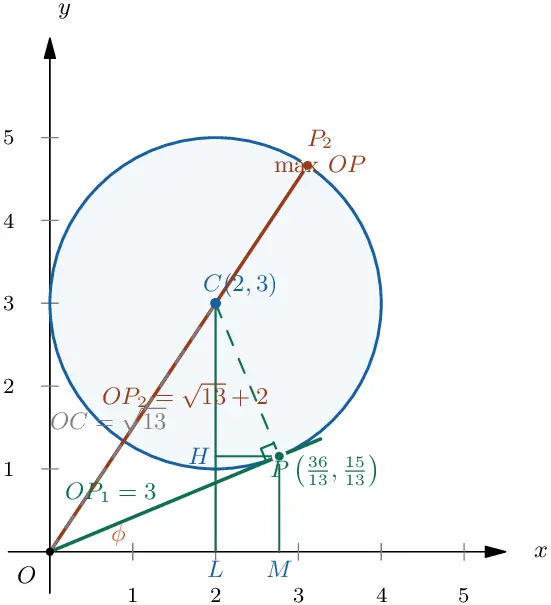
Let be a tangent and let -axis(which is a tanegent) touch the circle at
. Then will be minimum when is tangent to the circle.
Let then
Now
From figure or
will be maximum if becomes the point where extended part of cuts
the circle. Let this point be .
Slope is (let) .
Given circle is . First we find its point of contact with
-axis i.e. .
Putting . Thus, point of contact is .
Then we put to get . Thus, point of contact is (because
we get only one point in both the cases the circle touches the axes.)
The given circle is so its center is and radius is
.
The given points are and . The midpoint is .
The slope of the line joining the points is so the perpendicular slope is .
Hence the chord is the line through with slope
.
So its equation is .
So .
The length of the chord is .
The given circle is .
So the center is and radius is .
The given line is . The perpendicular distance from the center to the line is
.
The length of the chord is .
The midpoint of the chord is the foot of the perpendicular from the center to the line.
Using formula, midpoint is .
The given circles are and .
So we get or .
First circle is . So the center is and radius is
.
The distance from the center to the line is .
The length of the common chord is .
Hence, the length of the common chord is .
The given circles are and .
So we get or upon solving.
First circle is . So the center is
and radius is .
The distance from the center to the chord is .
The length of the chord is .
The given circles are and .
So so
.
So the common chord lies on .
The center is and radius is of the first circle.
The perpendicular distance from to the line is .
The length of the chord is . So it is .
This simplifies to . Hencem the length of the common chord is
.
For the circles to touch, the chord length must be zero. So . Hence,
the condition is .
The given circles are and .
Common chord's equaiton is .
First circle's center is and radius squared is .
The perpendicular distance from the center to the chord is .
So .
The length of the chord is .
.
The given circles are and .
So chord is which gives .
First circle's center is and radius squared is
.
The perpendicular distance from the center to the line is .
So .
The length of the chord is .
So the length is .
The center of the given circle is origin and radius is . The length of perpendicular from
center to tangent is equal to radius. Therefore,
.
Center of the given circle is and radius is .
Length of the perpendicular on the given line from center is , which is equal to the radius of the circle.
Hence, the given circle touches the given line.
Center of the given circle is the origin and radius is .
Length of the perpendicular on the given line from center is , which is equaal to radius.
Thus, the given line touches the given circle.
Center of the given circle is the origin and radius is .
Length of the perpendicular on the given line from center is .
Thus, locus of is the circle .
Given circle has center and radius .
For the given line to touch the circle length of perpendicular from center to the line must be equal
to the radius of the circle. Thus,
.
The given line is .
Expand to get .
For a fixed point to be the center of a circle touched by all these lines, the
perpendicular distance from to the line must be constant.
So distance is .
This becomes .
For this to be independent of , we must have and .
So the center is . Now the distance becomes constant equal to .
Hence, the radius is .
Therefore, the required circle is .
The given line is . So the required tangents are of the form .
For the circle , the center is and radius is .
The distance from the center to the tangent must be equal to the radius.
So . Hence, .
Therefore the required tangents are and .
The given circle is . So the center is and
radius is .
First consider tangents parallel to . Such lines are of the form .
The distance from the center to the line equals the radius. So .
or .
Hence, the tangents are and .
Now consider tangents perpendicular to .
Slope of the given line is so perpendicular slope is . So
the tangents are of the form .
Again distance condition gives or .
Hence, the tangents are and .
The given circle is .
So the center is and radius is
.
The given line is .
The distance from the center to this line is .
So the line touches the circle. Now the other parallel tangent is of the form .
Again use the distance condition. So .
This gives . So or .
Since gives the given line, the other tangent is .
The given circle is so the center is and radius is
.
The given line has slope . So the required tangents have slope
.
Hence, their equations are of the form .
The distance from the center to the tangent must be equal to the radius.
So . Thus .
. Hence, .
Therefore the required tangents are and .
The given circle is . So the center is and
radius is .
The given line has slope . So the required tangents have slope
.
Hence, their equations are of the form .
The distance from the center to the tangent equals the radius. So .
So .
Hence, the required tangents are and .
The given circle is so the center is and radius is
.
A line making an angle with the positive -axis has slope
.
So the required tangents are of the form .
The distance from the center to the tangent must be equal to the radius. So . Hence, .
Therefore, the required tangents are and .
The given pair of lines is .
Rewrite it as . So the lines are and .
The family of circles touching both lines has its center on the angle bisectors.
The angle bisectors are and . First take center .
The radius is the distance from to either line. So .
Hence, the circle is .
This gives one family. Now take center . The radius is .
Hence, the circle is .
Let and be the centers and and the radii of the
given circles respectively. Thus, , and .
and
Thus, , hence, the two circles touch each other internally.
The centers of the given circles are and and radii are and respectively.
The circle will touch internally or externally if or
Substituting the values and squaring we get .
The centers of the given circles are and respectively, and radii
are for both.
Distance between centers . Hence, the circles touch each other
externally.
Let the equations of the circles touching both the given circles be with center and radius .
, and similarly,
, and thus, we have our required circles.
The given circles are and .
First circle is . Hence, the center is and
radius is .
Second circle is . Hencem the center is and
radius is .
Now find the distance between the centers. So .
Also . Since , the circles touch externally.
The given circles have centers and and both have radius .
The distance between the centers is .
For the circles to touch externally, the distance must be equal to .
So . Hence .
Thus, . So the condition is .
The given circles are and .
Their centers are and . Their radii are and .
The distance between the centers is .
For the circles to touch, we must have .
.
equals the right side.
.
.
.
.
.
So . Hence, .
Given circle is (1)
For point , hence, the
point lies inside the circle.
Let be any chord of the circle through . Let , then
, the will be the middle point of .
Since and are fixed points is fixed.
will be minimum if is minimum and minimum value of is
, when coincides with .
Thus, minimum value of .
Let be the chord whose equation is (1) and given circle is
(2).
Center of the circle is . Let be the mid-point of the chord. Let
then
length of perpendicular from to line (1)
(radius of the circle).
From
Now angle at circumference angle at the center .
Let be a semicircle and be a diameter. Let be the middle point
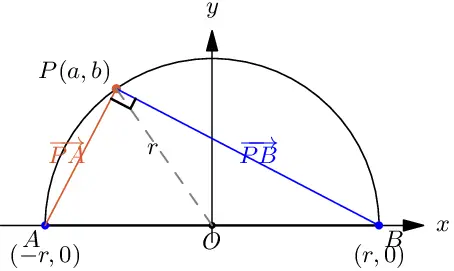
of . We take as the origin and as -axis. Let
be the radius of the semi-circle. Then and .
Let . Now
and
.
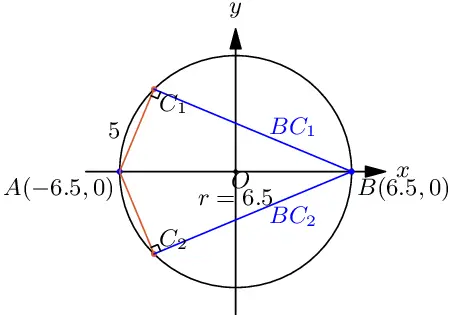
Given m, m. Let , then is the
mid-point of .
m and m. From
Slope of
Slope of
Equations of and are and
The join equation is .
The given circle is and the internal point is .
Let the center be and radius be where .
Let a chord through be at perpendicular distance from the center.
The length of the chord is .
For a fixed point inside the circle, the least chord occurs when the chord is perpendicular to the
line joining the center and the point.
In that case the distance from the center to the chord is the distance between the center and the
point.
So .
Thus, the least length is .
.
Equation of any curve through the point of intersection of given lines and coordinate axes is
If this is a circle then coeff. of coeff. of .
The given circle is so the radius is . The line is .
The perpendicular distance from the center to the chord is
.
Let the chord subtend angle at a point on the major segment.
Then the angle subtended at the center by the chord is .
The half angle at the center is .
So . Thus .
So .
The tangent to the circle at is
. So .
Now consider the second circle . So the center is and radius is .
Find the distance from the center to the line . So .
This equals the radius, so the line is tangent.
Put into the circle. So . This gives
.
So . So and . Then .
Hence, the point of contact is .
The given family is . Write it as .
For fixed points, the equation must hold for all . So (for
-axis) and .
Thus, or . Hence the fixed points are and .
So . Thus .
At we get slope . So tangent at is .
At we get slope . So tangent at is .
Solving gives and . This point lies on .
So . Thus,
so .
Hence, the required circle is .
Let be the center of the circle which is taken as the origin. Let be the radius of
the circle. Now . Since and .
Let
In
.
Now equation of the circle is and equation of tangent at
is
Equation of is . Solving this with we get
Thus, .
Let the center of the circle be taken as the origin and let be the radius of
the given circle. Let and be the and axes
respectively. Let the two parallel tangents to the circle at and be and .
Equation of the circle is (1) and equation of any other tangent at
point be (2)
Let and be the points of intersection of tangent (2) with the lines and respectively, then
and
Slope of (let) and slope of (let)
, hence, .
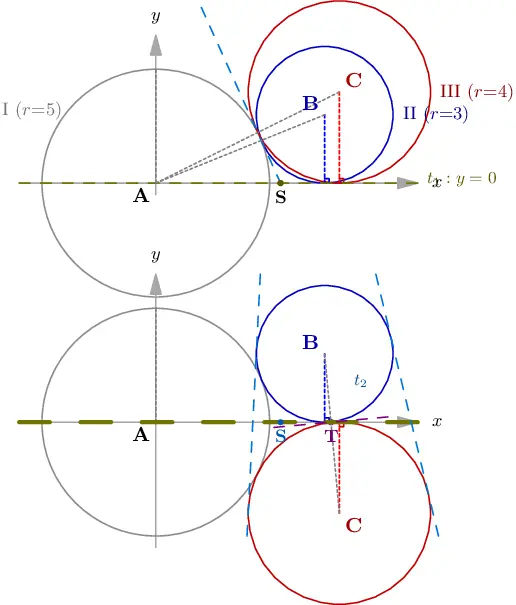
Given is the origin, which is the center of circle I, and are the
and axes respectively. and are the center of the circles
II and III respectively, and their radii are and respectively.
Since circles I and II touch each other externally, therefore, and since circles I
and III touch each other externally, therefore .
Let -axis. Then and .
Since both circles I and II touch -axis, therefore, is their common
tangent. Let meet at . Then one more tangent will pass through
and will divided internally or externally in the ratio
according as circles II and III lie in different qudrants or in the same quadrant.
Case I: When circles II and III lie in the first and fourth
quadrant respectively.
In this case and .
From similar and
Hence, divides internally in the ratio . Thus,
Equation of any line through will be
(1)
If (1) is tangent to circle II then
Thus, we have equation for common tangents.
Case II: When both circle II and III lie in the first qudrant.
In this case and .
One common tangent meeting at and will divide
extrenally in the ratio .
Thus, .
Now we can proceed like case 1 to find the other common tangent as well as case 3 when both the
circles will lie in fourth quadrant.
Center of the circle is and the point is .
The equation of the normal will be equation of line passing through these points, which is
.
The equation of the circle is
Putting gives us
Hencem we take as and as .
Equation of tangent at is
Equation of tangent at is
Solving the two tangents givens us .
Thus, area of the .
Equation of the tangent is .
Substituting gives .
Simplify to get . Hence, the equation of the tangent is .
The given circle is . We find the tangent at .
So .
Substituting gives .
Simplifying .
Now find the tangent at . So .
.
Both tangents have slope . Hence, they are parallel.
The given circle is . The tangent at a point on this
circle is .
At the tangent is . At the tangent is
.
From we get slope . From we
get slope .
Their product is so the tangents are perpendicular. Solving and
gives and .
Hence, the point of intersection is .
The equation of the tangent at is .
To find the intercepts, put . Then so .
So point is .
Now put . Then so . So point
is .
Now the area of triangle is .
So area is .
The given circle is .
So the center is . Tangent at is .
Tangent at is .
Tangent at is .
Solving the two tangents we get point of intersection as .
Split into triangles and .
Triangle has base and height . So area is
.
Triangle has base and height
. So area is .
Hence, total area is .
The given circle is .
So the center is and radius is . The given line is .
The distance from the center to the line is .
This equals the radius, so the line touches the circle.
Put in the circle. So .
Expanding gives .
so so . Then .
Hence, the point of contact is .
The tangent to the circle at is
Tangent at is . So .
Now consider the second circle .
So the center is and radius is .
The distance from the center to the line . So .
This equals the radius, so the line is tangent.
Put into the circle. So .
So and . Then .
Hence, the point of contact is .
The given circles are and .
First circle is so center is and radius is
.
Second circle is so center is and radius is
.
Distance between centers is .
Since , the circles touch externally.
The point of contact lies on the line joining the centers and divides it in the ratio .
So using section formula and
Hence the point of contact is .
Tangent at on first circle is .
The given circle is so the center is and radius is
.
The given line is .
The distance from the center to the line is .
This equals the radius, so the line touches the circle.
Put in the circle. So . Thus, so
.
Then . Hence, the point of contact is .
The given circle is . Its center is and
radius is .
For the line to touch the circle, the distance from the center to the line
must equal the radius.
So the condition is .
Squaring both sides gives .
Point of contact is the foot of the perpendicular from the center to the line.
So the coordinates are and .
The given circle is . So the center is
and radius is .
The line is . For tangency, the distance from the center to the line equals
the radius.
So . So or .
Now find the point of contact using foot of perpendicular from to the line.
For and . So
point is .
For and . So point is .
Hence, or and the points of contact are and .
The given circle is so the center is .
The normal at a point on a circle is the line joining the center to that point.
So the normal passes through and . The slope is .
Hence, the equation is .
The given circle is so the center is .
The given line has slope . So the required normal must also
have slope .
The normal to a circle passes through the center.
Hence, the normal is the line through with slope . So its
equation is .
Thus, .
Given circle is . Let . Since lies
inside the circle .
Let be the center and the radius of the circle, then and
.
Since the circle neither cuts the -axis nor touches it .
Again since the circle neither cuts the -axis not touches it
Combining the conditions we have .
Lenght of tangent is .
Given circles are (1) where is a variable.
Let the three values of be and . Let
and be the centers of the three circles respectively, then
and . If
be the origin, then
and .
Given that are in G.P.
Equation of another circle is . Let be any circle on
this point, then
Lengths of tangents from to the three circles are , and
. We see that
Thus, , and hence, are in G.P.
Let . Given that the lengths of the tangents are equal, therefore,
Solving we get .
Let the equation of the required circle is . It passes through
, therefore,
Equation of the tangent to the circle at is
Given that the equation of the tangent is .
Comparing coefficients we have
Thus, equation of the circle is .
The length of tangent from to is .
The length of tangent from to is .
Given the first is twice the second. So .
So .
Simplify to get . So .
The length of the tangent from to the circle is .
The second circle is which is .
So the length of the tangent from to this circle is .
Given .
So .
Let be any point on the circle .
So .
The length of the tangent from to the circle is
.
Using the first relation, substitute .
So the length becomes .
Let the required point be . The length of the tangent from to is
. For the circle it is .
For the circle it is .
Given .
Again .
Hence, the required point is .
Let the required point be . The length of the tangent from to is
. For the circle divide by
.
So it becomes .
Hence, the length is .
For the circle the length is .
Equating first and second. So .
Thus, so .
Now equate first and third. So . So .
Solve with . So .
and . Hence, the point is .
So length is .
Let the point be . For the circle , the length of
the tangent from is .
Now consider .
Substitute . So it becomes
.
The coefficient of is .
Now consider the remaining terms.
So we get .
Expanding inside. So .
Hence, the whole expression is .
Let the point be . The length of the tangent from to is .
The second circle is . So the length of the tangent from to this circle is .
Given the first is four times the second. So .
.
So . Hence, the point lies on the required circle.
The equation of the pair of tangents from is given by .
Here and .
Now is . So .
Thus the equation is
.
Let be any point on the circle . So
.
The second circle is .
The length of the tangent from to the second circle is
.
Using the first relation, substitute .
So the length becomes .
This simplifies to . So the tangent length is
.
The radius of the second circle is .
.
Let be the angle between the tangents. Then where is the tangent length.
So . Hence, .
The given circle is so the center is and radius is
.
Let the tangent from have slope . So its equation is .
This gives .
For tangency, the distance from the center to the line equals the radius. So .
or .
Hence, the tangents are and .
Their product of slopes is so they are perpendicular.
The given circle is . From the point the length of the
tangent is
which is real. Hence, two tangents can be drawn.
The equation of the pair of tangents is given by .
Here and .
Now .
So the equation is .
Thus, .
So .
The given circle is so the center is and radius is
.
Let the tangent through have slope .
So its equation is . This gives .
For tangency, the distance from the center to the line equals the radius.
So . Solve to get or .
Hence, the tangents are and .
The given circle is .
The equation of the pair of tangents from the origin is given by .
Here and . Now .
So the equation is .
This is the required pair of tangents.
Now find the intercept on the line . Substitute .
So .
The intercept is the distance between the two roots.
So length is .
Using the relation simplify the expression.
This reduces to .
Hence, the intercept is times the radius.
The given circle is . Let the midpoint of the chord be .
The chord whose midpoint is is given by .
Here and .
Now .
Substitute . So .
Thus, the chord is so .
Hence, the equation is .
The given circle is . Let the midpoint be .
The chord whose midpoint is is given by .
Here and .
Now .
Substitute . So .
Simplify to get . Thus, the chord is so .
Hence, the equation is .
The given circle is . So the center is .
The given line is or .
The midpoint of the chord is the foot of the perpendicular from the center to the line.
Using the formula for foot of perpendicular from to ,
and .
Here and .
.
So and .
Hence, the midpoint is .
The given circle is . The chord of contact from a point
is given by .
Here .
Substitute . So .
.
Given circle is (1)
The equation of the chord of contact of tangents drawn from to the
circle (1) is .
We have to find the area of . From draw . Now
Also,
.
Given circles are (1), (2), and
(3).
Let be any point on (1), then (4)
Equation of the chord of contact of the tangents from to (2) is
.
This chord of contact is tangent to (3), therefore,
, and
hence, are in G.P.
Common chord of the circles is . Let this meet the circles at
and . Let the tangents to first circle at and meet at , then will be the chord of contact of the tangents to the circle from
, therefore, equation of will be
The two obtained equations are same. Comparing coefficients we have , which yields
.
The given circle is . The chord of contact from a point is given by .
Here . Substitute .
So .
Hence, the chord of contact is .
The given circle is . The chord of contact from a point
is given by .
Substitute . So the equation becomes .
The given circle is . The line is .
Let the points of intersection be and . The intersection of tangents at
and is given by the pole of the line.
So we find the pole of with respect to the circle.
For the circle, the pole of is .
Here and . and .
Let the given circle be . Let the two points be and .
Since they are conjugate with respect to the circle, we have .
The lengths of tangents are and .
.
Now consider the square of the distance between the points.
So .
Using the conjugate condition, .
.
Thus, . Hence, .
The given circle is . Let the point be .
The chord of contact from is .
The area of the triangle formed by the two tangents and their chord of contact is
.
Here . So .
The distance from the center to the chord is
.
The given circle is . Let and be the points of contact of tangents from the origin.
The tangent at is .
Since this tangent passes through the origin, substitute . So .
Also since lies on the circle, .
Using , we get . Similarly .
Now consider the circle . Substitute and it
satisfies the equation.
Now substitute . Using and ,
we get .
So lies on it. Similarly lies on it. Hence this circle
passes through .
Therefore, it is the circumcircle of .
The given circle is . Let the tangent through have slope
.
So its equation is . This gives .
For tangency, the distance from the center to the line equals the radius .
So . Solve to get or .
Hence the tangents are and .
For , the tangent is .
Solve with the circle. So . This gives and
.
For , the tangent is . Solve with the circle. So
.
This gives and . Hence the points of contact are and
.
Equation of the polar is .
Let be the pole of the given line w.r.t. the given circle. Equation of
polar is
Comparing with the given line
. So the required pole is .
Given circles are (1) and (2). Let .
Polar of the point w.r.t circle (1) is given by (3)
Polar of this point w.r.t circle (2) is given by .
Thus, polars are same. Let be another point for which the polars are
same. The polars of this point w.r.t. given circles are
and
These two lines are same. Thus, comparing coefficients gives us
Solving this gives us two points one of whihc is the given point and another point is .
Let the circle be and points and .
Polars of and will be and .
.
First find the point of intersection of the lines and .
From the second equation we get . Substitute in the first equation.
So . Thus, . So the point is .
Now find the polar with respect to .
The polar of is .
So the required equation is .
The given circle is .
So the polar is .
The given circle is . The polar of a point
is given by .
So .
Substitute . So .
Hence, the polar is .
The polar of with respect to is .
For this line to touch the circle , the distance from its center
to the line must equal the radius .
So
.
The given circle is .
The polar of the origin is obtained by putting in .
So the polar is .
For this line to touch the circle , the distance from the center to the line must equal the radius .
So . Hence, .
Let the given line be . The pole of this line with respect to is .
Given this point lies on . So .
Thus, . So .
Now consider the circle . Its center is and radius is
.
The distance from the center to the line is .
Using the relation above, this becomes .
So the distance equals the radius. Hence the line is tangent to the circle .
The given circle is . Thus, and .
The pole of the line satisfies that this line is the
polar of .
So write . Thus, .
So coefficient of is and coefficient of is .
Hence, the equation becomes .
Compare with . So and .
Substitute values. So hence . And hence .
So the pole is . So it becomes .
Now compare again. So gives . And gives .
The given circle is . Compare with .
So . Let the pole be . The
polar of is
. This must represent the line .
So equate coefficients with a factor and .
Substitute .
So hence and hence .
Substitute into the third equation: .
Expand: .
Write .
Now and .
The given circle is . Let the pole of the line be . The polar of is
.
This must represent the same line as .
So coefficients are proportional. Let the factor be .
and .
So and .
Substitute into the third equation: .
So . Thus, .
Hence, .
So and .
The given circle is . Its center is .
Let the point be . The polar of is
.
So .
Thus, the normal vector to the polar is .
Now consider the line joining the center and the point .
Its direction vector is .
Hence, the polar is perpendicular to the line joining the point and the center.
The family of circles is . Let the given point be .
The polar of with respect to the circle is .
So .
Now observe that if , the term containing vanishes.
So the equation reduces to . Substitute .
Then . So .
Thus, the point satisfies the polar for all values
of .
Hence, all polars pass through this fixed point.
The polar of with respect to is .
For this line to touch the circle , the distance from its center
to the line must equal the radius .
So .
.
Thus, lies on the curve .
For the circle , the polar of is .
So the polars of are
, and .
These three lines are concurrent if there exists a point satisfying all three.
So , and .
Subtract pairwise: and .
For non-zero , these two equations imply .
This is equivalent to .
Thus the points are collinear.
The given circles are and .
Compare each with the general form .
For the first circle, we get , and .
For the second circle, we get , and .
Two circles cut orthogonally if .
Substituting the values .
Also .
Both sides are equal. Hence, the given circles cut each other orthogonally.
Let the two circles be and .
Their radii are and . So and .
Consider the circle .
Its equation is .
, where , and .
Now consider the circle . Similarly it becomes
where , and .
Two circles cut orthogonally if . After simplification, both sides
reduce to the same value.
Hence, the circles represented by intersect at right
angles.
Let the required circles pass through the points and .
Then their equation can be taken as since substituting and satisfies it.
Now this circle touches the line . So the distance of the center from the line is equal to the radius.
The radius is . So .
. This gives a quadratic in .
The two circles correspond to the two values of . Let them be and
.
For the two circles to cut orthogonally, the condition is .
So .
From the quadratic equation in , the product of roots is all divided by .
So . Equate this to .
Hence, .
Let the required circle be . Given circle one is .
So . Given circle two is .
So .
For orthogonality with first circle .
For orthogonality with second circle .
Substitute in first equation .
Now the center lies on the line . So .
Thus, . Substitute so .
Then, . Now .
Thus, the required circle is .
Let the required circle be . Since it cuts the circle orthogonally, the condition is .
So . Thus the circle becomes . Its center is
.
Given that the center lies on the line , so . Thus, or .
Substitute into the equation of the circle .
So . Rewrite as .
This represents a family of circles depending on .
For fixed points, eliminate . So the condition is .
Substitute into the equation .
So . or . Thus, the corresponding
values are and .
Hence, the two fixed points are and .
Let the required circle be . Since it cuts the given circles
orthogonally,
therefore (1) and (2)
Eliminating and from these equations gives us
, which is of the form
The given circles are and .
Compare them with the general form .
For the first circle, , and .
For the second circle, , and .
Two circles cut orthogonally if .
Substitute the values, .
Hence, .
Let the required circle be .
Since it passes through the origin, .
Now consider the circle .
Comparing with the general form, , and .
Since the circles cut orthogonally, .
Thus, .
Now consider the second circle .
Comparing with the general form, , and .
Again using the orthogonality condition, .
Substitute into . So .
Thus, the required circle is .
Let the required circle be . Since it passes through the
origin, .
Given that the center lies on the line , so .
Now consider the circle . Comparing with the general form,
, and .
Since the circles cut orthogonally, . So . Hence, .
Solving the two equation gives and .
Thus, the required circle is .
Let the third circle be . Let the other two circles be and .
Since the first two circles cut the third circle orthogonally, and
.
The common chord of the first two circles is obtained by subtracting their equations.
So its equation is .
From orthogonality .
Substitute into the equation of the common chord. Then .
Factor, . The center of the third circle is
.
Substitute and . The equation is satisfied.
Hence, the common chord passes through the center of the third circle.
Let the required circle be .
Let
and .
Since the circle cuts each of these orthogonally,
, and .
Now consider the circle .
Its equation is .
Divide throughout by . Then the circle becomes , where , and .
.
Using the orthogonality conditions, .
.
Hence, the circle cuts the circle orthogonally.
Any circle passing through and has equation .
Since lies on it, . Since lies on it,
.
Subtracting, . So . Then . Hence, the circle is
.
Its center is and radius is .
Now the circle touches the line
Therefore, the perpendicular distance of the center from the line equals the radius.
So .
Thus, . This quadratic gives the two possible
circles.
Let their corresponding parameters be and . Then .
Now the two circles are and .
They cut orthogonally if .
So . Hence, . Therefore, .
Let the required circle be .
Since it cuts the circle orthogonally, the condition is .
So . Hence the general equation of the circle is .
Now suppose it passes through the point .
Substituting, . So .
Now consider the point .
Substitute this point into the equation of the circle. We get
.
Combine the first two terms, .
.
Using , we get .
Substitute, .
Simplify, .
Hence, the circle also passes through .
Let the given circle be . Let and
be conjugate points with respect to this circle.
Therefore the polar of passes through . So .
Now consider the circle having as diameter. Its equation is .
Comparing with , we get and .
For orthogonality with the given circle, the condition is .
Substitute the values, .
Also .
Using the conjugate point relation, ,
we get .
Hence, . Therefore, the circle on as diameter cuts the circle
orthogonally.
Equation of common chord of the circle is , which is also the radical axis.
Center of second circle is , which lies on the line obtained. Hence, the line is a
diamter of the second circle, and hence, the circumference of the second circle is bisected.
The given circles are and .
Divide the first equation by . Then the circles become and .
Any circle coaxal with them is . So .
Divide throughout by . Then the circle is , where and .
Hence, the center is .
Subtracting, . So the center must satisfy .
.
.
Therefore, the required circle is . So .
The given circles are and .
The radical axis is obtained by subtracting the equations. So .
Hence, the radical axis is .
Now this line touches the circle . Its center is and radius is .
Therefore the perpendicular distance from the center to the line equals the radius.
So .
. Therefore, either or .
The given circles are and .
Their radical axis is obtained by subtraction. So .
Hence, the radical axis is .
Let one circle of the required family be .
Then every circle having the same radical axis with it is obtained by adding a multiple of the
radical axis.
Hence, the required family is .
Therefore, the general equation is ,
where is an arbitrary parameter.
Let the required point be . The square of the length of the tangent from to a circle is obtained by substituting the point in the equation of the circle.
For the circle , the tangent length squared is .
For the circle , the tangent length squared is .
Since the tangent lengths are equal, .
Thus, . Now consider the third circle .
The tangent length squared is .
Again equating tangent lengths, .
Therefore, the required point is .
Let the two circles be and .
Let the given point be .
The polar of with respect to is .
The polar of with respect to is .
These two polars meet at the point . Subtract the two equations.
Then the coordinates of satisfies .
So .
Now the radical axis of the two circles is .
Let the midpoint of be . Then and .
Substitute in the equation obtained above.
We get . But this is exactly the equation of
the radical axis. Hence, the midpoint of lies on the radical axis.
Let the given points be and .
Let be a point such that , where is a constant
and .
Then .
Squaring, .
Expand both sides, .
.
Since , divide by . The equation becomes of the form .
Hence, the locus is a circle.
At . So the condition gives , which is
impossible since is a fixed non-zero constant.
Hence, the circle does not pass through .
Similarly, at , so the ratio becomes infinite, which is impossible.
Hence, the circle does not pass through .
Let and be the two rods of lengths and respectively.
Let the equation of the circle passing through points and be , whose center is .
Putting gives us
Similarly, .
Hence, the locus of the point is .
Let and be two fixed points. Let , we take the mid-point
of as the origin and as -axis. Let
and .
Let one straight line which rotates about makes an angle with the -axis
at any time and at that time the second line which rotates about makes an
angle with -axis.
Now equations of these lines are (1) and
Solving we get and
and is the required locus.
Let . The equation of the circle through is
Its radius is . Here, are variables and is a constant.
Let and , then and
Equation of line is lies on the line .
Thus, locus of point is .
Let be the point whose locus is to be found. Let the given circle be
, and tangent to this circle is which
passes through .
Thus, .
This is a quadratic equation in and hance two values are possible. Thus, these lines will
be orthogonal if .
Thus, locus of is .
Given is the parametric equation of the circle. The cartesian equation will be .
Let .
Equation of tangent at is .
Similarly, equation of tangent at is
Squaring and adding with the equation of tangent at yields
, which is the required locus.
Equation of chord of intersection is .
Thus, is the equation of the chord of intersection. .
Since common chord of the two circles is -axis and their centers are and
lying on the -axis.
Therefore, one of and will be positive and other negative. WLOG we can assume
that with .
Let be an arbitrary line through which meets first circle at . Let the slope of be .
Equation of is and that of is .
Let . Let be the mid-point of . Putting
in first circle yields
and
Replacing by and by gives us
and
.
Hence, the locus of is .
The chord of contact of tangents drawn from to the circle is .
This chord subtends a right angle at the center . Let the perpendicular distance from
the center to the chord be .
For a chord of a circle of radius subtending a right angle at the center, .
Now the distance of the center from the chord is
.
Therefore, . So .
Hence, . Therefore, the required condition is .
Thus, the locus of is the circle .
Let the tangents to the circles and intersect at
the point .
The tangent from to the first circle has equation .
Since it passes through .
This gives the combined equation of tangents from to the circle ,
namely .
Similarly, the pair of tangents from to the circle is
.
Now the two tangents are mutually perpendicular. For a pair of tangents drawn from a point to the
circle , the angle between them is a right angle if .
Applying this separately to the two circles and combining for perpendicular tangents, we obtain
.
Hence, the locus of the point of intersection is . This is a circle
concentric with the given circles.
Let be the point from which tangents are drawn to the circle .
Let the angle between the tangents be . If is the external point and is
the center, then in the right triangle formed by joining the center to the point of contact,
. Hence, .
Now use the identity .
After simplification, .
Replacing by the general point , the locus is .
Let the variable line through the fixed point have slope . Its equation is
.
So . Let be the foot of the perpendicular drawn from
the origin to this line.
Since lies on the line, .
Also the line joining the origin to is perpendicular to the given line.
The slope of the given line is . Hence, the slope of the perpendicular from the origin is
.
Therefore, , so .
Substitute this in the line equation, .
Hence, the locus is .
Take the fixed point as the origin. Let the two fixed parallel lines be
and .
Then the points and lie on the perpendicular through .
Let and . Since is a right angle, the slopes
of and satisfy
. So . Now find the equation of
the line .
Using the two-point form, .
This simplifies to .
Let be the foot of the perpendicular from the origin to this line.
Then and .
So and .
Using , simplification gives .
Rewrite, . Complete the square, .
This is the equation of the circle whose diameter has endpoints and , that is, the circle on as diameter.
Hence, the locus of the foot of the perpendicular from to is the circle on
as diameter.
Let the other end of the diameter through be . Let the center of the
circle be .
Since the center is the midpoint of the diameter joining and and .
The circle touches the -axis. Therefore, the radius equals the distance of the center from
the -axis.
So the radius is . Now the radius is also half the length of the diameter.
Hence, . Substitute .
Then .
Let the required point be . The length of the tangent from to the
circle
is .
Similarly, the length of the tangent from to the circle is
.
Given that the tangent lengths vary inversely as the radii, .
.
Hence, . Therefore, the locus is the circle .
Take the square with sides parallel to the axes and center at the origin.
Since the side of the square is unity, its sides are , and .
Let be the moving point. Its perpendicular distances from the four sides are
,
and .
Given that the sum of their squares is .
. This is a circle centered at the origin, which is the center of
the square.
Therefore the locus is a circle concentric with the square. Its radius is .
The given circle is . Its center is .
Let the center be . Then and .
The length of the tangent from the origin to the circle is evaluated at the
origin, so .
The pair of tangents drawn from the origin are perpendicular.
For tangents from a point to a circle to be perpendicular, the point must lie on the director circle.
The director circle of is .
Since the origin lies on it, . So .
Now the radius squared of the circle is . Substitute the above relation,
.
Thus, . Replacing and , .
Hence, the locus of the center is .
Let the required circle have center and radius . The circle has center and radius .
The circle . So its center is and radius is .
Since the required circle touches both circles externally, , and
.
Subtracting, .
Let , and .
Then . Squaring, .
Simplify, .
So . Hence, .
Now square again, . Thus, .
Therefore, .
Replacing by , the locus is .
Let the required circle be . Its center is .
The given circles are , and .
For the first circle, , and .
Since the required circle cuts it orthogonally, .
Thus, . For the second circle, , and .
Again using orthogonality, .
So . Subtract the two equations, .
Hence, . Now let the center be . Then and .
Substitute, . So . Therefore, .
Let the fixed point on the -axis be . Take any tangent to the circle
.
Its equation may be written as .
Let be the foot of the perpendicular from to this tangent. Since
lies on the tangent,
.
Also the line joining to is perpendicular to the tangent.
Hence, its slope is . Therefore, , so
.
Substitute in the tangent equation, .
.
Transpose, .
Now square and simplify. After reduction, .
Replacing by , the locus is .
Let the point on the circle be . Then .
The tangent at is . This tangent cuts the -axis at the
point .
Putting , so .
Similarly, it cuts the -axis at the point . Putting ,
so .
Let the midpoint of be . Then , and .
Therefore, and . Substitute in .
We get . Hence, the locus is .
Let the triangle have vertices and . Its third side joins
and .
Hence its equation is . Or, .
This line touches the circle .
So the center is and the radius is .
Therefore, the perpendicular distance from to the line equals .
Thus, .
Squaring, .
Now the triangle is right-angled at the origin, so the circumcenter is the midpoint of the
hypotenuse.
Hence, the circumcenter is . Let it be . Then , and .
Substitute, . So .
.
Let the moving point on the circle be .
Let the midpoint of be . Since and , the midpoint is and .
Hence, and . Since lies on the circle,
.
Substitute, .
Replacing by , the locus is .
Let be the midpoint of a variable chord through the fixed point of
the circle .
Let the other end of the chord be . Since is the midpoint of and .
Now lies on the circle. Therefore, .
.
.
.
This is a circle. The center is . The center
of the given circle is .
The midpoint of the points and is .
Hence, the locus is a circle whose center is the midpoint of the fixed point and the center of
the given circle.
Also, its radius is half the radius of the given circle.
Therefore, the locus is the circle obtained by reducing the given circle in the ratio
with respect to the point .
Let the two fixed points be and . Let the moving line be
, where .
Then the algebraic perpendicular distances of the points from the line are
and .
Given that their algebraic sum is constant, say .
So . Hence, .
Substitute this in the equation of the line, .
Rearrange, .
Since , this represents the tangent form of a circle.
Therefore, the line always touches the fixed circle whose center is and radius is .
Hence, the required fixed circle is .