The joint equation is given by .
Let be the straight line passing through origin and making an angle
with .
Then
.
Thus, .
Since the pair of lines are perpendicular and form an isosceles triangle with
the pair will make with it. Let be the slope of pair of straight lines. Then
. So the lines are and as they
pass through origin.
Solving the three lines pairwaise we obtain vertices as .
Thus, .
The combined equation is given by .
Lines parallel to and are given by and
.
Given that both pass through , thus, and . So the
lines are and .
Thus, combined equation is .
The bisectors of angle between coordinates axes is given by and .
The combined equation will be therefore .
Comparing given equation with general equation in second degree we have
Now . Hence, the given equation represents a pair of
straight lines.
Comparing the given equation with the general equation of second degree we get
Putting these values in gives us
.
Comparing the given equation with the general equation of second degree we get
Putting these values in gives us
. Hence, the give equation represents pair of straight lines.
Comparing the given equation with the general equation of second degree we get
Putting these values in gives us
. Hence, the give equation represents pair of straight lines.
Comparing the given equation with the general equation of second degree we get
Putting these values in gives us
. We see that , hence, the lines are perpendicular to each other.
Comparing the given equation with the general equation of second degree we get
Putting these values in gives us .
Comparing the given equation with the general equation of second degree we get
Putting these values in gives us .
Comparing the given equation with the general equation of second degree we get
Putting these values in gives us or
.
from the given equation.
Let be the angle between the pair of straight lines. Then
, so the acute angle between the
lines is .
Given equation is .
Let be the angle between the lines. Then
Thus, angle between the straight lines is .
Comparing with the general equation, we have
. If is the angle between the pair of straight lines, then
Thus, acute angle between the lines is .
We can write the given equation as
Let the straight lines by and , then
, and
.
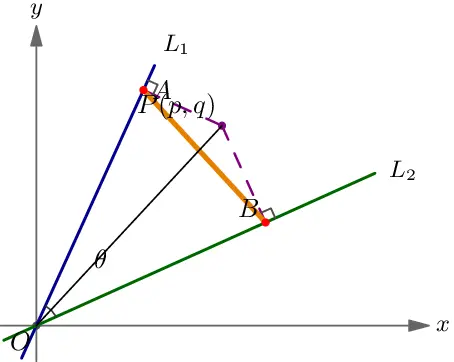
Let be the angle between the pair of lines given by the equaiton . Let be the foot of perpendiculars from on the two
lines.
If we draw a circle with as diameter then both and will be on tihs
circle because diameter will make right angle at any point on the circumference.
(let)
From , we have ,
and from , we have
From previous question
Hence, locus of point is .
Comparing with the general equation yields . Since , the
lines will be perpendicular to each other.
Like previour problem , the lines will be perpendicular to each other.
Comparing with the general equation yields .
If is the angle between lines then
.
Comparing with the general equation yields .
If is the angle between the lines then
Thus, the angle made by the pair of straight lines with one another is .
The given equation is .
Expanding the right-hand side gives .
So the equation becomes .
Canceling from both sides gives .
Using identities and , we get .
Factoring gives .
So the two lines are and .
The first line has slope undefined, and the second line has slope .
Using the angle formula between lines, the angle between them is .
The given equation is .
Compare with the general second degree form .
We identify so , and .
To check if it represents a pair of straight lines, we use the condition .
Here , and .
Substituting gives .
This simplifies to , so the
condition is satisfied.
Hence the equation represents a pair of straight lines.
Now for perpendicularity, we use the condition .
Here , so the lines are perpendicular.
We identify so , and .
First check if it represents a pair of straight lines using the condition .
Here , and .
Substituting gives .
This simplifies to , so the condition is satisfied.
Hence, it represents a pair of straight lines.
Now check for parallel lines using the condition .
Here and .
Since , the two lines are parallel.
, and .
Check the condition .
Substituting gives .
This simplifies to , so the condition is satisfied.
Hence, it represents a pair of straight lines.
Now the angle between the lines is given by .
Substitute and . So .
Then .
.
For perpendicular lines: gives so .
Using gives .
, which gives two straight lines
through origin and perpendicular to one another.
Given equation can be written as
Solving for gives and .
We can write the given equation as a quadratic equation in as follows:
Solving for yields and
.
Point of intersection is and angle between them would be
.
We can write the given equation as a quadratic equation in as follows:
Solving for yields and .
Thus, we have a pair of parallel straight lines.
Perpendicular distance between them is .
We can write the given equation as a quadratic equation in as follows:
Solving for yields and
Lines parallel to these lines and passing through are given byy
and i.e. and
.
The combined equation is
Thus, angle between lines is .
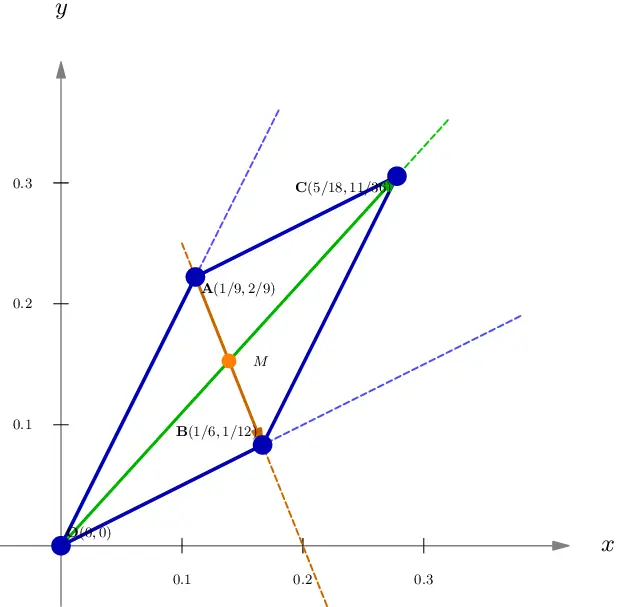
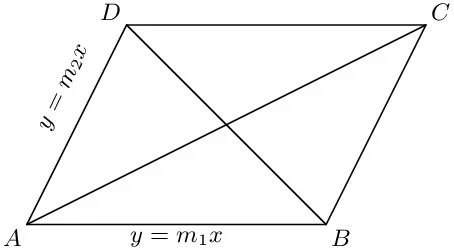
Given pair of lines is and are the two lines represenetd by it.
Let these sides are and . Let the given diagonal be i.e. .
Solving with the parallel sides we get as
and as . Thus, mid-point is
.
Thus, equation of other diagonal would be as it passes through and
.
Thus, and area of parallelogram is .
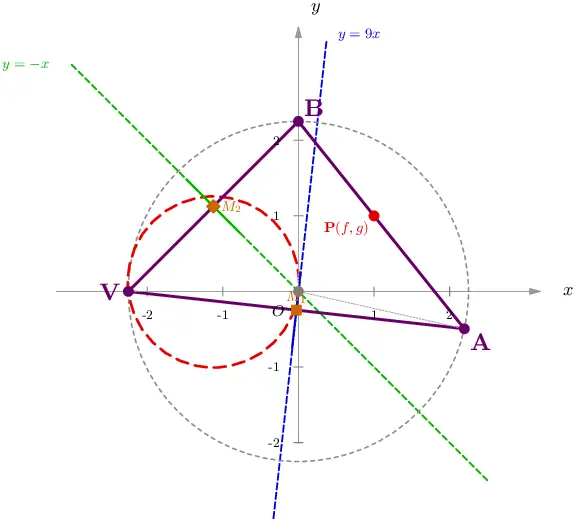
The given pair of lines is and .
Let the vertex be then and will be the equation of two sides perpendicular to the bisectors.
Let two other vertices be and . Then and
Also, mid-points will be and
.
Solving we get and
is collinear with these two points, therefore,
Thus, we get locus as .
The two pair of straight lines are and
Clearly the two pairs are parallel to each other. The distance between the lines are
for all pairs.
Thus, the given pair of straight lines form a rhombus.
Comparing given equation with the general equation of second degree we have
Since the equation represents two straight lines, therefore,
Thus, the equation becomes
, and clearly, these lines will make a rectangle with
coordinate axes.
Area of the rectangle is .
Assume given line represents a pair of straight lines: .
Expanding, .
Comparing coefficients: .
From and , we get .
Now solve for using and , giving .
Thus the factorization is .
Hence, the separate equations of the lines are and .
The given homogeneous equations represent pairs of straight lines through the origin.
First equation is . Divide by assuming
to get .
Let . Then .
The slopes are given by .
So the slopes are and .
Second equation is . Divide by to get .
Let . Then .
The slopes are .
So the slopes are and .
Now check perpendicularity using the condition that the product of slopes is .
Compute .
So is perpendicular to .
Compute .
So is perpendicular to .
Thus, each line from the first equation is perpendicular to one line from the second equation.
Given pairs of lines are and
We see that conincides and the other pair i.e. and are perpendicular to one another.
Clearly, the lines are perpendicular to each other.
From we get , so the lines are
and .
From we get , so the lines are and .
These four lines form a rectangle with vertices at and .
The diagonals join opposite vertices.
First diagonal passes through and . Its slope is .
Using point-slope form which simplifies to .
Second diagonal passes through and . Its slope is .
Using point-slope form which simplifies to .
The equation represents a pair of straight lines through the origin.
Divide by and put . Then which gives
.
Solving, . So and .
Thus the lines are and .
Now consider . This represents another pair of lines
parallel to the first pair.
Rewrite it as .
So the lines are and .
Hence, we have two pairs of parallel lines and
and .
The slopes satisfy , so the adjacent sides are
perpendicular. Also the perpendicular distance between each pair is equal.
Distance between and is .
Distance between and is
.
Thus the four lines form a square.
Vertices are obtained by intersection of adjacent lines
Intersection of and gives . Intersection of
and gives . Intersection of and gives , and intersection of
and gives .
One diagonal joins and . Slope is
so equation is or .
Other diagonal joins and . Slope is . Using point-slope form which simplifies to .
.
Factor the quadratic part .
So the equation becomes .
Factor out .
Hence, the given equation reduces to .
Therefore, it represents two straight lines and .
From we get . Substitute into so . Then .
Let one line represented by is . Thus,
Then according to question on of the lines of would be
From two obtained equation we cross-multiply to get
Thus,
.
Consider the equation which represents two straight lines through
the origin.
Let their slopes be and . Put so that or .
Thus, and are the roots of .
So and .
Given that one slope is times the other, let .
Then and .
Using we get so .
Now using we get .
.
Consider the equation which represents two straight lines through
the origin.
Let their slopes be and . Putting , we get or .
Thus, and are the roots of this equation, so and .
Given that one slope is the square of the other, let .
Then so .
Also .
Multiply this by .
Using , we get .
Multiply by .
Now square both sides, . Expand, .
Divide throughout by .
Now use . Then and
.
Substitute these into the equation and simplify. After simplification, we obtain .
Each represents a pair of straight lines through the origin. Let a common line have slope
. Then it must satisfy both equations.
Putting in each equation, we get and .
Thus is a common root of the two quadratic equations and .
For these two quadratics to have a common root, the condition is .
Comparing given equation with the general equation in second degree gives us
and .
We know that the equation of bisector of angles is given by
Substituting the values yields .
The line will be equally inclined to the lines if it is parallel to bisector of lines of .
Comparing given equation with the general equation in second degree gives us
and .
Equation of bisectors is given by
Substituting the values we obtain .
Clearly, the given line is parallel to .
The two pair of straight lines will be equally inclined if they have the same bisectors.
For the bisectors are given by
For the bisectors are given by .
Thus, bisectors are same for them, and hence, they are equally inclined.
The bisectors of are given by .
, whose bisectors are given by
.
Equation of the bisectors for the second equation is , which is given to be the same as first equation.
Comparing coefficients .
Given pair of lines is
The equation of bisectors is given by , which is independent of . Hence, proven.
Equation of bisectors for lines is given by
.
Equation of bisectors for lines us given by
, which is same as previous
bisectors.
The lines will be equally inclined if their bisectors are parallel. The bisectors of are given by
.
The bisectors of are given by
.
Since the bisectors are same the lines are equally inclined.
Since the rotation of lines balance each other the bisectors in new position will be same as
bisectors of the original position.
Thus, equation of bisectors of angles between the lines is given by
.
Let the pair of lines be given by the homogeneous second degree equation .
Since one of these lines is the bisector of the angle between the coordinate axes, it must be either
or , because these are the angle bisectors of the axes.
Substitute into the given equation which simplifies
to .
For this to represent a line, the coefficient must be zero, so .
Now substitute into the equation
which simplifies to . Thus we get .
In either case, the condition for one of the lines to be an angle bisector is that either or .
Both can be written together as . Squaring both sides gives .
First consider the pair of lines .
Assume a line through the origin has slope , so it is . Substituting in the
homogeneous equation gives . (we consider only homogeneous part)
After dividing by we obtain .
Thusm the slopes of the two given lines satisfy .
Let the roots be and . Then and .
The slopes of the angle bisectors satisfy .
Substituting the values gives .
Multiplying by simplifies this to .
Hence, the bisectors through the origin have slopes satisfying .
Now the required lines pass through and are parallel to these bisectors, so their
form is .
Eliminating using the quadratic condition gives the combined equation .
Given line is .
Given equation is
The above equation represents two lines through origin to the point of intersection of given line
and curve.
Coeff. of Coeff. of . Hence, the lines are perpendicular to each
other.
. Now equation of the curve is
.
This is the equation of the lines passing through origin and point of intersection of the given line
and curve.
Angle between lines is .
We can write
which is of the form i.e. the lines pass through origin and point of
intersection of the given curve and the given line.
The lines obtained will coincident if . Substituting the values yields
. Hence, proved.
The pair of lines which joining the origin to the point of intersection of the two gives curves can
be obtained by making the given curves homogeneous.
Multiplying first with and second with and subtracting yields
These lines will be perpendicular to each other if
.
The required lines pass through the origin and the points of intersection of
and .
Let the slope of such a line be , so its equation is .
Substitute into the line which gives
and hence .
Now substitute and into the curve .
This gives or .
Substitute .
This simplifies to .
Thus, the slopes satisfy .
Replacing by gives the combined equation of the pair of lines
.
Multiplying by we obtain .
Hence, the required pair of straight lines is .
Let the required lines through the origin have slope , so .
From , substitute so .
Substitute in .
Put and simplify .
This gives .
If slopes are and , then . Hence, the lines are
perpendicular.
Given and .
Substituting
Let roots be . Then , and
Slopes of lines from origin are
Product is
Using identity:
Simplifying,
For perpendicular lines:
So, .
Let the required lines from origin be .
Point of intersection satisfies both:
Also from parabola:
Substituting
Simplifying,
Rearrangeing
So slopes satisfy:
Hence, the required lines are given by: where satisfies
Condition for perpendicularity is
So, .
Expanding gives .
Homogenizing with yields the joint equation of lines from the
origin.
For perpendicular lines the condition is , where and are the
coefficients of and :
.
Homogenizing with gives ,
which expands to , i.e. .
For perpendicular lines, , so the sum of coefficients of and
must vanish, i.e. , giving ,
hence, .
Rewrite the circle as and
homogenize using :
.
The coefficient of is and of is
. Applying the perpendicularity condition :
.
Since , the second factor is nonzero, so .
Let the straight lines represented be and for
Then, and
The lines perpendicular to these would be and . Thus,
combined equation is
.
Let one of the lines have slope then another line will have slope
. Thus,
and
.
Let
Let and be the length of the perpendiculars from on
the two lines. Then
.
Let .
If and then the equation of lines making an
angle of with these lines will be given by
Substituting the values yields .
Let the equation of any line through the origin be .
Distance from to the line is
Putting in the above equation yields
.
Let the slope of the lines given by first equation be and . Then
(1) and (2)
Then the slope of the lines of the second equation will be and
and
(3) and (4)
Multiplying (2) and (4) gives
. From (4),
Substituting the values of and in (1) yields
Substituting and in (3) yields
. Hence proven.
Let the equations of parallel lines represented by the given equation are
and , then
Comparing coefficients yields
. Hence, .
The distance is given by
Now and
.
Let two straight lines and , then
Comparing coefficients yields,
Solving the two straight line equations we get point of intersection as .
Distance squared from origin is
Substituting values yields .
Let the lines be and represented by . Then
which implies
Since the lines are equidistant, therefore
Squaring yields
upon substitution and simplification.
Let the lines and be two parallel lines intersecting at the
origin . Then and
Clearly, the diagonal is as it does not pass through
origin. Solving this digonal with the two parallel lines we get coordinates of and .
Let be the point of intersection of the two diagonals then
and let be
the origin.
Equation of other diagonal passing through the origin and is given by .
Let be the triangle such that and are given by
and such that
. Let and be
perpendiculars from and on opposite sides.
Equation of which is perpendicular to and passes through , the
origin, is given by
(say)
Orthocenter will be on this line and its coordinates are for such suitable values
of for which the point may also lie on , perpendicular from on
, which is perpendicular to line .
Thus, we find , the orthocenter as
So equation of is
Substituting yields
Thus, .
Let and be the lines represented by i.e. then
and . Let these lines meet at and respectively, then will be the origin.
Solving the equations we get
and
Then .
Let be the acute angle between the lines of
then
Writing as a quadratic
equation in we have
Taking the positive sign we find angle between these lines and is also
, and hence, the triangle is equilateral.
Computing altitude from to we find the area as
.
Let the pair of lines be
This represents two lines through the origin. Rewrite it as
Taking square roots and
So the two lines are and
First line
Second line
Thus
So . Hence the two lines are inclined at
Now consider the third line
The first two lines pass through origin and make angle . The third line does not
pass through origin so it intersects both lines forming a triangle.
Since the angle between the two lines is and the third line cuts them
symmetrically with equal intercept structure, the triangle formed has all angles .
Hence, the three lines form an equilateral triangle.
Given
Putting
Lines are
Given
Comparing yields
Lines are
Product of slopes are
Distances between and is .
And between and is
Parallel pairs, perpendicular adjacent sides, equal distances gives a square.
Lines parallel to these are and . Since both lines
pass through , therefore
So the combined equation is .
The equation from whcih these were reflected will be bisectors which are perpendicular to each
other. Equation of bisectors is given by
.
Given and
Homogenizing yields
Expanding
For perpendicular pair,
.
Given . For rotation of axes by an angle
(anticlockwise), the standard transformation is
and
Now taking
We know
Substituting, and
Hence, for rotation:
Substituting
Rewriting , thus equation is .
Let the equations make angles of and with the positive direction of
-axis. Then
is -axis. Since the lines make angle after
reflection they will make same angle with negtive direction of -axis. Thus, reflected
lines will make angle with positive direction of -axis.
Thus, new equation is .
Given the pair of straight lines
Let the lines be and where
Hence and
The perpendicular distance from to the line is
The sum of the squares of the perpendiculars is
On combining the two terms into a single fraction and expanding, and then using the relations and , the numerator simplifies to
The denominator simplifies to
Therefore the sum of the squares of the perpendiculars is
.
Let the pair of lines represent two lines through the origin. Let
their slopes be and so that . Hence and .
The triangle is formed by these two lines and .
Intersection with gives and .
Intersection with gives and .
The centroid is and .
So and .
Now
and .
Substitute and to get .
Also .
Thus, .
Similarly
.
Hence .
Therefore the centroid is .
Let the two sides of the triangle through the origin be represented by
Let their slopes be and . Then they satisfy
Hence and . The two sides are
therefore and .
Let the third side be and let the orthocenter be .
The altitude from to the line is perpendicular to it, so its
slope is . Hence its equation is .
Since this altitude lies along the other side , substitute to
get .
On simplifying this relation and using , a relation between
and is obtained. A similar relation is obtained from the other altitude. Combining these
and eliminating the parameters gives the equation of the third side.
After simplification using and , the
equation of the third side is found to be .
Given . Putting .
and .
Angle between the lines so .
Hence, the angle at the origin is .
The third side is .
Distance from origin to this line .
This is the altitude of the equilateral triangle.
Let side be . Altitude .
Area .
Given the pair of lines
Put
Angle between the two lines is so
Now the third line is . Its slope is
Check angle with so
so
Therefore the triangle is equilateral and the angles are each.
Given and
Let slopes of the pair be where
So
Points of intersection with give
Area of triangle is
Also
So area becomes .
Given
Set to get intersection with -axis,
Let roots be . So base lies on x-axis with endpoints and
Base length
The pair of lines has angle factor of
Hence, area of triangle formed by the pair of lines and x-axis is .