The area of a triangle with vertices and is given
by
Substituting the given points, we compute
This simplifies to .
Substituting the given points in the formula, we obtain
This simplifies to .
ubstituting the given points in the formula, we obtain
Simplifying each term, .
Simplifying each term, .
.
.
.
Since the area is zero, the points , and lie on a straight line and are
collinear.
Since the area of the triangle is zero, therefore, the points are collinear.
Hence, the area is zero, which proves that the points collinear.
Let be a triangle with vertices and . Let be the
midpoint of . Then the coordinates of are .
, and
Now, consider the sum . Using the midpoint formula, we can write , and after simplification, we obtain
Hence, in any triangle , if is the midpoint of , then .
Let triangle have vertices , and .
Let , and be the midpoints of and
respectively. Then .
Let be the point that divides internally in the ratio . By the
section formula, .
Simplifying, .
Similarly, for the line , let divide it internally in the ratio . Then
,
which simplifies to .
For the line , let divide it internally in the ratio . Then
,
which simplifies to .
Hence, the point that divides in the ratio also divides and
in the same ratio. This point is the centroid of triangle .
Let the vertices of the quadrilateral be and
.
The area of a quadrilateral can be computed by dividing it into two triangles, for example
and , and adding their areas.
The area of triangle is .
The area of triangle is .
Hence, the area of the quadrilateral is
.
Substituting the given coordinates in the formula obtained in previous problem, we get
Simplifying each term, we get
.
Like previous problem,
Simplifying each term, we get
.
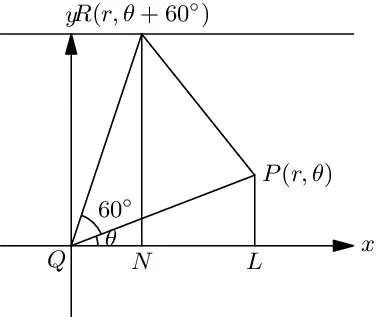
The distance between two points in polar coordinates can be found by first converting to Cartesian
coordinates:
The distance between two points and is .
Substituting the Cartesian coordinates, we get
Expanding the squares, we have
Grouping terms, we get
Using and , we get .
The distance between two points in polar coordinates is
Substituting the given values, we get
Simplifying inside the cosine, .
Since , we have .
Like previous problem .
Simplifying,.
We know , so .
Simplifying the middle term, , so .
Hence, the distance between the points is .
Like previous problem .
Simplifying, .
Since , we have .
.
Let the vertices of the triangle be , , and
.
First, convert the polar coordinates to Cartesian coordinates:
.
The area of a triangle with vertices is
.
Substituting the Cartesian coordinates in terms of polar coordinates, we get
.
Hence, the area of the triangle is
.
Let the vertices be .
Convert to Cartesian:
Area formula:
Substitute: .
Let the vertices be .
Convert to Cartesian coordinates:
.
Substitute the coordinates:
.
Let the vertices be .
Convert to Cartesian coordinates:
.
Substitute the coordinates:
.
Let the points be and .
The distance between two points and is .
Substitute the coordinates: .
Factor out in each term: .
Use the identity .
Factor 2: .
Let the points be and .
The distance between two points and is
.
Substitute the coordinates:
.
Factor out from the first term and 2a from the second term:
.
Simplify: ,
.
So .
Factor .
Take out of the square root: .
The equation can be rewritten in polar coordinates.
Recall that and . Substituting, we get:
Hence, the equation becomes , or equivalently, .
Consider the equation . In polar coordinates, we have and .
Substituting, we get:
Dividing both sides by (assuming and ),
we obtain:
Hence, in polar coordinates, the equation becomes: , where
is any integer.
Consider the equation . In polar coordinates, and
.
Substituting these, we get:
Simplifying the left side:
Dividing both sides by (assuming ), we obtain:
Thus, in polar coordinates, the equation becomes: .
Consider the equation . In polar coordinates, and
.
Substituting these, we get:
Factor on the left:
Divide both sides by (assuming ):
Hence, in polar coordinates, the equation becomes: .
Consider the equation . In polar coordinates, and
.
Substituting these, we get:
Simplifying both sides:
Divide both sides by (assuming ):
Solving for .
Consider the equation .
Using and , we have:
Dividing both sides by .
Given the polar equation , we square both sides to obtain .
Since , the Cartesian form is: .
Given the polar equation , taking the tangent gives:
Since , we obtain the Cartesian equation: .
Given the polar equation , multiply both sides by
Using and , we obtain: .
Given
Using , and
Substituting:
Multiplying both sides by .
Given the polar equation , use the identity .
Since and , we have:
Dividing both sides by gives the Cartesian equation: .
Given the polar equation , square both sides:
Using , we get:
Since , this gives:
With , the Cartesian equation is: .
Given the polar equation , squaring gives:
Using , we obtain:
Substituting and leads to: .
The polar equation can be converted
to Cartesian coordinates using and .
Using the triple-angle formulas and
, we can write:
and
Adding these gives:
Multiplying both sides of the original equation by
The right-hand side becomes
Multiplying both sides by to eliminate the denominator:
Substituting yields the final Cartesian equation: .
Distance formula is
Substituting given coordinate in the formula:
Simplifying gives us (rejecting negative value for distance).
Like previous problem substituting the coordinates gives us
, which is independent of .
Let the points be , , and .
The distance formula between two points and is:
Compute the distance
Compute the distance :
Compute the distance :
Using the Pythagorean identities: and
Substitute these into the distances and simplify. After simplification, we find that:
Therefore, the points are collinear.
Let , and .
Since M is equidistant from and , we have:
Squaring both sides:
Expanding both sides:
Expanding each square:
Adding the terms on each side:
Left:
Right:
Subtracting from both sides:
Simplifying
Divide both sides by
Bringing all terms to left-hand side:
Simplifying:
Dividing both sides by .
Let the points be and .
Computing the sides:
Since , the is right-angled at .
Solutions are given below:
Computing the sides using the distance formula:
Since , the triangle is equilateral.
Let the points be and .
Computing the sides using the distance formula:
No combination satisfies the Pythagoras theorem exactly, so the triangle is not right-angled.
Since all sides are different (), the triangle is
scalene.
Let the points be and .
Computing the sides using the distance formula:
Since two sides are equal, the triangle is isosceles.
Check for a right angle using the Pythagoras theorem:
Hence, the triangle is right-angled isosceles at angle
.
Let the point be and the origin be .
The distance formula between two points and is:
Computing the distance :
Using the Pythagorean identity :
, which is independent of
Let the points be , , and .
Given
Squaring both sides:
or or .
Let the points be , , and .
Check if
Since , the points , , and are collinear.
Let the points be , , .
Since , all sides are equal.
Let the points be , , and .
By the cosine law, for triangle with angle at :
Substituting the distances:
Expanding
Substituting:
.
Let the vertices be , , and .
Let the circumcenter be , which is equidistant from all three vertices:
Squaring both sides:
Also, >
Squaring both sides:
Solving the system: From , we get
Substitute into
Then 3
Thus, the circumcenter is
The circumradius is:
The diagram is given below:
Let and then .
Given >.
We take as the pole and as the initial line. Polar coordinates of
and will be and , respectively.
Now , coordinate of and ,
coordinate of
.
Let and be opposite vertices of the square. Let and be the other two vertices.
The center of the square is the midpoint of
In a square, the distances from the center to all vertices are equal:
Also, and lie on a line through that is perpendicular to
. Using the fact that diagonals of a square are equal and perpendicular, we solve:
Solving this quadratic gives: and
Hence, the remaining vertices are: .
Given and , points and are symmetric
about the -axis: and
The trapezium is , with vertices in order .
Perimeter of trapezium: .
Given , let be the reflection of across .
Reflection across swaps the coordinates: if , then . Thus .
Distance .Given ,
let be the reflection of across .
Reflection across swaps the coordinates: if , then . Thus .
Distance .
Given and . Rotate about by
anticlockwise.
Rotation formula about :
, ,
Thus, .
Given point . Reflecting in the -axis:
(the -coordinate changes sign)
Translate parallel to the positive -axis by units: .
Given and .
Segment from to
Rotating this segment about by anticlockwise:
Since ,
So . Reflecting in the -axis: .
Let and .
For a point dividing the line segment joining and in the
ratio :
Internal division formula is .
External division formula is .
Here and .
Internal division point is .
External division point is .
The roots of are and . Since ,
we have and .
The roots of are and . Since , we have
and .
So the coordinates are , , and .
Now, ,
,
.
Let , , and .
The length of the internal angle bisector at is .
Substituting values, .
Let the points be and . Let divide in the
ratio .
Using the section formula for the -coordinate, .
So, .
Hence, the point divides the line segment externally in the ratio .
Now using the -coordinate formula, .
The given points are , , and .
Let the lines and intersect at point .
Equation of in parametric form is , .
Equation of in parametric form is , .
At the point of intersection, .
From the first equation, .
Substituting in the second equation, .
Therefore, .
Let be points.
is bisected at , so .
is divided at in the ratio , hence .
Substituting the coordinates of , .
Now is divided at in the ratio , so .
Substituting the coordinates of , .
Proceeding similarly, after dividing at in the ratio
, we get
.
Let the straight line be and let it intersect the line joining
and at the point .
Suppose divides in the ratio .
Then, by the section formula, the coordinates of are
and
Since lies on the line , we have .
Multiplying by .
Hence, .
Therefore, .
The negative sign means that the quantities and
are of opposite signs.
Geometrically, this implies that the points and lie on
opposite sides of the line .
Let the line intersect at , at , and
at .
Equation of the line may be written as .
Since lies on , by the result for division of a line by a straight line,
.
Similarly, since lies on .
And since lies on .
Multiplying the three ratios, we get
.
The vertices of the triangle are , , .
Since the circumcenter is at the origin, we have .
Hence .
The coordinates of the orthocenter are
, .
Substituting , we get , .
Therefore, .
The vertices of the triangle are , , and , where
, , and are the roots of .
The centroid of the triangle is .
Since and , we
have
.
Let the points be , , and
.
The distance between and is
The distance between and is
Then .
Hence, is independent of .
Let , , and . , so .
From distances: , .
Simplifying gives .
Substituting in or .
Then or .
Hence, or .
Let the vertices of the triangle be , , .
The circumcenter is given by
Denominator:
Hence the circumcenter is .
The circumradius is the distance from to any vertex, say :
.
Given , , and .
Using cosine law at angle
.
The given points are and .
Distance between two points in polar coordinates is:
Here, , and . Now
Substituting: .
Given and . Length .
Midpoint of
Since is vertical, the equilateral triangle lies horizontally. Height of an equilateral
triangle with side is:
The origin lies to the left of line , so the vertex opposite to the
origin lies to the right.
Hence, .
Given points in polar coordinates: , , and .
Converting to cartesian coordinates using and
, , and
Finding squares of side lengths using distance formula:
. And hence, the triangle is a right-angled triangle.
Let and .
Internal division in the ratio , and
So, the point of internal division is .
External division in the ratio , and
So, the point of external division is .
The solutions are given below:
Let and . The trisection points divide the line
internally in the ratios and .
First point (ratio ): , and
So, the first trisection point is .
Second point (ratio ): , and
So, the second trisection point is .
Let and . The trisection points divide the line
internally in the ratios and .
First point (ratio ): , and
So, the first trisection point is .
Second point (ratio ): , and
So, the second trisection point is .
Let and . Point lies on produced such
that .
The ratio of division for external point is .
Coordinates of using external division: ,
and
So, the coordinates of are .
Let the points be and .
Midpoint is given by: , and
The line passing through satisfies:
Substituting and
.
Let one end of the diameter be and the center be . Let the
other end be .
The midpoint of is the center , so ,
Substituting the known values:
Thus, the coordinates of the other end of the diameter are: .
Let the vertices be , , .
Median from to midpoint of : Midpoint of :
Length of median
Median from to midpoint of : Midpoint of
Length of median
Median from to midpoint of : Midpoint of
Length of median .
Let , , and . Point divides
in the ratio .
Using section formula for internal division:
.
Let , , with between
and .
Distance . Distance
Since divides internally in the ratio .
Use section formula for internal division: , and .
Let , , and divides in the
ratio .
Using section formula:
Multiply both sides by .
Let , , and be the point where the line
meets the -axis.
Suppose divides in the ratio . Using section formula for
-coordinate:
.
Let , , and be the intersection of line
with . Suppose divides in the ratio .
,
Line
Equating coordinates: , and
Eliminate .
Let , , and be the point where
meets the line .
Suppose divides in the ratio .
Coordinates of using section formula: , and
Substituting into the line equation
.
Let , , and be the point where the line
meets . Suppose divides in the ratio
.
Coordinates of using section formula: , and
Substituting into the line equation
Combining terms:
.
Let , , and divides in the ratio
.
Coordinates of using section formula: , and .
Distance of from origin: .
Let the vertices be , , .
Midpoints of sides: , ,
Midpoint formula:
Solving for -coordinates:
Adding first two:
Subtracting third:
From
Then ,
Solving for -coordinates:
Adding first two:
Subtracting third:
Then .
The solutions are given below:
Let , , .
Centroid
Side lengths: ,
and
.
Incenter formula:
Here, , ,
-coordinate:
-coordinate: .
Let , , .
Centroid
Side lengths:
Incenter formula:
Let , ,
-coordinate:
-coordinate:
Let , , , and centroid .
Centroid formula:
-coordinate:
-coordinate: .
Let , , and divides externally in the
ratio .
Let and
Since , divides externally i.e. ratio
Coordinates of using external division formula: , and .
Let .
Area formula:
.
Let the vertices be , taken in order.
Area formula for quadrilateral:
Substituting values:
.
Let A = (6, 3), B = (-3, 5), C = (4, -2), P = (x, y).
Area of a triangle with vertices :
Now, ratio: .
Let .
Points are collinear if the area of is
Substituting values:
For collinearity,
Divide by (): .
Let , , . Let
be a point on the internal bisector of . Let , .
The area of a triangle can be expressed using the determinant:
Let and
let
By the angle bisector theorem, a point on the bisector divides the opposite side in the ratio of
adjacent sides:
The signed areas satisfy the same ratio:
Cross multiplying: .
Let the points be:
Three points are collinear if the determinant vanishes:
Substitute and :
Multiplying each row by its denominator to simplify:
Expanding the determinant and simplifying (using factorization of cubic polynomials) gives:
.
Let the vertices of the triangle be , , . The centroid .
Coordinates of the centroid:
Substitute values:
So .
Area of
Substituting values: .
Assume an equilateral triangle has vertices , , with all coordinates rational.
Distance formula: ,
, and
.
For an equilateral triangle:
Consider the line >. The perpendicular from to must satisfy the
formula for height of an equilateral triangle:
Coordinates of satisfy the perpendicular distance formula from line :
All numbers on the left are rational, but the right-hand side involves , which is
irrational. This is a contradiction.
Hence, the coordinates of the vertices of an equilateral triangle cannot all be rational.
Let , , .
Midpoints: , , and
Hence, .
Let , , .
Points dividing sides: divides in > and divides in
.
Let the vertices be: , , .
Substitute coordinates:
, , and
.
Adding terms:
Divide by : , which is independent of .
Let the vertices be , , .
Area formula:
Substitute coordinates:
Simplify:
Multiply both sides by
Solving for absolute value: or .
Vertices: , , , .
Area: .
Vertices: , , , ,
.
Area: .
Vertices: , , , , , .
Area: .
Vertices: , , .
Area: .
Thus, the points are collinear.
A divides and in ratio :
Area of :
or .
Vertices: .
Area formula:
Area
Given
Solving:
.
Vertices: .
.
Vertices: .
Area: .
Length of perpendicular from on :
.
Centroid , vertices .
Centroid formula:
Solve for : and
Area: .
Vertices: , centroid M lies on -axis -coordinate
Area formula: ,
or
So or .
Given: such that
Perpendicular bisector condition:
Simplifying:
Area formula:
Simplifying:
Solve system: and
Case I:
Solving with
Case II:
Solving with .
Let the points be .
Area of triangle:
Simplifying each term: , ,
So
Expanding: .
Hence, i.e. points are collinear.
Let the points be .
If points are collinear,
Divide both sides by :
Splitting terms:
Hence proved.
Points: .
Collinear
Simplifying: .
Points: .
Collinear
Simplify:
Hence, points are collinear if .
Let the points be .
Opposite sides equal: .
Diagonals:
Equal diagonals imply that all angles are right angles.
Let the three consecutive vertices be , and let
be the fourth vertex.
In a parallelogram, the diagonals bisect each other and
Solving for and
Hence, the fourth vertex is .
Let and be the midpoint of . Let .
Left-hand side:
Right-hand side:
Hence, .
Let and be the centroid:
Let .
Using distance formula:
Grouping terms:
Since , rewriting:
.
Let , and let be the
midpoints of respectively:
.
Substituting midpoints:
Let be the vertices of a triangle. Let
and be the midpoints of and :
.
Length of
But .
Let .
Let divide in ratio
Let divide in ratio
Let divide in ratio
Centroid of
Centroid of
Simplifying gives .
Hence, the centroids coincide.
Let . Let be the midpoints of
respectively.
, and
Medians:
Using distance formula and simplifying:
.
Let . Centroid .
But,
Hence, .
Let . Centroid .
Area of
Substitute and simplify:
Similarly, and
Hence, .
Let the right angled triangle be right angled at . Take .
Midpoint of hypotenuse
Distances:
Thus, .
Let .
divides in ratio
divides in ratio
Simplifying: .
Given roots: and
Ratios in which and divide and
Sum:
Simplify numerator:
Numerator expands to:
Substitute root relations:
Using condition gives numerator
Hence:
Thus, the sum of the ratios in which and divide is zero.
Given and .
and
Distance
Given and with .
Centroid lies on -axis
-coordinate of
Then .
Centroid:
Let the vertices of the triangle be .
Centroid:
Circumcenter: . Orthocenter: .
In coordinate geometry, the orthocenter satisfies: and x1
Multiplying centroid coordinates by and
Substitute: and . Hence proved.
Vertices:
Centroid
Circumcenter : Using the perpendicular bisector formula: the circumcenter is
the intersection of the perpendicular bisectors of any two sides.
Equation of perpendicular bisector of : Midpoint
If , line : slope not needed, solve using:
Solve these two equations simultaneously:
Orthocenter using formula and .
Let be the vertices of a triangle.
and are roots of , so and .
and are roots of , so and .
and are roots of , so and .
Solving these gives .
The centroid of the triangle is .
Let the vertices of the triangle be ,
where are roots of .
By Vieta's formulas, ,
,
and .
The centroid of the triangle is .
Since , we have .
Therefore, the centroid is .
Let the forces N and N act at points and
.
The resultant acts along the line joining and and its point of application
divides in the inverse ratio of the forces: .
Using coordinate geometry, if a point divides the segment joining and in the ratio , its coordinates are .
Here . Then
, and .
Thus, the point of application of the resultant force is .
Let , and the other vertices be with
diagonals intersecting at on the positive -axis.
For a parallelogram, diagonals bisect each other: .
Let , then .
Area formula: .
Substituting: .
Hence, and .
Let .
The point such that triangles , and have equal area
is the centroid of :
.
Let be the th, th, th terms of an H.P., so
are in A.P.
Consider the points .
Three points are collinear if .
Since are in A.P., this relation is satisfied.
Hence the points are collinear.
Let be in A.P. and be in A.P.
Consider the points .
Three points are collinear if the determinant .
Since are in A.P., .
Since are in A.P., .
Then .
Hence the points , , are collinear.
Consider the points .
Three points are collinear if .
Factor each difference of squares: .
Simplifying: for distinct .
Hence, the points are not collinear.
Let be the vertices of a triangle, and let
be the midpoint of , so the median through is the line joining and
.
Let be a point on this median. Then and lies on the line joining and :
.
Consider the determinants: and
The first determinant represents twice the signed area of triangle and the second
determinant represents twice the signed area of triangle .
Since lies on the median , triangles and have
equal areas with opposite signs, so their determinants sum to zero:
.
Let .
Area or .
Centroid lies on .
Solve with area condition: and .
Let .
Midpoint of , midpoint of , so is a parallelogram.
Area .
divides in ratio , midpoint of is .
, so are collinear.
Let the points be .
Compute slopes of opposite sides:
Slope of ,
Slope of .
Slope of ,
Slope of .
Since and , the quadrilateral is a trapezium.
Let the vertices of a triangle be with integer
coordinates.
The squared distance between two points is , similarly
for and .
If the triangle is equilateral, then for some integer .
Consider the triangle modulo : the square of any integer is or
modulo . The sum of two squares modulo can be , but never
. In an equilateral triangle with integer coordinates, all three squared distances must be
equal modulo .
It can be shown that no three distinct integer points satisfy modulo . Hence, a
triangle with integral coordinates cannot be equilateral.