We take the two perpendicular lines as axes of the coordinates. Let be any point
satisfying the given condition. According to condition .
This is the relation which connects the coordinates of any point on the locus is the equation to the
locus.
In the next chapter we will study that it is an equation of a straight line.
Let be any position of the moving point. By given condition from the question we
have
This is the relation between coordinates of each and every point that satisfies the given condition,
and is the equation to required locus.
The equation tells us that the square of distance of the point from the origin is
constant and equal to , and therefore, the locus of the point is a circle whose
center is origin and radius is .
Let the point be . According to question
.
Let the point be . Given that
.
Given that
.
Given that
Squaring,
Squaring again, .
Given that
Simplifying gives us .
Let be the point in question. Its distance from -axis would be
. Thus, according to question
.
Let be the point in question, then according to the question
.
Let be the point in question, then according to the question
.
Let be the point in question, then according to the question
.
Distance from -axis is and distance from -axis is , then
according to the question .
.
According to question, .
According to question, .
According to question, .
.
Let the fixed straight line be parallel to the -axis, and let the fixed point be the
origin .
Since the fixed point is at a perpendicular distance from the line, and the line is
parallel to the -axis, its equation must be .
We consider moving point as .
Its distance from origin is . Its distance from fixed line is .
Thus, .
From given condition
and .
Let , then
.
Let be the required point, then according to the question
.
Let , where is and is . Let
be the moving point. Then according to the question
.
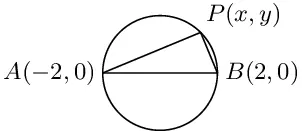
Tip: The obtained equation is a circle(we will see this in
later chapters) which is evident because from diameters the angle on any point on the perimeter is a
right angle.
The diagram is given below:
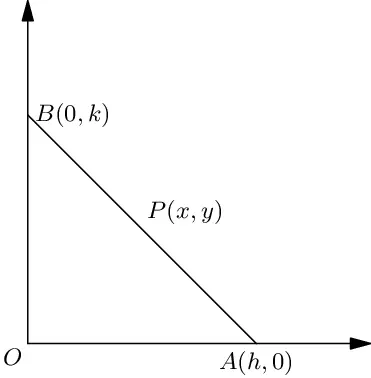
Let and . Given .
Now , hence, divides in the ration
.
Thus,
Also,
.
Let . Let the moving point be then according to the
question lies on the curve .
. Also, since is the mid-point of ,
and
Thus, . Thus, locus of point
is .
Let .
Thus, the point does not lie on the given curve.
Since the given equation represent the identical curves the ratio of coefficients of terms must be
equal. Thus,
.
Let . Then .
Let , then .
Let , then .
Centroid will be given by . Let it be .
Let , then
and .
Subtracting we get .
Let be the moving point. Then
and
Substituting for in we have .
Let be the point whose locus is to be determined, then according to the question
.
Let be the point whose locus is to be determined, then according to the question
.
Let be the point whose locus is to be determined, then according to the question
and
.
Let the given points be and . Let be a
point such that .
and
Since
Rearranging,
This is a linear equation in and , hence it represents a straight line.
Now let be the midpoint of . Then .
Substituting the coordinates of into the equation satisfies it, so the line passes
through the midpoint of .
Now we consider triangles and and we see that so both the triangles are congruent. We also find that , thus,
the triangles are right angled as well at . Thus, we have proven that the locus bisects
at right angle.
Distance of from is
Sqauring gives us, .
Let and .
The area of triangle is given by
Substituting and
or .
Let and let be a variable point on the curve .
Let be the midpoint of . By the midpoint formula,
Hence, .
Since lies on the curve,
So the locus is .
If divides internally in the ratio , then by section
formula,
.
.
Rearranging, , .
Thus, , .
Using ,
.
Hence the locus of is .
Let a variable line through cut the -axis at .
Let be the midpoint of .
By midpoint formula, .
So, .
From the first equation, .
Since is arbitrary (any real number), can take any real value, while is constant.
Hence the locus of is .