- 5.1. Special Cases
- 5.2. Circle on a Diameter
- 5.3. Parametric Form of a Circle
- 5.4. Position of a Point w.r.t. a Circle
- 5.5. Intersection of a Line and a Circle
- 5.6. Tangents and Normals
- 5.7. Condition that a Line Touches a Circle
- 5.8. Chord of Contact of Tangents
- 5.9. Poles and Polars
- 5.10. Equation of a Chord
- 5.11. Intersection of Circles
- 5.12. Radical Axis
- 5.13. Coaxial Circles
- 5.14. Problems
Circles are special cases of ellipses(we will study these the Chapter 7). For circles the length of major and minor axes of an ellipse are equal. Equivalently, a circle can be defined as locus of a point whose distance from a fixed center remains constant.
Consider a point as the center, the distance called radius as and the point then the general equation of the locus can be written as
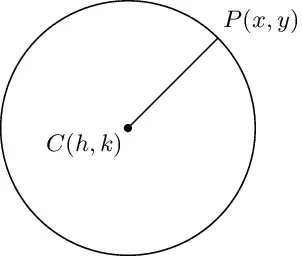
(5.1)
If we take the origin as the center then this equation reduces to
(5.2)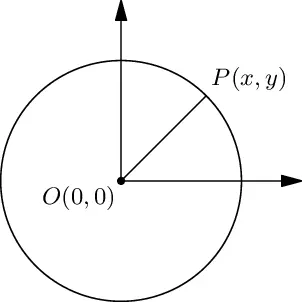
In the last chapter we found the condition for general equation of second degree to represent a pair of straight lines. Here, we will find the condition for it to represent a circle.
Recall that general equaiton of second degree in and is given by and equation of circle is .
Comparing the coefficients, we find that, , hence, coeff. of should be equal to coefficient of and coeff. of should be zero.
Thus, general equation in second degree which represents a circle is (5.3)
which will have center at and radius equal to .
Case I: The circle passes through the origin.
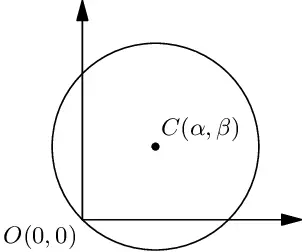
The equation of the circle is . Since it passes through the origin, therefore, (5.4)
If we consider general equation then we find that , thus the equation of circle is given by (5.5)
Case II: The circle touches the -axis.
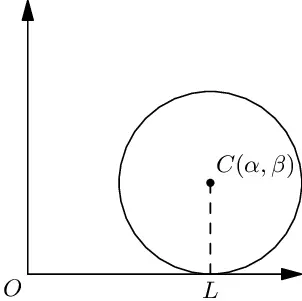
We see that so we can write that (5.6)
In case we write it in form of general equation then . Thus, the equation of circle becomes
(5.7)Case III: The circle touches the -axis.
We see that so we can write that (5.8) In case we write it in form of general equation then . Thus, the equation of circle becomes (5.9)
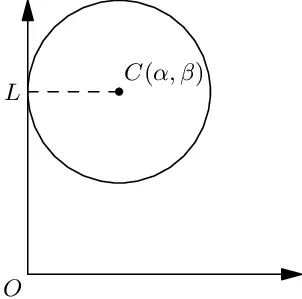
Case III: The circle touches both the axes.
We first consider the case of first quadrant.
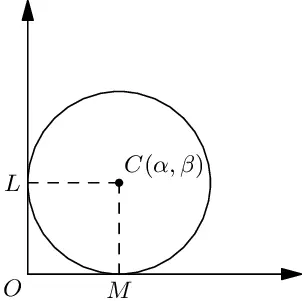
In this case , and hence, the equation becomes (5.10)
Similarly, in 2nd, 3rd and 4th quadrant the equation would be , , and .
We will find equation of a circle one of whose diameters has endpoints as and .
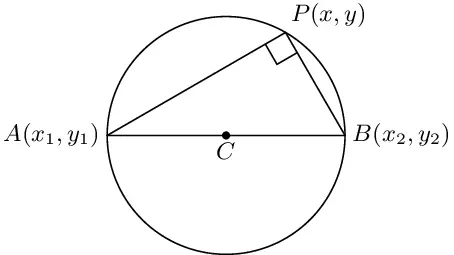
Let and be the endpoints of the diameter of the circle as shown. Also, let on the circle. We know from geometry that will subtend a right-angle on .
Slope of , and slope of
Since these two lines are perpendicular to each other, we have
Thus, equation of circle would be (5.11)
We have the equation of the circle as then any point on the circle in parametric form can be given by .
If the center of the circle is at the origin i.e. the equation is then the point's coordiantes changes to . The point is often referred as point “”.
Consider any point . For any circle the point will be inside, outside or on the circle as or .
For general second degree equation the condition would be or .
We know that one of the equations of a straight line is . This equation represents a line passing through a point making an angle of with positive direction of -axis. Let this ratio be equal to , where is the algebraic distance of the point from . So the coordiantes on this line are given by .
If this point lies on the circle , then i.e. (5.12)
This is a quadratic equaiton in , and hence, the line through meets the circle at two points and . Then we see that , which is independent of , i.e. the direction of the line.
This we know from geometry that from a point a secant drawn to cut the circle in two points and , the product of the distances and is constant.
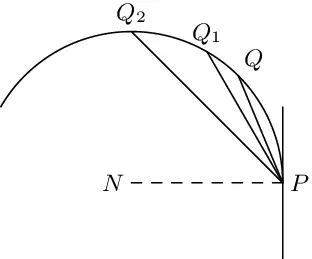
Consider two points and on a curve. The position to which the line tends as becomes closer to the point i.e. the limiting position of chord as tends to along the curve is called the tangent to the curve at point . The point is called the point of contact of the tangent.
We will find equation of a tangent to a circle at a point on the circle .
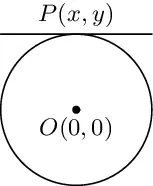
Let be another point on the circle. Then the equation of is
Since both and lie on the same circle, therefore, and
Subtracting gives us
Substituting this in the equation of gives us
As Q, and thus,
. Thus
(5.13)is the equation of tangent at on the circle.
Aliter: We know that the tangent to a circle at a point in perpendicular to the radius through that point. The center of our circle is at the origin. Thus, slope of the radius is .
So the slope of the tangent will be . Thus, equation of tangent will be .
Aliter(Using Calculus): The equation of our circle is .
Differentiating w.r.t. 𝑥 gives us
Thus, slope at point is . Thus, equation of tangent will be .
Now we will find tanegent to the circle represented by the equation .
Like the first method we see that both and lie on the circle. Thus, we can write
and
Subtracting
We know that equation of the line is
Substituting we get
As Q, and thus,
(5.1.4)
Aliter: Center of the circle is and slope of radius is
So slope of tangent would be . Thus, equation of tangent is
Proceeding like earlier the equation of tangent is found to be .
You are encourage to try the third method using calculus for this as well.
Now we will find equation of the normal at for the circle . Normal is defined as perpendicular to tangent and it always passes through the center of the circle.
We have found the equation of tangent as , and thus, its slope is , this makes the slope of the normal as .
Since the normal pass through , therefore, its equationis given by i.e. (5.15)
You are implored to prove this by other techniques as well.
Similarly for the circle , the equation of the normal at is found to be (5.16)
We will find the condition for a line to touch the circle .
Since the line touches the circle, therefore, .
Since the line touches at one point the above equation will have a repeated root and the discriminant must be zero for that. Thus,
. Thus, the required condition is (5.17)
Thus, general equation of tangent is .
The equation of the line is and equation of tangent is . Since both equations represnet tangents at , therefore, comparing the coefficients
Thus, point of contact is .
We will prove that from a point outside the circle two tangents can always be drawn to the circle.
Let the circle be . We know that the equation of tangent is
Let the external point be . Since the tangent passes through it, therefore, , which is a quadratic equation in . Thus, it will give two values of , and hence, two different tangents can be drawn from the same point.
If we check the nature of roots then discriminant is given by i.e. if the point is external then two real 𝑚s mean two different tangent.
We will find the length of a tangent from an external point to a circle.
Let the point be and the circle be . From point draw a tangent to the circle, whihc touches the circle at . will be perpendicular to .
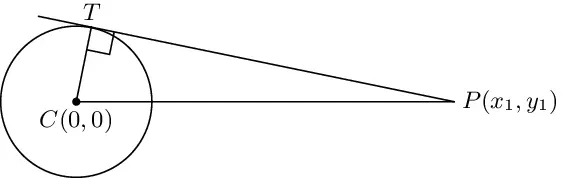
Thus, in right-angle , we have . Thus, (5.18)
Similarly if the circle is and the center is then
(5.19)We will find the equation of pair of tangents drawn from an external point to a circle.
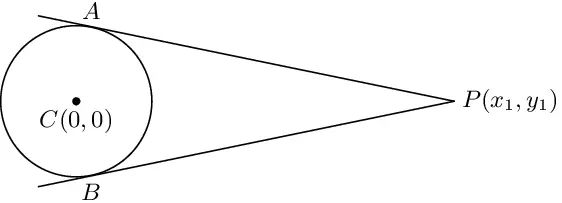
Let the point be from which we draw two tangents and to the circle, touching the circle at and respectively.
Let be any point on any one of the tangents, say . Then the locus of will be the required equation of the pair of tangents to the circle from point .
Equation of is
Now
So locus of is
(5.20)This is the required equation of pair of tangents drawn from . If circle is denoted by then the pair of tangents is given by .
For the circle the pair of tangents is given by (5.21)
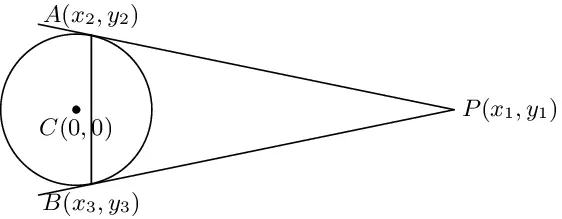
Let be a point outside a circle. From two tangents and can be drawn to touch the circle at and , respectively just like last section. The chord is called the chord of contact for point .
We will now find the equation of this chord of contact.
Let and as shown in the figure.
Since these points lie on the tangents, therefore, and .
Since both pass through , therefore, and .
Thus, we can say that passes through and . Hence, the equation of line is this equation.
Similarly, for the circle the equation of chord of contact is given by .
If from a point any straight line is drawn to meet the circle in and and tangents at and meet at then locus of is called the polar of w.r.t to the circle and is called the pole of its polar i.e. .
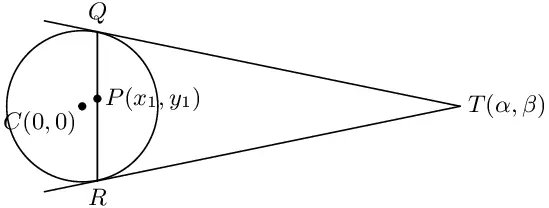
The point can be inside or outside the circle. The diagram shows one such inside the circle through which the line passes and tangents meets at .
Clearly, is the chord of contact of whose equation is , but it passes through , therefore,
Putting instead of we get the locus of as (5.22)
This is the required equation of the polar of point and as can be seen from the equation it is a straight line.
Similarly, for circle the equation of the polar is given by (5.23)
Now we will find coordinates of pole of a line.
Consider a line whose pole is to be found w.r.t. the circle .
Let the pole be . Now the equation of polar of point w.r.t. to the circle is given by .
Comapring coefficients with the given line
Hence, coordinate of the pole is given by .
-
If the polar of a point w.r.t. to a circle passes through then the polar of
w.r.t. the circle will pass through .
Let the equation of the circle is . Also, let and .
Now equations of the polars of these two points will be and .
If the polar of passes through then .
Thus, we have proven our assumption. The points and are called conjugate points.
f the pole of a line w.r.t. a circle lies on another line, then the pole of the other line w.r.t. the same circle will lie on the first line.
Let the circle be and the lines be and .
Let the pole of first line w.r.t to circle be . Then the polar will be . Comapring coefficients we arrive at .
This point will lie on the second line, therefore, .
Similarly we let pole of the second line w.r.t. to the circle be . Then the polar will be . Comapring coefficients we arrive at
This point will lie on the first line, therefore, .
Thus, the points lies on corresponding lines. Such lines are called conjugate lines.
If the polars of two point and w.r.t. a circle meet at , then is the pole of the line .
Let and be two points. Then the polar and of and w.r.t. to the circle will be and .
According to question they meet at . Solving the two equations, we have , which gives .
We have to prove that polar of w.r.t. the circle is line . The polar of w.r.t. the circle is
, which is the line .
We will find equation of a chord whose midpoint is given.
Let the equation of the circle be with center .
Let be the chord whose mid-point is . Slope of line
Since , herefore, slope of . Equation of is
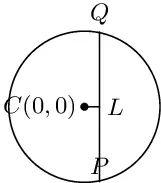
Thus, equation of the chord is given by (5.24) Similarly the equation of chord for the circle is given by (5.25)
The angle between two circles is the angle between their tangents at their point of intersection. Let be a point of intersection of two circles. Let and be the tangents to the two circles at the point of intersection. Then the angle is defined at or . If and be the centers of the two circles then
and or .
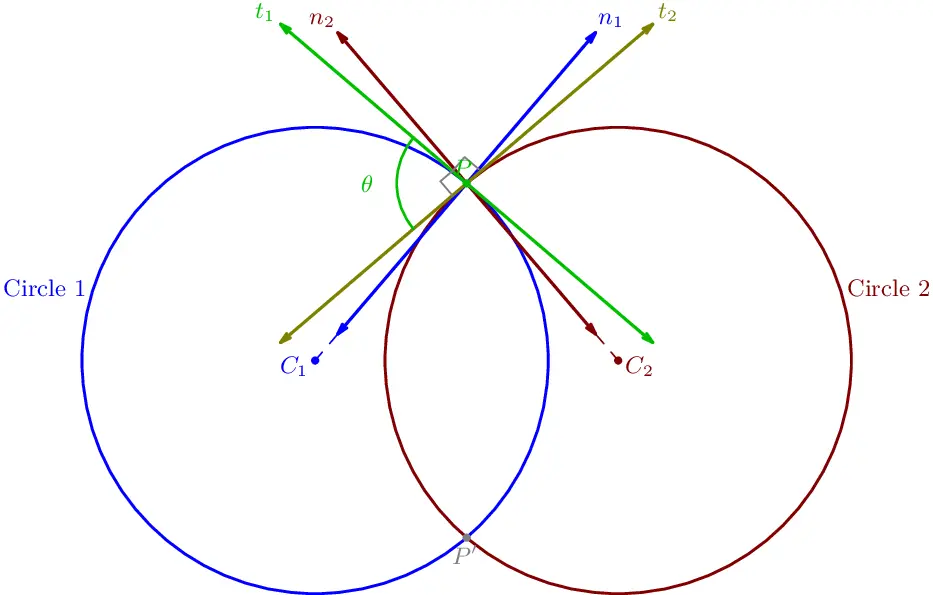
Two circles are said to intersect orthogonally if they intersect at right angles. We will find the condition for two circles and are orthogonal.
Let and be the center of these circles and and be their radii respectively. Then
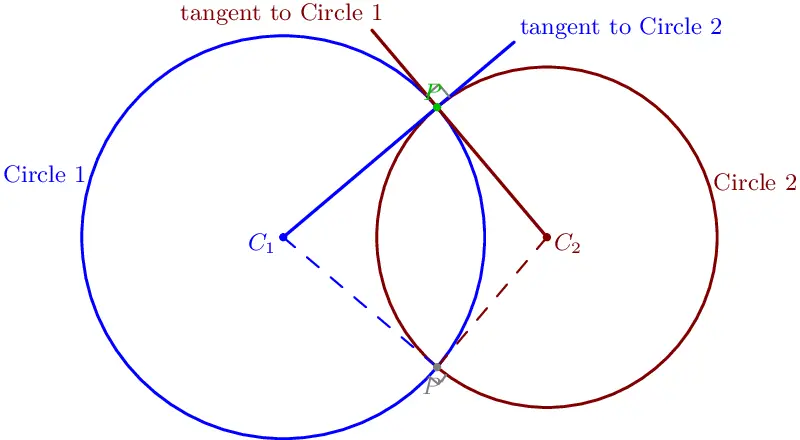
Since the circles are orthogonal
(5.26)
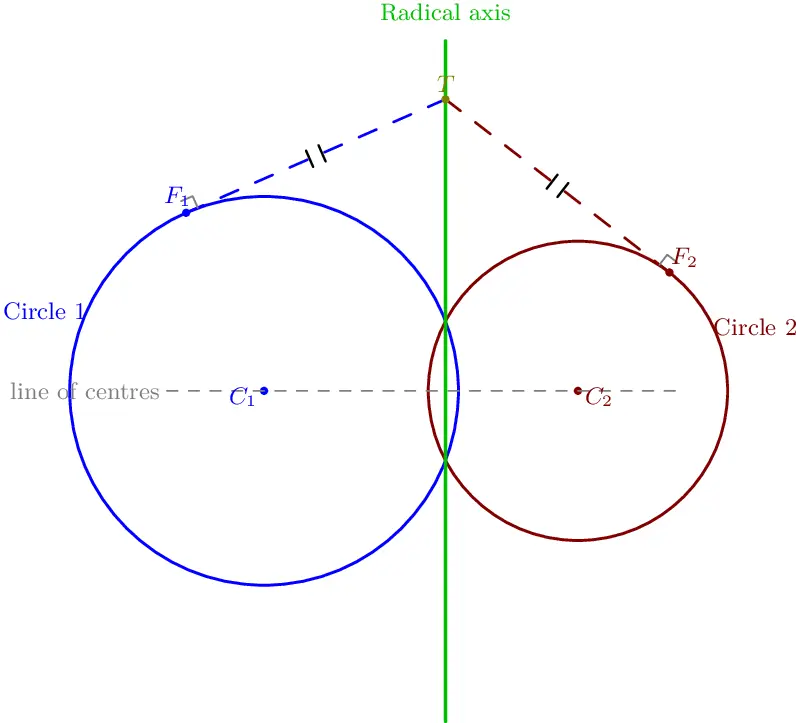
The radical axis of two circles is the locus of a point which moves so that the length of the tangents drawn from it to the two points are equal.
We will find equation of radical axis of two circles and .
Let be any point from which the tangents from it to these circles are equal. Let the tangents from this point to the two circles be and .
Now and
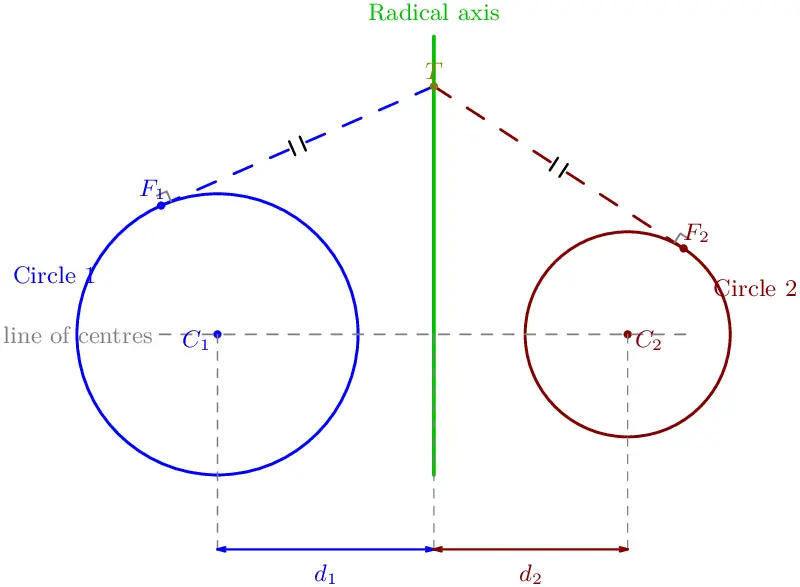
We have
Hence, locus of is (5.27) which is a straight line and equation of radical axis.
-
The radical axis of two circles is perpendicular to the line of centers.
Let the two circles be and .
Let and be the centers of these two circles. Then slope of is , which is negative reciprocal of .
Thus, the radical axis of two circles is perpendicular to the line of centers.
-
The radical axis of three circles takes two at a time are concurrent.
Consider three circles, which are and .
So radical axes will be and .
Adding these we get equality, hence, the three lines are concurrent. The point where these radical axes meet is called the radical center of the three circles.
-
The radical axis of the two circles bisect their common tangent.
Let be one of the common tangents meeting the raidcal axis at , then since lies on the radical axis, hence, by definition of radical axis .
Thus, the radical axis bisect the common tangent.
-
he locus of the cetner of a circle cutting two given circles orthogonally is the radical
axis of the two circles.
Consider three circles, which are and . Let them cut each other orthogonally.
and
Subtracting we get
Thus, locus of the center is which is the radical axis of the two circles being cut orthogonally.
A system of circles is said to be coaxial if each pair of circles of the system has the same radical axis.
Consider two circles and .
Equation of radical axis will be .
We know that the radical axis of two circles is perpendicular to the line joining their centers, therefore, if we take the line joining the centers as -axis and radical axis as -axis, then
and equation of radical axis will be .
Thus, constant term in all the circles must be same for them to be coaxial circles.
Consider a system of coaxial circles having equation , where is a constant and is a parameter.
The radius is . If then the radius vanishes and the circle becomes point circle.
Thus, there are two circles of the system whose radii are zero, centers of these circles are and .
These points are called limiting points of the system.
Consider a circle and a line .
Consider the equation which is also the equation of a circle.
The coordinates which satisfy the considered circle and line also satisfy this equation of circles. Thus, point of intersection of the considered circle and line lies on this new circle.
Similarly we can say that is the locus of points of intersection of two circles.
- Find the center and the radius of the circle .
- Prove that the radii of the circles and are in A.P.
- Find the area of an equilateral triangle inscribed in the circle .
- Find the center and the radius of the circle .
- Find the center and the radius of the circle .
- Find the center and the radius of the circle .
- What will be the radius and center of the circle ?
- Prove that the centers of the circles and are collinear.
- Prove that the radii of the circles and are in A.P.
- Prove that the radii of the circles and are in A.P.
- Prove that the circles cut off equal intercepts between the circles on the line .
- Find the equation of the circle whose center is and which passes through the point .
- If the equations of two diameters of a circle are and and the radius of the circle is , find the equation of the circle.
- Find the equation of the circle whose center is and which touches the line .
- Find the equation of a circle which passes through the point and whose center is the limit of the point of intersection of the lines and as tends to .
- A circle has radius of units and its center lies on the line . Find the equation of the circle if it passes through .
- Find the equation of the circle, which touches the axes and whose center lies on the line .
- A circle of radius lies in the first quadrant and touches both the axes of coordinates. Find the equation of the circle with center at and touching the above circle externally.
- Find the equation of the circles whose center is and which cut off an intercept of length 6 from .
- Find equations of the circles touching -axis at and making intercept of units on the -axis.
- Find the equation of the circle having the pair of lines as its normals and having the size just sufficient to contain the circle .
- A circle of raidus units touches the coordinate axes in the first quadrant. If the circle makes one complete roll on the -axis along the positive direction of -axis, find its equation in the new position.
- The circle rolls up the tangent to it at by units, assuming the -axis as horizontal, find the equation of the circle in the new position.
- Find the equations of the circles touching the lines and and having the centers at a distance from the origin.
- Find the equation of the circle passing through the point touching the lines and and having coordinate of the center of the circle numerically less than or equal to .
- Find the equation of the circle whose center is and radius is .
- Find the equation of the circle whose center is and diameter is .
- If the equation of two diameters of a circle are and and the radius is , find the equation of the circle.
- Find the equation of the circle which passes through the point of intersection of and and whose center is .
- Find the equation of the circle whose center is and which passes through the point of intersection of and .
- ind the equation of the circle passing through the center of the circle and being concentric with the circle .
- Find the equation of the circle passing through the point of intersection of and and whose center is the point of intersection of lines and .
- Find the equation of the circle whose radius is and the center lies on the positive side of -axis at a distance from the origin.
- Find the equation of the circle which passes through the points and and whose center lies on the line .
- Find the equation of the circle which passes through the point and and whose center lies on the line .
- Find the equation of the circle whose radius is and which touches the circle at the point .
- Find the equation of the circle whose center is and which touches the line .
- Write down the equation of a circle concentric with the circle and tangent to the line .
- Find the equation of the circle of radius and touching the line at .
- If the raidus of the circle is 5 and the equations of the twp normals to the circle are and , find the equation of the circle.
- Find the equation of the circle which touches the -axis at a distance from the origin towards the positive side of -axis and cuts of an intercept on the -axis.
- Find the equation of the circle which touches both the axes and whose radius is .
- Find the equation of the circle passing through the point and touching the -axis at origin.
- Find the equation of the circle touching the axis of at the origin and touching the line .
- What is the parametric equation of the circle .
- Find the equation of the circle which touches the line at and the line .
- Find the euqation of the circle touching the lines and having the center on the line .
- A circle of raidus units touches the coordinate axes in the first quadrant. Find the equation of its image w.r.t. the line mirror .
- The equation of a circle is . Find the equation of the image of this circle by the line mirror .
- The circle is rolled on the 𝑥-axis in the positive direction through one complete revolution. Find the equation of the circle in the new position.
- The center of a circle is and its radius is units. If the center is shifted on the line through a distance of units, find the equation of the circle in the new position. How many such circles are possible?
- Find the equation of the circles which pass through the origin and cut off equal chords of units from the straight lines and .
- Find the center of the circle which is inscribed in the triangle formed by the lines and .
- Show that the equation of the circle which touches the coordinate axes and whose center lies on the straight line is .
- Of the two concentric circles the smaller one has the equation . If the intercept on the line made between the two circles is , find the equation of the larger circle.
- Is an interior point or an exterior point of the circle ? If inerior, find the equation of the circle centered on it and of maximum area contained in the given in the circle. If exterior, find the circle of maximum radius centered on it containing the given circle.
- Find the equation of the circle with minimum raidus which contains the three circles and .
- Find the equation of the circle whose diameter is the line joining the points and . Find also the intercept made by it on -axis.
- The sides of a square are and . Find the equation of the circle drawn on the diagonals of the square as its diameter.
- Find the equation of the circle on the line joining the origin and as diameter.
- Find the equation of the circle, the endpoints of whose diameter are and . Find its center and radius.
- Find the equation of the circle drawn on the intercept between the axes made by the line as a diameter.
- Find the equation of the circle the endpoints of whose diameter are the centers of the circles and .
- The sides of a square are and . Find the equation of a circle drawn on the diagonal of the square as its diameter.
- Find the equation of the circle circumscribing the rectangle whose sides are and .
- The abscissa if two points and are the roots of the equation and the oridinates are the roots of the equation . Find the equation of the circle with as its diameter. Also find the coordinates of the center and the length of the raidus of the circle.
- If be one endpoint of the diameter of the circle , find the coordinates of the other endpoint of the diagonal.
- ind the equation of the circumcircle of the quadrilateral formed by the four lines and .
- Find the equation of the circle which passes through the points and and whose center lies on the line .
- Find the equation of the circle passing through the origin and the points where the straight line meets the coordinate axes.
- Show that the cyclic quadrilateral is formed by the lines and taken in order. Find the equation of the circle.
- Find the equation of a circle passing through the points and and touching the line .
- A circle touches both the -axis and the line . Its center is in the third quadrant anf lies on the line . Find the equation of the circle.
- Find the equation of the circle passing through the points and .
- Find the equation of the circle passing through the points and .
- Find the equation of the circle which passes through the origin and cuts off chords of length and on the positive side of -axis and -axis respectively.
- Find the equation of the circumcircle of the triangle formed by the lines and .
- Find the incenter of the triangle whose sides are and . Find the equation of the incircle.
- Find the equation of the circles passing through the origin and cutting off equal intercepts from the lines and .
- Find the equation of the circle described on the common chord of the circles and as diameter.
- Show that the circle on the chord of the circle as diameter is .
- Prove that the equation represents a family of circles touching each other at a common point for all , where is a given constant.
- Show that the general equation of a circle which passes through the points and may be written as , and hence, deduce the diameter form of the equation of a circle.
- The line cuts the circle in and . The line cuts the circle in and . If are concyclic points show that .
- A fixed circle is cut by circles passing through two given points and . Show that the chord of intersection of the fixed circle with any one of the circled, passes through a fixed point.
- Tangents and are drawn to the circle from the point . Find the equation of the circumcircle of .
- Find the equation of the circle passing through the point of intersection of the circles and and with its center on the line .
- If the circle bisects the circumference of the circle , prove that .
- Find the equation of the circle of radius 4 and passing through the point of intersection of circles and .
- Show that the common chord of the circles and pass through the center of the second circle and find its length.
- Find the equation of the circle whose diameter is the common chord of the circles and .
- If be the equation of a chord of the circle , prove that the circle of which this chord is a diameter has the equation .
- Find the equation of the circle which passes through the point of intersection of the circles and and whose center lies on the line .
- Prove that the equation represents a circle for all values of , passing through two fixed points. Find the fixed points.
- Find the equation of the circle through the points of intersection of the circles and and touching the line .
- Find the equation of the circle which passes through the points of intersection of the circle and the line and also through the point .
- Find the equation of the circle which has for its diameter the chord cut off on the line by the circle .
- The point is outside the circle and are tangents to the circle. Find the equation of the circumcircle of .
- Show that the line will meet the circle having center at and the radius in real and distinct points if .
- Find the length of the chord of the circle .
- Prove that the line touches the circle . Also find the point of contact.
- Find the equation of tangents of the circle which are parallel to the line .
- Show that the common tangents to the circles and form an equilateral triangle.
- Three concentric circles of which the biggest is have their radii in A.P. If the line cuts all the circles in real and distinct points then find the interval in which the common difference of the A.P. will lie.
- If , then shown that the line touches a fixed circle. Find the center and raidus of the circle.
- Find the point on the circle such that (i) is minimum (ii) is maximum, where is the origin and is the -axis.
- Show that the circle touches both the axes. Also, find the point of contact.
- Find the length of the chord of the circle which bisects the join of the points and perpendicularly.
- Find the length of the chord intercepted by the straight line and the circle . Also, find the middle point of the chord.
- Find the length of the common chords of the circles and .
- Find the equation and length of the common chord of the circles and .
- Prove that the length of the common chord of the circlea and is . Hence find the condition that the two circles may touch each other.
- Prove that the length of the common chord of the two circles and is .
- Prove that the length of the common chord of the circles and is .
- If the line touches the circle then prove that .
- Prove that the line touches the circle .
- Show that for all values of , touches the circle .
- If touches the circle , prove that the point lies on the circle .
- Find the value of so that the line may touch the circle .
- Show that the line touches a circle for all values of . Find the circle.
- Find those tangents to the circle which are parallel to .
- Find the equation of the tangents to the circle which are (i) parallel, (ii) perpendicular to the line .
- Show that the line touches the circle and find the equation of the other parallel tangent.
- Find the equation of the tangent lines to the circle which are perpendicular to the line .
- Find the equation of tangents to the circle , which are perpendicular to the line .
- Find the equation of the tangents to the circle , which make an angle of with the positive direction of -axis.
- Find the equation of the family of circles which touch the pair of straight lines .
- Examine if the two circles and touch each other externally or internally.
- Prove that the circle and touch each other if .
- Prove that and are two equal circles touching each other. Find the equation of circles of equal radius touching both the circles.
- Prove that the circles and touch each other.
- Prove that the condition for the circles and to touch each other is .
- Prove that the circles and touch each other if .
- Find the length of the chord of the circle through , which is of minimum length.
- Find the angle that the chord of circle along the line subtends at the circumference the larger segment.
- Prove, analytically, that the angle in a semi-circle is a right angle.
- A circle of diameter m with the center coinciding with the origin of coordinate axes, has the diameter on the 𝑥-axis. If the length of the chord be m, find the equation of pair of lines , having two possible positions.
-
Show that the least chord of the circle which passes
through the internal point is equal to
. - If the line and cut the coordinate axes in concyclic points prove that .
- The chord along the line of the circle , subtends an angle of in the major segment of the circle cut off by the chord. Find .
- Prove that the tangent to the circle at the point also touches the circle and find its point of contact.
- rove that the equation , where is a parameter, represents a family of circles passing through two fixed points and on the -axis. Also, find the equation of that circle of the family the tangents to which at and meet on the line .
- is a diameter of a circle. is a chord parallel to and . The tangent at meets the line produced at . Prove that .
- Two parallel tangents to a given circle are cut by a third tangent at point and . If be the center of the given circle, prove that is a right angle.
- A circle of radius meters is having its center at at the origin. Two circles II and III with centers and of radii and meters respectively touch the circle I and also touch the -axis to the right of . Find the equation to any two common tangents to the circles II and III.
- Find the equation of the normal to the circle at the point .
- The extremeties of a diagonal of a rectangle are and . A circle circumscribes the rectangle and cuts an intercept on the -axis. Find the area of the triangle formed by and the tangents to the circle at and .
- Find the equation of the tangent to the circle at the point .
- Prove that the tangents to the circle at the point and are parallel to each other.
- Find the equations of the tangents to the circle at and and prove that they cut at right angles. Find their point of intersection also.
- The tangent at the point to the circle cut the axes of coordinates in and . Prove that the area of the is , being the origin.
- Let 𝐴 be the center of the circle . Suppose that the tangents at the point and on the circle meet at the point . Find the area of the quadrilateral .
- Prove that the line touches the circle . Find the point of contact.
- Prove that the tangent to the circle at the point also touches the circle , and find its point of contact.
- Show that the circles and touch each other. Find the coordinates of the point of contact and the equation of the common tangent at the point of contact.
- Prove that the line touches the circle . Find the point of contact.
- Find the condition that the straight line should touch the circle and also find the coordinates of the point of contact.
- If the line touches the circle , find the value of and also the point of contact.
- Find the equation of the normal to the circle at the point .
- Find the equation of the normal to the circle , which is parallel to the line .
- The point is inside the circle whose equation is of the form . What are the possible values of if the circle neither touches the axes not cuts the them?
- Find the length of the tangent drawn from the point to the circle .
- Distances from the origin to the centers of the three circles , where is a constant and a vairable are in G.P. Prove that the lengths of tangents drawn from any point on the circle to the three circles are also in G.P.
- From a point tangents drawn to the circles and are of equal lengths. Find the equation of the circle thorugh which touches the line at the point .
- If the length of the tangent from to the circle be twice the length of the tangent from to the circle then will ?
- If the length of the tangent from a point to the circle be four times the length of the tangent from it to the circle , show that .
- Show that the length of the tangent from any point on the circle to the circle is .
- Find the point from which the tangents to the three circles and are equal in length.
- Find the point from which the tangents to the three circles and are equal in length. Find the length as well.
- If is the center of the circle and 𝑡𝑖 is the length of the tangents from any point to this circle ; then show that .
- Show that if the length of the tangent from a point to the circle be four times the length of the tangent from it to the circle , then lies on the circle .
- Find the equation of the pair of tangents drawn to the circle from point .
- If from any point on the circle , tangents are drawn to the circle , show that the angle between the tangents is equal to .
- Find the equations of tangents to the circle which pass through and show that they are at right angles.
- Show that two tangents can be drawn from the point to the circle ; also find the equation of the pair of tangents and the angle between them.
- Find the equations of the tangents through to the circle .
- Find the equation of the pair of tangents from the origin to the circle , and show that their intercept on the line is times the radius of the circle.
- Find the equation of the chord of the circle , whose middle point is .
- Find the equation of the chord of the circle whose mid-point is .
- Find the coordinates of the mid-point of the chord which the circle cuts off on the line .
- Find the equation of the chord fo contact of the tangents drawn from to the circle .
- Tangents are drawn from the point to the circle . Prove that the area of the triangle formed by them and their chord of contact is .
- The chord of contact of tangents from a point on the circle to the circle touches the circle . Show that are in G.P.
- Tangents are drawn to the circle at the points where it is met by the circle ; find the points of intersection of these tangents.
- Find the equation of the chord of contact of the tangents drawn from an external point to the circle .
- Find the equation of the chord of contact of the tangents drawn from to the circle .
- Find the coordinates of the point of intersection of tangents at the points where the line meets the circle .
- The lnegth of tangents from the two given points to a given points to a given circle are and . If the tow given points are conjugate to each other w.r.t. the given circle, prove that the distance between the points will be .
- Find the area of the triangle formed by the tangents drawn from the point to the circle and their chord of contact.
- If and are the tangents from the origin to the circle , where and are the points of contact, show that the equation of the circumcircle of the is .
- Find the point of contact of the tangents to the circle that pass through the point and give the equation of tangents.
- Find the equation of the polar of the point w.r.t. the circle .
- Find the pole of the line w.r.t. the circle .
- Show that the polars of the point w.r.t. the circle and coincide. Prove that there is another point, the polars of which w.r.t. these circles are the same and find its coordinates.
- Let be the center of a circle. The lines and are the polars of the points and respectively. w.r.t. the circle. Perpendiculars and are dropped from to the line and from to . Prove that .
- Find the polar of the point of intersection of the line and w.r.t. the circle .
- Find the polar of the point w.r.t. the circle .
- Find the polar of the point w.r.t. the circle .
- Prove that the polar of the point w.r.t. the circle touches if .
- Show that the polar of the origin w.r.t. the circle touches the circle if .
- Prove that if the pole of a straight line w.r.t. the circle lies on the circle , the line is a tangent to the circle .
- Find the pole of the straight line w.r.t. the circle .
- Find the pole of the straight line w.r.t. the circle .
- Find the pole of the line w.r.t. the circle .
- Prove that the polar of any point w.r.t. a circle is perpendicular to the line joining the point and center of the circle.
- Prove that the polar of a given point w.r.t. any of the circles , where is a variable, always passes through a fixed point.
- If the polar of the point w.r.t. the circle touches the circle , show that is on the curve given by .
- Verify that the three points and will be collinear if and only if their polars w.r.t. the circle are concurrent.
- Show that the circles and cut each other orthogonally.
- If and are the two circles with radii and respectively. Show that the circles intersect at right angles.
- Prove that the two circles pass through the points and and touch the line will cut orthogonally if .
- Obtain the equation of the circle orthogonal to both the circles and , and whose center lies on the line .
- Prove that a circle cutting the circle orthogonally and having its center on the line , passes through two fixed points, and find the points.
- Prove that the general equation of circles cutting the circles orthogonally is .
- For what value of the circles and cut orthogonally.
- Find the equation of the circle passing through the origin and cutting the circles and at right angles.
- Find the equation of the circle passing through the origin and has its center on the line and cuts the circle orthogonally.
- If two circles cut a third circle orthogonally then prove that their common chord will pass through the center of the third circle.
- If a circle cuts orthogonally three circles ; prove that it cuts orthogonally any circle of the form .
- Prove that the two circles each of which passes through the points and and touches the line will cut orthogonally if .
- Find the general equation of a circle cutting orthogonally and show that if it passes through the point will also pass through the point .
- If and be a pair of conjugate points w.r.t. a circle , prove that the circle on as a diameter cuts the circle orthogonally.
- Prove that the circle bisects the circumference of the circle .
- Find the equation of a circle which is coaxal with the circles and . It is given that the center of the circle to be determined lies on the radical axis of these circles.
- If the radical axis of the circles and touches the circle , show that either or .
- Find the general equation of circles, any two of which have the same radical axis as that of the circles and .
- The equations of three circles are . Determine the coordinates of the point such that the tangents drawn from it to the three circles are equal in length.
- The polars of a point w.r.t. two given circles meet in a point ; show that the radical axis of the circles bisedct the line .
- Show that the locus of a point such that the ratio of its distances from two given points is a constant, is a circle. Hence, show that this circle cannot pass through the given points.
- Two rods of lengths and slide along the axes in a manner that their ends are always concyclic. Find the locus of the center of the circle passing through these ends.
- Two straight lines rotate about two fixed points. If they start from their positions of coincidence such that one rotates at the rate double that of the other. Prove that locus of their point of intersection is a circle.
- A circle of radius passes through the origin , and cuts the axes at and . Let be the foot of the perpendicular from the origin to the line . Find the equation of the locus of .
- Show that the locus of points from which the tangents drawn to a circle are orthogonal, is a concentric circle or find the equation of the cirector circle of the circle .
- Find the locus of the point of the point of intersection of tangents to the circle at points whose parametric angles differ by .
- The circles and intersect at and . A line through meets one circle at and a parallel line through meets at the other circle at . Show that the locus of the mid-point of is a circle.
- Find the condition that the chord of contact of tangents from the point to the circle should subtend a right angle at the center. Hence, find the locus of .
- A tangent is drawn to each of the circle and . Show that if the two tangents are mutually perpendicular, the locus of their point of intersection is a cricle concentric with the given circle.
- S how that the locus of the point, the tangents from which to the circle include a constant angle is .
- A straight line passes through the fixed point . Find the locus of the foot of the perpendicular drawn to it from the origin.
- is a fixed point and and are two fixed parallel straight lines; is perpendicular to both and is a right angle. Prove that the locus of the foot of the perpendicular drawn from upon is the circle on as diameter.
- A variable circle passes through the point and touches the -axis; show that the locus of the other end of the diameter through is .
- Find the locus of a point, which is such that the lengths of the tangents from it to two concentric circles and vary inversely as their radii.
- A point moves such that the sum of squares of its distances from the sides of a square of side unity is equal to . Show that the locus of a circle whose center is coincides with the center of the square. Also, find its radius.
- Find the locus of the center of the circle when the pair of tangents drawn from the origin to the circle are perpendicular to each other.
- Determine the locus of centers of the circles which touches the two circles and externally.
- Find the locus of the centers of the circles which cut the circles and orthogonally is .
- Find the locus of the foot of the perpendicular drawn from a fixed point on the -axis to any tangent to the circle .
- The tangent at any point on the circle cuts the axes in and . Find the locus of the middle point of .
- A triangle has two of its sides along the axes, its third side touches the circle . Find the equation of the locus of the circumcenter of the triangle.
- The point is joined to any point of the circle . Find the locus of the middle point of as moves on the circle.
- Chords of the circle drawn through a fixed point . Find the locus of the mid-points of these chords and interpret the locus.
- A straight line moves so that the algebraic sum of the perpendiculars drawn to it from two fixed points is constant, show that the line always touches a fixed circle.