- 6.1. Definition
- 6.2. Parabola
- 6.2.1. Intersection of a Line and a Parabola
- 6.2.2. Equation of a Tangent at a Given Point on a Parabola
- 6.2.3. Equation of a Normal at a Given Point on a Parabola
- 6.2.4. Equation of the Normal in terms of its Slope
- 6.2.5. Parametric Equation of the Parabola
- 6.2.6. Equation of a Chord of a Parabola
- 6.2.7. Tangent and Normal at any Point
- 6.2.8. Equation of the Chord of a Parabola whose middle point is
- 6.2.9. Position of a Point w.r.t. a Parabola
- 6.2.10. Tangents from a Point outside a Parabola to the Parabola
- 6.2.11. Equation of Pair of Tangents from a Point to a Parabola
- 6.2.12. Equation of Chord of Contact of point w.r.t. a Parabola
- 6.2.13. Pole and Polar of a Parabola
- 6.2.14. Diameter of a Parabola
- 6.2.15. The Optical Property of a Parabola
- 6.3. Ellipse
In this chapter we will study parabola, ellipse and hyperbola, their properties and elements like tangents and normals. The study of conic sections combines geometry and algebra. Using the coordinate plane, every conic can be represented by an equation in and , allowing geometric properties to be studied analytically. Conics have rich mathematical structures involving focus, directrix, axis, eccentricity, tangents, normals, and chords.
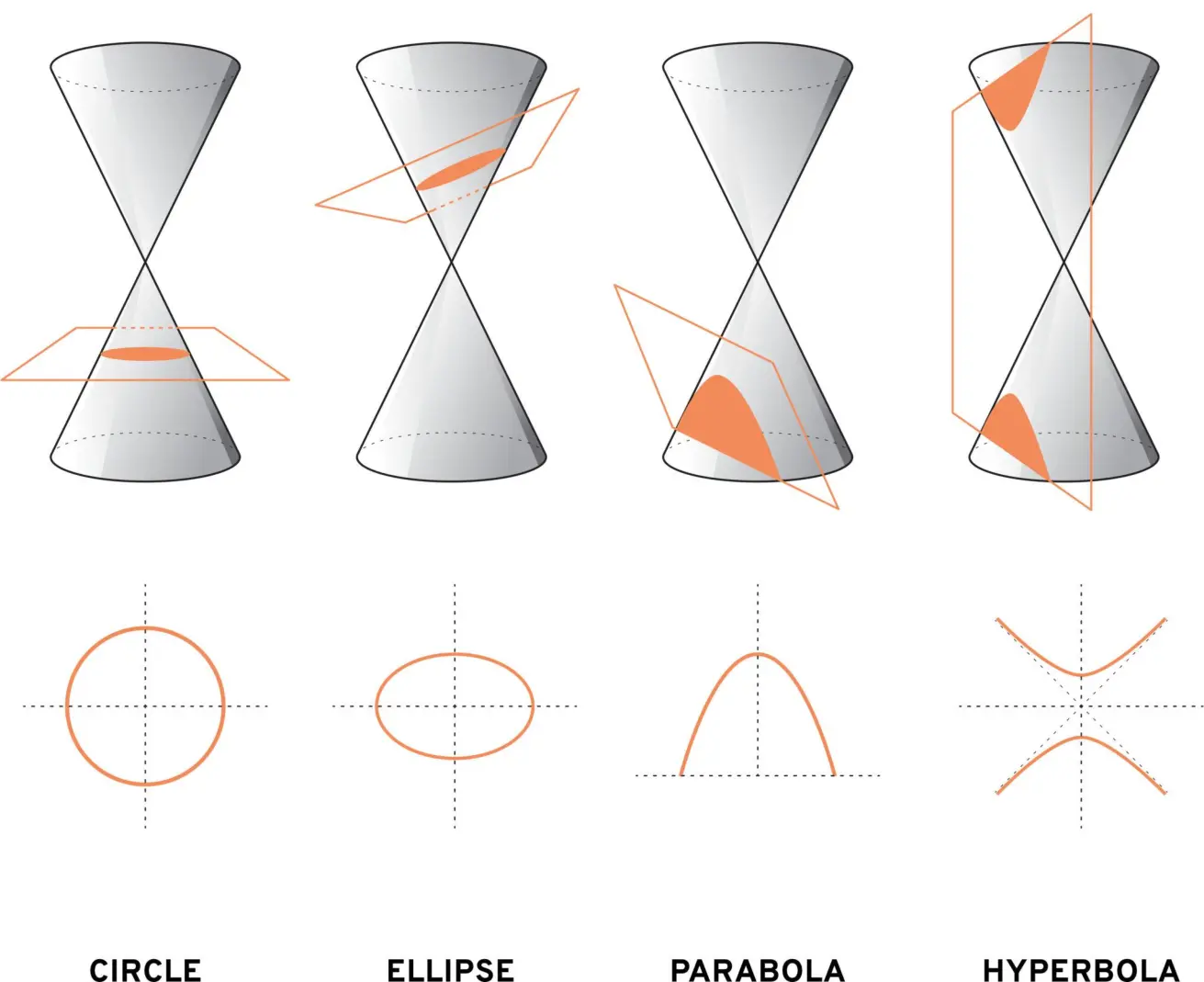
Pair of straight lines, circles, parabolas, ellipses and hyperbolas are sections of a right circular cone by a plane, and so they are called conic sections.
As you can see in the
A conic section is defined as the locus of a point, which moves in a plane such that the ratio of its distance from a fixed point and a fixed line is a constant.
The fixed point is called the focus and the fixed line the directrix of the conic section. The constant ratio is called eccentricity of the curve and is usually denoted by . One such conic section is shown below:
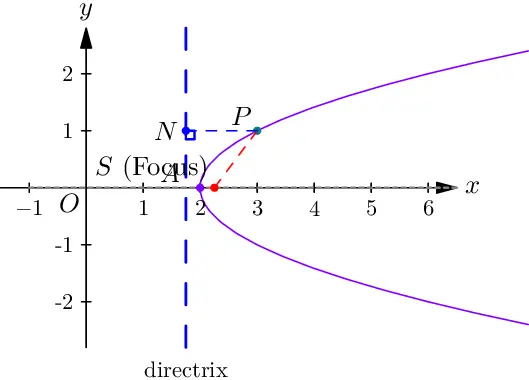
If , then the resulting coninc is a parabola, if , then the resulting conic is an ellipse, and if , then the resulting conic is a hyperbola. In the given diagram .
The straight line perpendicular from the focus to the directrix is called the axis of the conic. The point of intersection of the conic and its axis us called the vertex of the conic.
In the given diagram is the focus, the directrix, is the axis and is the vertex of the conic.
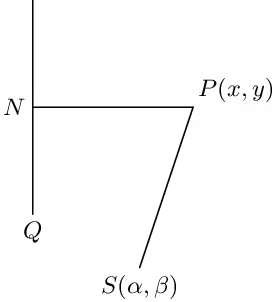
Let be the focus and the directrix whose equation is .
Let be any point on the conic section. From draw . Let be the eccentricity, then by definition .
and
, which on simplification will have the form , where are constants.
Corollary: Let the focus lie on the directrix and be taken as the origin and be taken as the -axis. Let be any point on the conic then
, which is a pair of straight lines through the focus or the origin.
Corollary: The general equation of the second degree represents a parabols if and , where or alternatively a second degree equation represents a parabola if second degree terms form a complete square and .
The second degree equation will represent an ellipse if . We will see that a circle is a special case of an ellipse.
The second degree equation will represent a hyperbola if and and a pair of straight lines if .
A parabola is the locus of a point which moves so that its distance from a fixed point, called the focus, is equal to the distance from a fixed line, called the directrix.
The straight line perpendicular from the focus to the directrix is called the axis of the parabola.
The equation of the parabola can be obtained if its directrix and focus are given.
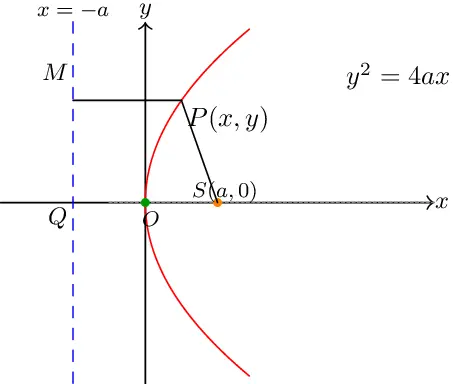
Let be the focus and the directrix of the parabola. From draw perpendicular to the directrix. Let be the middle point of . Take as the origin and as the -axis and through perpendicular to as the -axis.
Let then .
Now and the equation of is . Let be any point on the parabola. Join and drop perpendicular on .
Be definition of the parabola (6.1)
Notes:
- If the point lies on the parabola then point will also lie on the parabola. Hence, the parabola is symmatrical about its axis.
- The point of intersection of the axis of a parabola and the parabola itself is called the vertex if the parabola.
- If the perpendicular drawn from a point to the axis of the parabola meets the parabola at its symmateric point then is called a double oridinate.
-
The double ordinate which passes through the focus is called the latus
recturm of the parabola. The length of latus rectum of is
.
The equation of the latus ractum of the parabola is .
- Joining any two points on a parabola yields a line segment called chord.
- If a chord passes through focus of a parabola is called focal chord.
- The distance of any point on a parabola from the focus of the parabola is callled focal distance.
The other parabolas having the same length of latus rectum as that of are and .
Consider a straight line given by the equation and a parabola given by the equation .
Solving the equations gives us .
The above equation, which is a quadratic equation in will have two roots. If the roots are real i.e. , then the will cut the parabola at two different points. If , then there will be a repeated root and the line will be a tangent to the parabola and if , then roots will be imaginary and the line will not inttersect with the parabola.
We see that is the condition for tangency. Thus, (6.2)
Thus, any line of the form will be a tangent to the parabola.
Let the equation of parabola be . Let and be any two points on the parabola. The equation of will be given by
(1)
Since both the points lie on the parabola, therefore and
Subtracting these two equations yields
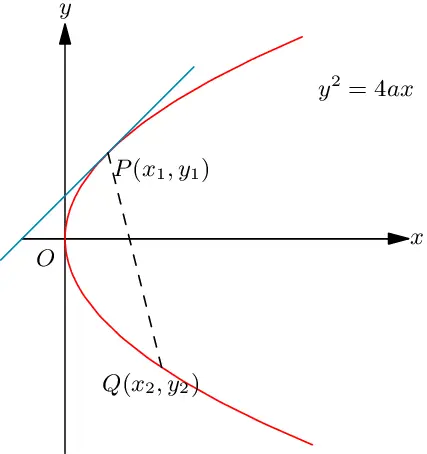
Putting this in (1) gives us
Now, when and so the above equation becomes
Substituting we have (6.3)
which is the equation of the required tangent.
We have obtained the equation of the tangent to a parabola at as (1), The slope of tangent is .
The normal will be perpendicular to the tangent, and hence, its slope will be .
Thus equation of normal would be (6.4)
The normal to the parabola at is .
Let . Since
, which is the equation of the normal in terms of its slope.
Notes: The equation of the normal obtained is . This normal passes through . Thus, .
This is a cubic equation in , which will have three roots of which at least one will be real because complex roots occur in pair.
Any three points on the parabola, normals at which pass through a common point, are called co-normal points.
The point whose coordinates are lies on the parabola , which can be trivially verified by substituting in .
This representation in which and are represented using a single parameter is called the parametric equation of the parabola.
The point is also referred to as the point ''.
Consider two points and on the parabola forming a chord.
The equation will be given by
(6.5)
is the equation of the the chord.
If this line passes through the focus i.e. then . Thus, if one point is then the condition for the chord to pass through the focus requires the other point to be .
The tangent to the parabola at the point is given by
.
The normal to the parabola at the point is given by
.
We see that two tangents at and have as their point of intersection and the normals at the same points will have as their point of intersection.
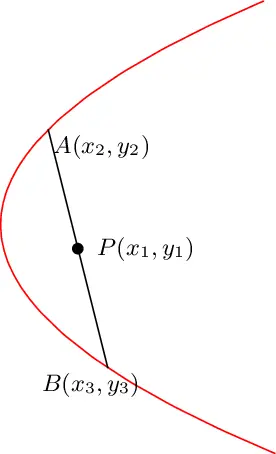
Equation of the parabola is . Let be a chord of the parabola whose middle point is .
Equation of the chord is , where is the slope of .
Let and and
But is mid-point of , so we can write
Thus, equation of the chord is .
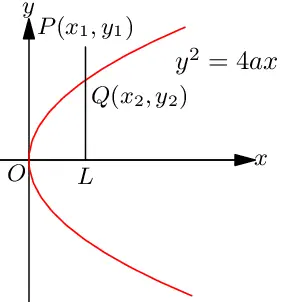
Let be a given point. Let and let intersect the parabole at . Since lies on the parabola, therefore .
Point will lie outside, on or inside the parabola
.
Let the parabola be and be a given point.
The equation of a tangent to the parabola is
i.e. if the point lies outside the parabola then will be real and the equation will have two real roots, which gives us two tangents to the parabola from the point .
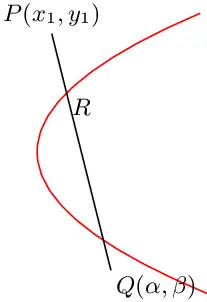
Let the parabola be . Let be a point outside the parabola. Let a chord of the parabola through the point cut the parabola at and let be any arbitrary point on the line . Let divide in the ratio , then
Since lies on the parabola, therefore
(1)
Line will become a tangent to the parabola if the roots of the above equation (1) are equal
Hence, locus of i.e. equation of pair of tangents from is
, where and have usual meanings.
Let the parabola be (1) Let be a point outside the parabola. Let and be the two tangents from to the parabola (1). Let and be the two tangents from to the parabola (1).
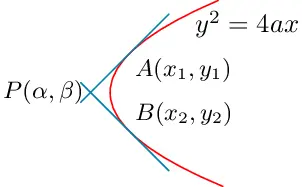
Let and . Equation of the tangent is and that of is .
Since both the lines pass through , therefore and .
Now we consider the equation . We see that this line passes through both and . Therefore, it is the equation of chord of contact of point w.r.t. the parabola.
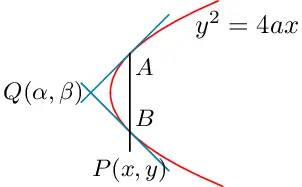
Let be a given point. Let a line through intersect parabola at two points and . Let the tangents at and meet at . The locus of is a straight line called the polar of point .
If the line is the polar of a point w.r.t. a parabola, then the point is called the pole of the line w.r.t. the parabola.
Let the parabola be (1) Let be the given point. Let a line though cut parabola in two points and .
Let be the point of intersection of the tangents to the parabola at and .
Clearly, is the chord of contact of point w.r.t. the parabola. Thereforem, equation of will be
(2)
Since this line passes through , therefore .
Hence, locus of i.e. equation of polar of point w.r.t. the parabola is
(6.6)
According to the above definition of polar, will not be a part of the locus because no two tangents to the parabola can intersect on the line segment .
So the correct definition is here. Let be any point. The line whose equation is that of the tangent to to parabola whether lies on the curve or not is called the polar of point w.r.t. the parabola. According to this definition equation of polar of point w.r.t. the parabola is or .
Diameter of a conic is the locus of mid-points of a series of its parallel chords.
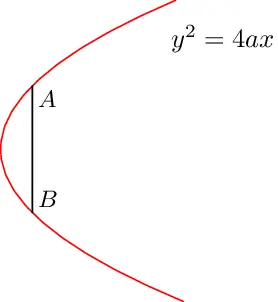
Let the parabola be (1)
Let be one of the chords of a series of parallel chords having slope . Let be the mid-point of chord , then equation of will be .
(2)
Slope of this line is . But slope of the line is , therefore .
Hence, locus of i.e. equation of diameter is (6.7)
Clearly, this line is parallel to the axis of the parabola.
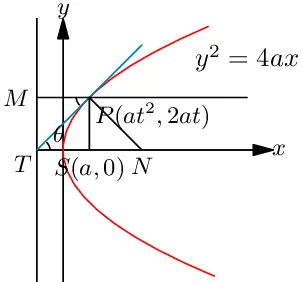
The tangent at any point on a parabola bisects the angle between the focal chord through and the perpendicular from on the directrix.
Let the parabola be (1)
Let be a point on the parabola and let .
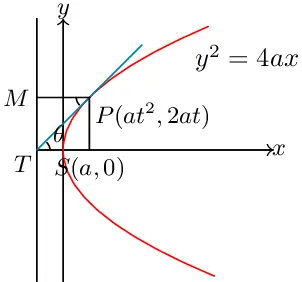
Equation of the tangent to parabola at is . Slope of this tangent is
Slope of .
.
Hence, .
Therefore bisects .
The other property we know from physics is that rays coming from infinity are reflected by parabolas in such a manner that they pass through focus. We will prove that here.
Let be normal to . In and
Since
Also,
.
Thus, a ray parallel to the axis of parabola after reflection from parabola passes through the focus.
An ellipse is the locus of the point, which moves in the plane so that the ratio of its distance from a fixed point, and a fixed line is a constant, which is less than one.
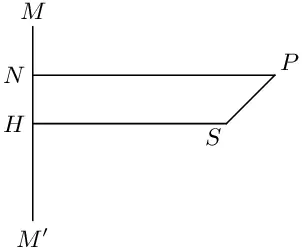
The fixed point is called the focus, the constant ratio is called the eccentricity, and the fixed straight line is known as the directrix of the ellipse.
In the figure above, is the focus and the directrix. Let be any point on the ellipse, then .
Thus, we can find the equation of an ellipse when the coordinates of the focus, the equation of the directrix, and the eccentricity are known.
Let be the focus and be the directrix of the ellipse. Draw , wed divide internally and externally in the ratio at points and respectively, then
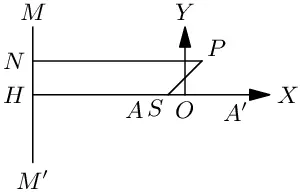
(1) and (2)
Clearly, and will lie on the ellipse. Let . Let be the mid-point of . We take as the origin and and as the and axes respectively.
From (1), and from (2) .
.
From (1) .
and .
Equation of is .
Let be a point on ellipse. Draw
Now
.
Let
Then the locus of is the equation of the ellipse, which is
(6.8)
It is clear that if is the focus, and is the directrix even then the ellipse will have the same equation.
Thus, the ellipse has two foci and two directrices.
A circle is a special limiting case of an ellipse whose major axis is , both foci approach the center and eccentricity approaches .
A typical ellipse is given below:
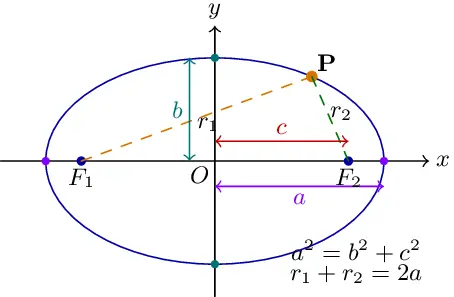
As you can see an ellipse cuts -axis at and , cuts -axis at and . Equation of ellipse does not change when or are changed to and , hence, an ellipse is symmetrical about and axes.
We have .
Similarly, .
We see that ellipse is bounded between and so an eclipse is a closed curve.
. At and , the slope is not defined, and hence, tangent at and will be perpendicular to -axis.