- 1.1. Number Line
- 1.2. Coordinates
- 1.3. Cartesian Coordinate System
- 1.4. Distance Between Two Points
- 1.5. Section Formula
- 1.6. Area of a Trapezium
- 1.7. Area of a Triangle
- 1.8. Centroid of a Triangle
- 1.9. Incenter of a Triangle
- 1.10. Area of a Quadrilateral
- 1.11. Polar Coordinates
- 1.12. Polar Coordinates and Cartesian Coordinates
- 1.13. Problems
Coordinate geometry is study of geometric using algebra. It is also called Analytical Geometry. In geometry, we study about points, lines, triangles, quadrilaterals, circles, polygons etc. without the use of algebra but as said in coordinate geometry these geometrical figures are studied using variables and equations of algebra. In coordinate geometry we will come to know a term called Cartesian plane or cartesian coordinates, which are named after René Des Cartes who first published his work on coordinate geometry in 1637. Pierre de Fermat also independently discovered, but he did not publish his discovery.
We take a straight line and any point on it. This point is taken such that it divides the line in two equal parts. We take the part right of this point as positive part and the part left of it as negative part of this line. We represent the number with the point . Let us take another point such that it represents on the number line. Now represents a unit, and thus we can represent all natural numbers in terms of it. We can also represent all real numbers on this number line. Positive real numbers will lie on the right side and negative real numbers will lie on the left side of the mid- point, which is . Because all real numbers can be represented on this line we call it real line or in general number line.

As we know from our basic algebra that there are a infinite number of rational and irrational numbers between any two numbers so we will have infinite points between any two points on this number line which we know from geometry.
Consider any point in a -dimensional plane. To define the location of this point we need a reference. In any -dimensional plane no point can be given an absolute position rather we define location of points in relation to some other point in the same plane. Typically, we define axes of the plane and take intersection of these axes as origin, represented by and every other point is defined with reference to this point. This method gives us cartesian coordinates. The other way is choosing an origin and one axis. Every point is then defined in terms of its distance from origin and the angle made by the line joining the point and origin with the axis. This method gives us Polar Coordiantes. We will first study cartesian coorsinates, and later we will study polar coordinates.
In general, when we study cartesian coordinate system we mamke use of two perpendicular axes. However, to prevent the loss of generality let us make use of inclined axes or oblique axes. Consider the diagram given below:
is called the -axis and is called the -axis. As said the point is called the origin of coordinates or simply, the origin.
Consider a point . Draw a line from it parallel to to meet at . The distance is called the abscissa and the distance is called the ordinate of the point , while together they are called its coordinate.
Distances when measured parallel to -axis are typically denoted by with or without a suffix, for example: and distances when measured parallel to -axis are typically denoted by with or without a suffix, for example: .
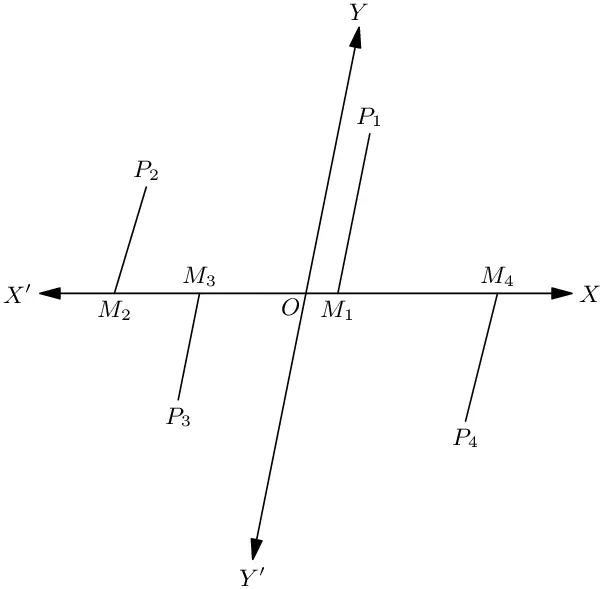
A point having the abscissa and the ordinate is typically denoted as . For example, if a point is at two units distance from -axis and at a distance of three units from -axis then it is written as .
Distances measured parallel to are positive while distances measured parallel to are negative. Similarly, distances measured parallel to are positive and distances parallel to are negative. Thus, cartesian plane is divided into four quadrants. is the first quadrant in which both abscissa and ordinates are positive. represents the second quadrant in which abscissa is negative and ordinate is positive. is the third quadrant where both abscissa and ordinate are negative and finally is the fourth quadrant in which abscissa is positive and ordinate is negative. Observe that these quadrants are taken in anti-clockwise order and similar to qudrants in trigonometry.
In Figure 1.1, “Number line” we can say that lies in first quadrant, lies in second quadrant and so on.
The axes, when they are not at right angles, are called Oblique Axes. The angle between positive -axis and -axis i.e. angle between and or the is generally denoted by the Greek letter .
In general, it is convenient to take the axes at right angles. The axes are then called the Rectangular Axes. You can assume that axes are rectangular unless otherwise stated. As you can guess this system is called Cartesian Coordinate System in the honor of Des Cartes.
Let and be two points as shown in the diagram with coordinates and . and . Thus, and .
From trigonometry, we know that which is (1.1)
In the case when axes are rectangular i.e. axes are at right angle or then the Eq. 1.1 reduces to and therefore in rectangular coordinate system the distance between two points is .
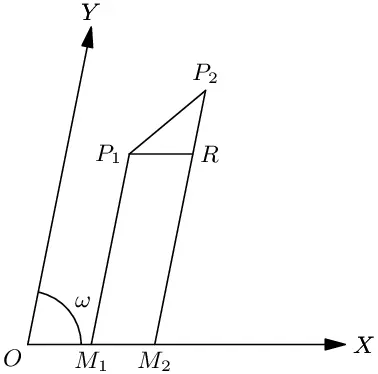
Clearly, the distance between any point and the origin will be .
Consider the diagram given below.
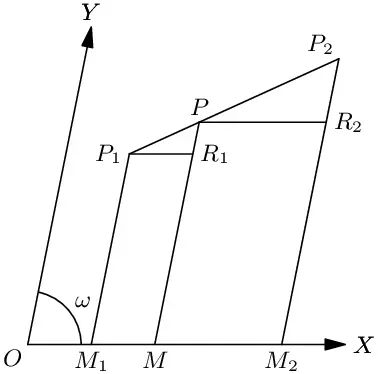
Consider points and . The point divides
the line segment such that
then we need to find the coordinates of .
We have , and .
. Then
and .
From the similar triangles and we have
. Similarly, it can be found that .
Thus, the coordinates of the point which divides in the ratio is (1.2)
If the point divides these two points externally then we can prove in a similar manner that the point’s coordinates is (1.3)
Clearly if the point is mid-point then we find that the coordinates of mid-point is given by (1.4)
We will consider the area of a trapezium in this section from geometry because it will be useful in the coming sections. Consider the following diagram:
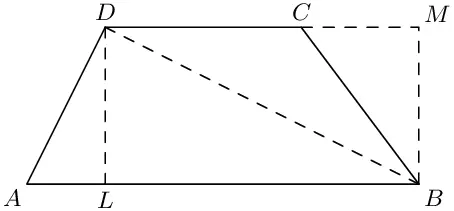
We know that area of a triangle is half of the product of height of any side and the perpendicular drawn from the opposite angle. Thus,
Consider following diagram with and .
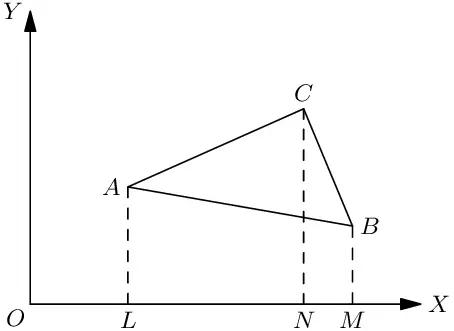
Let denote the area of the . Then,
On simplification, we obtain (1.5)
The equation can be represented in the determinant form as given below: (1.6)
In the above calculation if the axes are oblique with an angle then the area of the triangle would be: (1.7)
If one of the vertices is the origin then the area of the triangle would be .
As you can see from the formula; area of a triangle could be positive or negative. There are two ways to fix this. The first is to take modulus of the equation. The second is to plot the points of triangle in clockwise direction. If we plot the points in anti-clockwise direction then area of the triangle will be negative in that case we can take modulus of the value obtained.
From the above relation we can extrapolate that if the area of the triangle is zero then the three vertexes would collapse into a straight line. Thus the condition of collinearity of these three points can be written as: (1.8)
Now that we have area of a trapezium and area of a triangle finding area of other polygons is trivial and we will find them in our exercises.
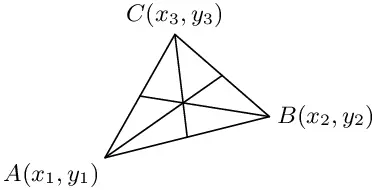
The point of intersection of the medians of the triangle is called the centroid of the triangle.
Let and be the vertices of the . Let and be the three medians.
Since is middle point of .
Let be the centroid i.e. intersection of the three medians. will divide in the ratio i.e. then
(1.9)Similarly it can be shown that has same coordinates for other medians. Thus, lies on the same coordinates for all three medians.
Thus, is the centroid of the triangle.
The point of intersection of the bisectors of the angles of the triangle is called the incenter of the triangle.
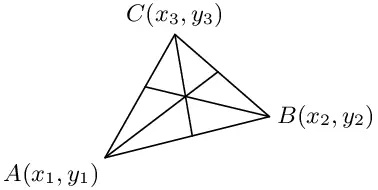
Let and be the vertices of the . Let and be the three internal bisectors of the angles and respectively. Let these bisectors meet at the incenter .
Since is internal bisector of , therefore,
The incenter divides internally in the ratio .
Similarly it can be shown for two other bisectors that has the same coordinate. Thus, (1.10) is the incenter of the triangle.
Consider following diagram with and .
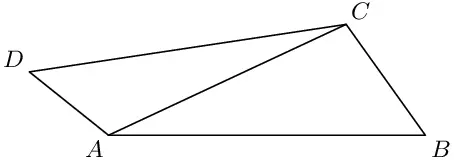
If are in anti-clockwise order then area of quadrilateral will be positiive but if it is clockwise then it will be negative and we will have to take modulus of it.
Area of
Another way to find area of a quadrilateral is
(1.11)Consider a line through a point . We call the line initial line and we call the pole or the origin.
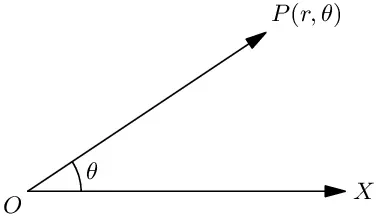
As you can figure out the position of a point can be found by knowing its distance from the pole and the positive counter-clockwise angle made by the line joining the point with the initial line. The distance is typically denoted by and the is denoted by . or is called the radius vector and is called the vectorial angle of the point.
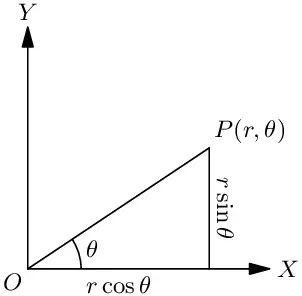
As we can see from the diagram a point having polar coordinates can be represented in terms of cartesian coordinate as . Similarly, if a point has cartesian coordinates then and would represent the equivalent polar coordinates.
Find the areas of the triangles the coordinates of whose vertices are respectively:
- and .
- and .
- and .
- and .
- and .
- and .
Prove by showing that the area of the triangle formed by them is zero that the following points are in a straight line:
- and .
- and .
- and .
- In any prove that , where is the middle point of .
- is a triangle and and are the middle points of the sides and ; prove that the point which divides internally in the ratio also divides the line and in the same ratio.
- Find the area of a quadrilateral whose vertices are and .
Find the areas of the quadrilaterals the coordinates of whose vertices, taken in order, are
- and .
- and .
Find the lengths of the straight lines joining the pairs of points whose polar coordinates are
- and
- and .
- and .
- and .
Find the areas of the triangle whose coordinates are
- and .
- and .
- and .
- and .
Find the distance between the points:
- and .
- and .
Change the following equations to polar coordinates:
- .
- .
- .
- .
- .
- .
Change the following equations to cartesian coordinates
- .
- .
- .
- .
- .
- .
- .
- .
- Find if the distance between and is .
- Prove that the distance between the points and is independent of .
- Use distance formula to show that the points and are collinear.
- If the point be equidistant from the points and , prove that .
- Prove that the points and are the vertices of a right angle triangle.
Determine the type(isosceles, right angled, right angled isosceles, equilateral, scalene) of the following triangles whose vertices are
- and .
- and .
- and .
- Prove that the distance of the point from the origin is independent of .
- Let and be three points such that . Find the value of .
- Using distance formula, show that the points and are collinear.
- Prove that the points and are the vertices of an equilateral triangle.
- If the line segment joining the points and subtend an angle at the origin , prove that or .
- Find the circumcenter of the triangle whose vertices are and . Also find the radius of the circumcircle.
- The distance between two parallel lines is unity. A point lies between the lines at a distance from one of them. Find the length of a side of an equilateral , vertex of which lies on one of the parallel lines and vertex on the other line.
- The opposite angular points of a square are and , find the coordinate of the remaining vertices of the square.
- and are two given points. and are symmetric to the given points and respectively with respect to -axis. Calculate the perimeter of the trapezium .
- Point is symmetric to with respect to the bisector of the first quadrant. Find .
- A line segment through a point which makes an angle of with the positive direction of -axis is rotated about in anti-clockwise direction though an angle of . If be the new position of the point find the coordinate of .
- The point is reflected in the -axis and then translated parallel to the positive direction of -axis through a distance of units. Find the coordinates of the point in the new position.
- The line segment joining and is rotated about in the anticlockwise direction by an angle of so that point goes to C. If is the reflection of in -axis, find the coordinates of .
- Find the coordinates of the point which divides the line segment joining the points and internally and externally in the ratio .
- coordinates of two points and are the roots of the equation and their coordinates are the roots of the equation . If coordinates of is less than coordinate of and coordinate of is greater than the coordinate of and coordinate of a third point be , find the length of the bisector of the interior angle at .
- Find the ratio in which the point divides the line segment joining and and hence find the value of .
- If are points whose coordinates are respectively, find the ratio in which is divided by .
- If are points in a plane whose coordinates are respectively. is bisected in the point ; is divided at in the ratio ; is divided at in the ratio ; and so on until all the points are exhausted. Show that the coordinates of the final point so obtained are
- Show that the straight line divides the join of points and in the ratio . Explain the negative sign.
- A line intersects three sides and of in and respectively. Show that .
- The vertices of a triangle are . If the circumcenter of coincides with the origin and is the orthocenter of , (where are of the same sign). Show that .
- If and are the real roots of the equation , find the centroid of the triangle whose vertices are and .
- If and be any three points, show that is independent of .
- If two vertices of an equilateral triangle be and , find the coordinate of the third vertex.
- Find the circumcenter and circumradius of the triangle whose vertices are and .
- The vertices of a triangle are and . Find .
- Find the distance between the points and .
- and are two given points; is an equilateral triangle on the side of opposite to the origin. Find the coordinates of .
- Show that the points and are the vertices of a right angled triangle.
- Find the coordinates of the point which divides the line segment joining and in the ratio internally and externally.
Find the coordinates of the points which trisect the line segment joining the points
- and .
- and .
- and are two points and D is a point on produced such that , then find the coordinates of .
- If the middle point of the line segment joining and is and , find the value of .
- One end of a diameter of a circle is at and the center is , find the coordinates of the other end of the diameter.
- Find the length of the medians of the triangle whose vertices are and .
- If the point divides the line segment joining and in the ratio , find the coordinates of .
- are collinear points and lies between and . and are and respectively. If units, find the coordinates of .
- Find the ratio in which divides the line segment of the points and .
- In what ratio does the -axis divides the line segment joining the points and .
- Show that the straight lines joining the points and divides the line joining the points and internally in the ratio .
- Find the ratio in which the line segment joining the points and is divided by the line .
- Find the ratio in which the line divides the line segment joining and .
- Find the distance of the point from origin which divides the line segment joining the points and in the ratio .
- The coordinates of the middle points of the sides of a triangle are and , find the coordinates of the vertices.
-
Find the centroid and incenter of the triangle whose vertices are
- and .
- and .
- Two vertices of a triangle are and . If its centroid is , find the third vertex.
- and are two points. is a point on such that . If , find the coordinates of .
- Find the area of the triangle whose vertices are respectively , and .
- Find the area of the quadrilateral whose vertices are and .
- The coordinates of points and are and respectively, prove that .
- Show that the points and are collinear if .
- If and are the vertices of a and be a point on the internal bisector of , then prove that , where and .
- If the points and are collinear for three distinct values and then show that .
- If be the center of gravity of a triangle and the coordinates of its any two vertices be and , find the area of the triangle.
- Prove that the coordinates of the vertices of an equilateral triangle cannot all be rational.
- If are the points respectively and are the middle points of respectively prove that .
- The vertices of a are and . A straight line divides and in the ratio at and E respectively, prove that .
- If and are the vertices of a triangle, show that its area if independent of .
- If and are the vertices of a triangle of area units, show that or .
- Find the area of the quadrilateral whose vertices are and .
- Find the area of the pentagon whose vertices are and .
- Find the area of the hexagon whose consecutive vertices are and .
- Find the area of the triangle whose vertices are and .
- The point divides the join of and in the ratio . Find the two values of k for which the area of , where and are given, is equal to units in magnitude.
- The coordinates of are respectively. If , find .
- If the area of the quadrilateral whose angular points taken in order are and be zero; show that .
- Find the area of the triangle whose vertices are respectively, and hence, find the length of perpendicular from on .
- The coordinates of the centroid of a triangle and those of two of its vertices are respectively . Find the area of the triangle.
- The area of a triangle is square units. Two of its vertices are and the centroid off the triangle lies on x-axis. Find the coordinates of the third vertex is .
- and are the points and , find the point such that and .
- If the points and be collinear, show that .
- f the points and are collinear show that .
- Show that the points and are collinear if .
- Prove that the points and are the vertices of a rectangle.
- If the points be the three consecutive vertices of a parallelogram, find the coordinates of the fourth vertex.
- In any , prove that , where is the middle point of .
- If be the centroid of the and be any other point in the plane of the , then prove that .
- Prove that the area of a triangle is four times the area of the triangle formed by joining the mid points of its sides.
- Prove that the line segment joining the middle points of two sides of a triangle is half the third side.
- If divide the sides of in the same ratio, prove that the centroid of both the triangles coincide.
- Prove that in any triangle four times the sum of the squares of the medians is equal to three times the sum of the squares of the sides.
- If be the centroid of a , prove that .
- Show that the line joining the centroid of a triangle to its vertices divide it into three triangles of equal area.
- Show that the middle point of the hypotenuse of a right angled triangle is equidistant from its vertices.
- are the vertices of a . The side is divided by the point in the ratio and then the line segment is divided by the point in the ratio . Find the coordinates of .
- The four points and are such that are the roots of the equation and are those of the equation . Show that the sum of the ratios in which and divide is zero if .
- and are two points. The lines are produced to and respectively such that and . Find .
- Two vertices of a triangle are and . The third vertex lies on the line . If the centroid of lies on the -axis, find the coordinates of and the centroid.
- If and are the coordinates of the circumcenter, the centroid and the orthocenter of a triangle, prove that and .
- Find the coordinates of the centroid, circumcenter and orthocenter of the triangle whose vertices are and .
- If and be the vertices of a , where are the roots of the equation ; are the roots of the equation and are the roots of the equation , being positive, find and the coordinates ofo the centroid of .
- If are the roots of the equation , find the centroid of the triangle whose vertices are and .
- Two unlike forces equal to and newtons are applied at the point and respectively. Find the point of application of resultant force.
- The area of a parallelogram is units. Two of its vertices are the points and . Find the other two vertices of the parallelogram if the point of intersection of diagonals lies on the positive side of -axis.
- Give the points find the coordinates of the point such that the triangles and have the same area in magnitude and sign.
- If be the th, th and th terms respectively of an H.P., show that the points are collinear.
- If are in A.P. and are also in A.P. prove that the points are collinear.
- If are distinct real numbers, show that the points and are not collinear.
- If are the vertices of a and be a point on the median through , show that .
- he area of a triangle is sq. units. Two of its vertices are and , the centroid of the triangle lies on the line . Find the third vertex .
- rove that the quadrilateral whose vertices are and is a parallelogram and find its area. If divides in the ratio , prove that and the middle point of are collinear.
- Prove that points and taken in order are vertices of a trapezium.
- If the vertices of a triangle have integral coordinates, prove that the triangle cannot be equilateral.