When the movement of a point is represented by an equation or equations then it means that the movement of point satisfies some geometric condition or conditions, the associated equation or equations or the path traced by the point is called its locus. In coordinate geometry all the equations whether they are straight lines, circles, parabolas, ellipses or hyperbolas are all locus of a point to some equation.
A common example is that of a circle. Consider a point which moves as to form a circle. Then the condition is that the distance of point from the center of the circle is equal to the radius of the circle. Let be the center of the circle and be its radius. Then the equation which governs this movement is given by , also known as general equation of a circle. In this case the circumference is the locus of the point .
Another example could be given as bisector of a line segment. Consider a point and a line segment formed by two points and B. In this case the path is governed by the fact that moves in such a way that its distance from and remains equal. Let be and be . Then we can say that satisfies
is the equation of the straight line which representd the locus of the bisector of , which is a straight line.
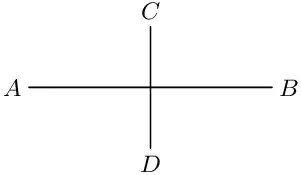
In the given figure both and are bisectors of each other.
We can also state our circle example in another manner, which will lead to same locus but a different equation. By geometry, we know that the end points of a diameter and any point on the circumference subtend a right angle at the circumference. Thus, and can be two different fixed points and can be a point such that is a right-angled triangle at . The locus of is therefore again a circle with as a diameter.
Consider equation of a straight line. (2.1)
The Eq. 2.1 is a relationship between two quantities and as such there are infinite solutions that exist. We cannot know all solutions but we can definitely enumerate some of the solutions. For example, are some of the values which will satisfy the above equation. These are the points which will lie on the line represented by the Eq. 2.1.
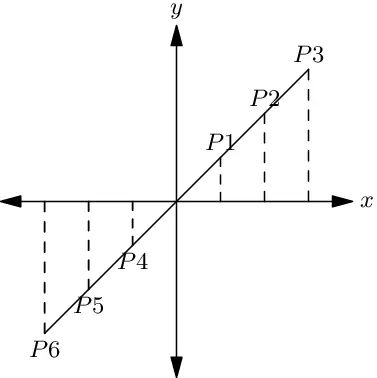
We see from Figure 2.2, “Locus of a straight line.” that the points we have chosen indeed lie on the equation representing the locus.
Now we consider our example of a circle again. Imagine a circle with center at origin having radius of units. The equation of this circle is given by (2.2)
Like straight line there are infinite points on this circle and we consider some of them. For example, .
These points are shown on the circle in the figure below:
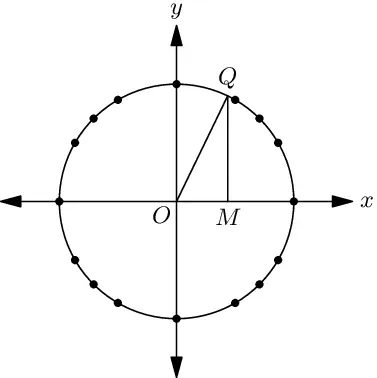
We can take any point on Figure 2.3, “Locus of a circle.” such that is the perpendicular on -axis then we find that , which is what the equation of a circle is. Thus, all the points on the circle satisfy the Eq. 2.2. We take one more example of that of a parabola. We take a specific parabola given by the equation (2.3)
Like the circle example there are infinite points on this parabola as well and we consider some of them like the circle example. For example, .
These points are shown on the parabola in the figure below:
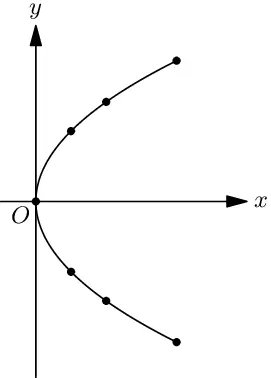
If we take any other point on the parabola then it will satisfy the equation of the parabola like it did for the circle example. Thus, all the points on the parabola satisfy the Eq. 2.3.
Similarly, we can prove that is locus of an ellipse, and s that of a hyperbola. You are encourage to draw the diagram and verify it.
Let the coordinates of the moving point be . Apply the given geometrical constraint or condition tp obtain the relationship between and known quantities. Replace by in the obtained equation. The resulting equation will be the locus of the point under consideration.
If a point moves in such a manner that it satisfies any given condition it will describe some definitive curve, or locus then we can always find an equation between 𝑥 and 𝑦 of any point on the path. This equatio is called equation of the locus or the curve in question.
Definition: Euqation to a curve:The equation to a curve is a relation, which exists between the coordinates of any point on the curve, and which holds for no other points except lying on the curve.
It is obvious that for every equation between and a geometrical locus can always be found.
- Cartesian Form: If the equation of the locus has the form or , where and are the cartesian coordinates of the point , it is called cartesian equation of the locus. All the examples we have covered are of the cartesian form.
- Polar Form; If the equation of the locus has the form or are the polar coordinates of the point , it is called polar equation of the locus. For example, is the equation of the circle in polar form.
- Parametric Form: If and coordinates of the point are given in terms of a third variable 𝑡(called the parameter). This equation is called parametric equation of the locus. For example, the equation of parabola, which is in cartesian form can be written in parametric form as and . If we eliminate then we get cartesian form of the equation to the locus.
- point moves so that the algebraic sum of its distances from two given perpendicular axes is equal to a constant quantity ; find the equation to its locus.
- The sum of squares of the distances of a moving point from the two fixed points and is equal to a constant quantity . Find the equation to its locus.
- Find the locus of a point which moves such that its distance from the point is always three times its distance from the point .
and being the fixed points and respectively, obtain the equations giving the locus of , when
- = a constant quantity .
- being a constant.
- , a constant quantity.
- being the point .
- ind the locus of a point whose distance from the point is equal to its distance from the -axis.
Find the equation to the locus of a point which is always equidistant from the points whose coordinates are
- and .
- and .
- and .
Find the equation to the locus of a point which moves so that
- its distance from the -axis is three times its distance from the -axis.
- Its distance from the point is always four times its distance from the axis of .
- the sum of the squares of its distances from the axes is equal to .
- the square of its distance from the point is equal to .
- its distance from the point is three times its distance from .
- its distance from the -axis is always one half its distance from the origin.
- A fixed point is at a perpendicular distance 𝑎 from a fixed straight line and a point moves so that its distance from the fixed point is always equal to its distance from the fixed line. Find the equation to its locus, the axes of coordinates being drawn through the fixed point and being parallel and perpendicular to the given line.
- In the previous question if the first distance be (1), always half, and (2), always twice, the second distance, find the equations to the respective loci.
- If the coordinates of a variable point be , where is a variable quantity, find the locus of .
- Find the equation of the locus of a point such that the sum of its distances from and is .
- and are two fixed points having a distance of . Find the locus of a point such that is a right angle.
- A line segment of length moves such that its extremities and always remain on the axis of and respectively. Find the locus of a variable point on such that .
- If be the origin and be a point on the locus . Find the locus of the middle point of .
- Examine whether point lies on the curve .
- If the equations and represent the same curve, find and .
- Find the locus of a variable point , where is the parameter.
- If the coordinates of a variable point be , where is variable quantity, then find the locus of .
- If the coordinates of a variable point be , where is a variable quantity, then find the locus of .
- If and are the vertices of a , find the locus of its centroid if varies.
- The position of a moving point in the -plane at time is , where are constants. Find the locus of the moving point.
- A point moves so that its distance from the point is always three times its distance from the point . Find equation to its locus.
- and are two given points whose coordinates are and respectively. A point moves in such a manner that . Find the equation to the locus of .
- is the point and is the foot of perpendicular drawn from a point to the -axis. If moves such that the distance and remain equal, find the locus to .
- Prove that the locus of the point equidistant from two given points is the straight line which bisects the line segment joining the given points at right angles.
- If a point moves such that its distance from is always equal to coordinate of , show that the locus of is .
- If and are two fixed points, find the locus of a point so that area of is units.
- If is the middle point of the straight line joining a given point and where is a variable point on the curve . Find the locus of .
- is a fixed point and a variable point. If divides internally in the ratio , find the locus of .
- From the point all possible lines are drawn to cut the -axis. Find the locus of their middle points.