- 3.1. Angle of Inclination of a Line
- 3.2. Slope or Gradient of a Line
- 3.3. Equation of a Straight Line
- 3.4. Equation of Lines Parallel to Axes
- 3.5. Forms of Straight Line
- 3.6. Representing General Equation in Standard Forms
- 3.7. Angle between Two Straight Lines
- 3.8. Point of Intersection
- 3.9. Concurrency of Three Straight Lines
- 3.10. Two Sides of a Straight Line
- 3.11. Length of a Perpendicular
- 3.12. Bisectors of Angles between Straight Lines
- 3.13. Problems
Straight lines are the simplest locus which a point can have. We have studied the concept of locus in previous chapter. In this chapter we will study different forms of the straight lines and problems related to these concepts. It goes without saying that it is one of most fundamental and important concepts in coordinate geometry.
We know certain facts about straight lines:
-
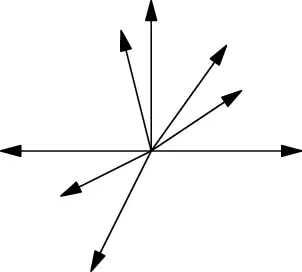
Infinitely many lines can be drawn through a point. See Figure 3.1, “Infinite lines through a point.”
-
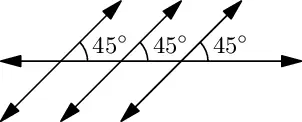
Infinitely many lines can be drawn in a direction. See Figure 3.2, “Infinite parallel lines.”
-
One and only one line can be drawn through a fixed point in a given direction. See Figure 3.3, “A line through a point having direction.”
-
One and only one line can be drawn through two given points. See Figure 3.4, “A line through two points.”
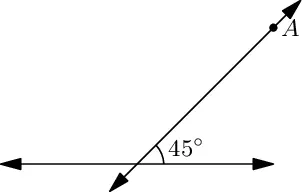
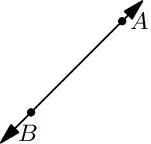
The angle of elevation of any line which cuts the 𝑥-axis the angle which it makes with x-axis in the positive anti-clockwise direction.
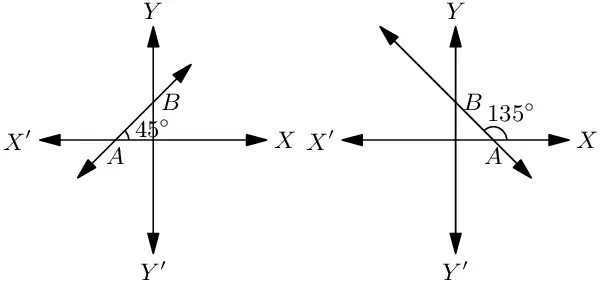
If the angle of inclination is then is called the slope or gradient of the straight line. Usually it is denoted by . Thus, the slope of the lines shown in Figure 3.5, “Inclination angle of a straight line.” are and i.e. and .
If a line passes through two points and then the slope is given by as we will see soon.
Equation of a straight line is the equation in and , which is satisfied by the coordinates of all the points on the line and is not satisfied by any point which is not on the line. It is always an equation of first degree in and . Thus, the general form would be , where and are constants. There are other forms or representations of this equation which will follow this section. The equation may be an equation in and or only or only .
Let be an arbitrary point on -axis. Since lies on -axis, therefore, . The relation is true for all points on -axis, while varies. Hence the equation of -axis is (3.1)
Let be an arbitrary point on -axis. Since lies on -axis, therefore, . The relation is true for all points on -axis, while varies. Hence the equation of -axis is (3.2)
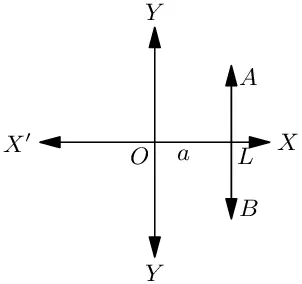
Let be a straight line parallel to -axis at a distance from it on the positive side of -axis.
Let meets -axis at , then . Let be any point on the line . Now or . This relation is satisfied for all points on the line and is not satisfied by any point, which does not lie on .
Hence, the equation of the straight line parallel to -axis at a distance from it on the positive side of -axis is (3.3) Similarly if the line is on negative side of -axis is (3.4)
We will find an equation to a straight line whose slope is and which cuts an intercept on the -axis i.e. which passes through the point .
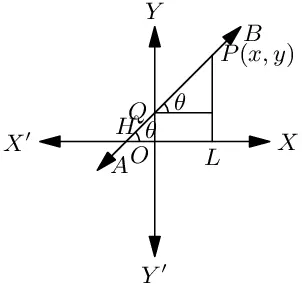
Let be a line whose slope is and which cuts an intercept on -axis. Let and line cuts -axis at .
Then from the figure and .
Let be any point on the line . From we draw and from we draw .
Since .
Now in (3.7)
Note: If the line passes through origin, then and the equation of the line becomes .
We will find an equation to a straight line whose slope is and which passes through a point . See Figure 3.8, “Point slope form of a straight line.”.
Let be a straight line whose slope is and which passes through the point . Let the line cut the -axis at and then .
Let be any point on line . From and we draw and perpendiculars on and from we draw perpendicular on .
Since and and since and .
Since
Now from (3.8)
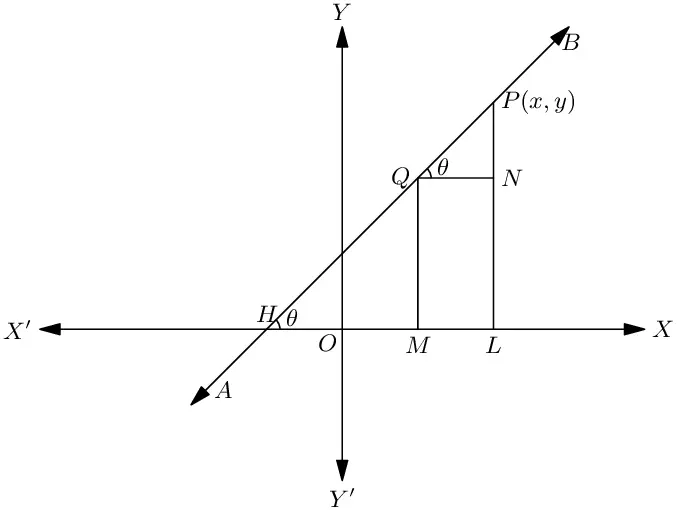
Aliter: Since is the slope of the line therefore its equation may be written as . Since lies on this line therefore we can write . Thus, .
We will find an equation of a straight line which passes through two points and . See Figure 3.9, “Two-point form of a straight line.”.
Let be a line which passes through two points and . Let be any point on .
From and we drop and perpendiculars to x-axis. From we drop perpendicular to and from we drop perpendicular to .
and .
From similar and , we have
(3.9)
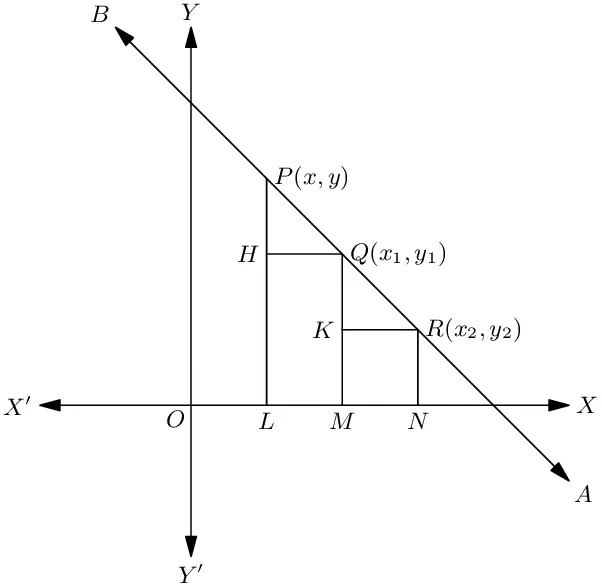
Aliter: Since points and are collinear, therefore .
Aliter: Let the equation of straight line be . Since it passes through and , therefore . Now
Substituting we get .
We will find the equation of the straight line which cuts the intercept and at -axis and -axis respectively. See Figure Figure 3.10, “Intercept form of a straight line.”
Let be a line which cuts intercept and on -axis and -axis respectively. Let line cut -axis at and -axis at , then and .
Let be any point on line , then and .
Now in similar and , we have
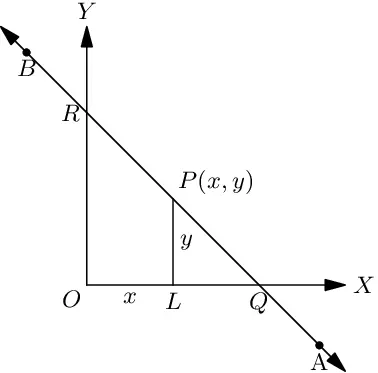
(3.10)
Aliter: Since and , therefore and . Since points and are collinear, therefore,
Aliter: .
We will find the equation of the straight line upon which the length of the perpendicular from the origin is and this normal makes an angle 𝛼 with the positive direction of -axis.
Let be a line and be perpendicular from the origin to . Let and (the point can be different than but in this diagram is such that is perpendicular to ).
Let be any point on the line . From we draw perpendicular to . Let line cut the -axis and -axis at and respectively.
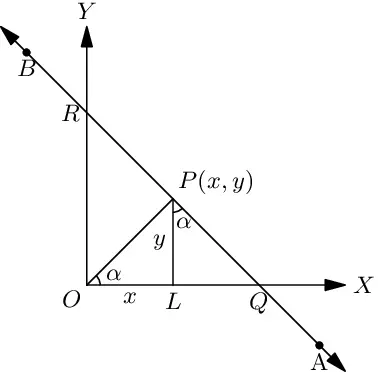
Since . Since
From . Now (3.12)
Aliter: and since
Hence,
Now the points and are collinear, therefore,
.
We will find the equation of the straight line passing through the point and making an angle with the positive direction of -axis.
Let be a line which passes through the point and makes an angle with the positive direction of -axis.
Let be a point on the line . From and we draw and perpendicular on -axis. From , we draw perpendicular to .
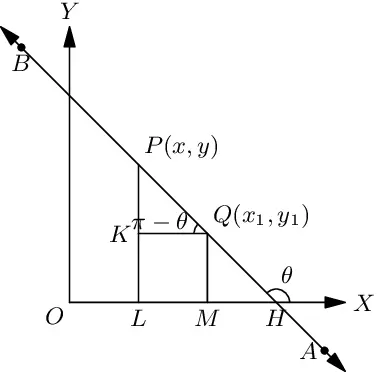
.
Let . From
Also, . Thus, (3.13)
Corollary: From Eq. 3.13 we can say that (3.14)
which is parametric form of a straight line.
If be a point on a line , which makes an angle with the positive direction of -axis, then there will be two points on line and their coordinates will be and . These two points will be on two opposite sides of on the line .
We will show that the general equation of first degree in and always represent a straight line.
Let the general equation of first degree in and be .
Let and be two points on this line. Then and .
Multiplying the two equations by and respectively and adding gives us .
.
Thus, point will lie on the straight line we have chosen.
Since and are arbitrary numbers, therefore, each point on the line will lie on this locus. Hence, the general equation of a straight line is (3.15)
Aliter: Let the general equation of first degree in and be .
Let and be any three points on the above line. Then and .
Thus, are collinear. Thus, the equation is equation of a straight line.
Converse: Every straight line may be represented by a first degree equation in and . We know that through two points one and only one straight line can be drawn. Let and be two points on the straight line and let be any point on it. Now since are collinear
,
which is of the form , where and .
Since the equation is satisfied by all points on the line and it will not be satisfied by the coordinates of any point which does not lie on the line , hence, it represents the equation of line .
We will reduce the equation to .
Given equation is , which is of the form
Comparing we have and .
We will reduce the equation to .
This reduction is possible only if .
Given equation is , where .
, which is of the form , where and .
We will reduce the equation to the form , where is the angle made by the perpendicular on the line from origin and is the length of the perpendicular.
Given equation is
Case I: When i.e. .
Dividing both sides by gives us
, which is of the form .
Case II: When i.e.
Given equation can be written as
, which is of the form .
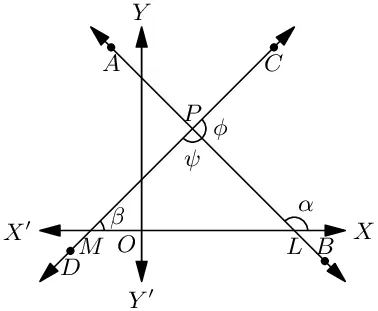
We will find the angle between two straight lines given by the equations and .
Let and be two given lines whose equations are and .
Let and cut each other at and they cut the -axis at points and respectively.
Let and . Now since line makes an angle with -axis and its slope is . .
Again since makes an angle with -axis and its slope be . .
From the figure
If then
Since and are the two angles between the lines and , it follows that the angle between these two lines is given by
If is the acute angle between the lines then (3.16)
Notes:
- here are two angles between two non-perpendicular lines. One of them is acute and the other one is obtuse and their sum is . Thus, if acute angle between the two lines is known then the other angle will be .
- The formula is valid only when and are defined.
- f both the lines are perpendicular to 𝑥-axis then the angle between them is .
- If one of the lines is perpendicular to -axis and the other line makes an angle of with positive direction of -axis then the angle between them is .
Our equation for angle between two straight lines is . If the lines are parallel then the value of would be . Thus, . For special case when two lines are parallel to -axis i.e. then both the lines are taken as parallel.
For lines to be perpendicular then . When either of or is not defined then one of them has to be parallel to -axis while the other has to be parallel to -axis.
Writing the equation in slope intercept form we find that the slopes are given by and .
If be the angle between the two lines then
or
Clearly, the lines will be parallel if i.e. (3.17) and the lines will be perpendicular if (3.18)
We will find equation of a line parallel to another line in standard form i.e. .
Let the line parallel to give line is .
From Eq. 3.17 these two lines will be parallel if (say) then , which makes the equation of the line as or , where .
Thus, equation of any line parallel to is given by (3.19)
We will find equation of a line perpendicular to another line in standard form i.e. .
Let the line perpendicular to give line is .
From Eq. 3.18 these two lines will be parallel if or (say)
Thus, , where
Thus, equation of any line perpendicular to is given by (3.20)
We will find the point of intersection of two lines in standard form i.e. between the lines given by and .
Let is the point of intersection of these two lines then and .
By cross-multiplication we have
Thus, the point of intersection is given by .
As you can see in case of parallel lines and then and are not defined.
In this case neither nor will be zero, otherwise i.e. the two lines will be coincident or same.
We will find the general equation of a straight line passing through point of intersection of two straight lines in standard form i.e. lines given by and .
We consider the straight line in first degree equation .
Let be the point of intersection then and and .
Clearly, the third equation is an equation of a line passing through . Thus, our desired equation is (3.21)
We will find condition for concurrency of three lines in standard form i.e. the lines are given by and .
Let be the point where these three lines meet. Then will lie on all three lines. Thus,
Thus, the point of intersection is given by .
Now this point will lie on the third line and therefore will satisfy the equation for third line. Hence, .
Thus, the required condition for concurrency of three lines is give by (3.22)
Aliter: Equations of given lines are and .
Let be the point where these three lines meet. Then will lie on all three lines. Thus, and .
Eliminating we can write that , which expands to Eq. 3.22.
Corollary: The straight lines and . will be concurrent if and only if there exists three constants (not all zero at the same time) such that identically i.e. for all values of and .
Since are not zero at the same time let . Let be the point of intersection of first two lines. Then
and
Since the given condition is true for all and , therefore
Thus, the third line also passes through .
Every line divides the plane in two regions. Any point which does not lie on the line can be only on one side of the straight line.
We will show that a point will be on one or the other side of the line according as the expression or .
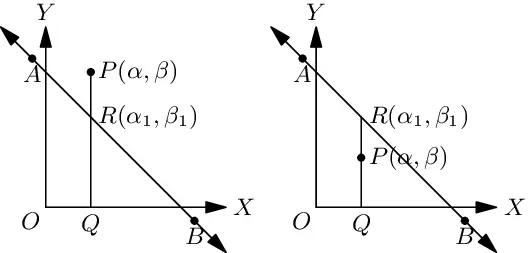
Let 𝐴𝐵 be the given line whose equation is . Let be a point which does not lie on this line.
From we draw perpendicular on -axis. Let cut line at . Clearly, coordinate of and are same.
Let . Since it lies on the line, therefore, .
When , on left side of the Figure 3.14, “Side of a point.” or or or .
Similarly, for right side of the figure we can establish .
When , on left side of the Figure 3.14, “Side of a point.” or or or .
Similarly, for right side of the figure we can establish .
Thus, we see that or according as the point lies on one or the other side of the line .
Corollary: It follows from previous article that two points and will lie on the same side or opposite side of the line according as and are of the same sign or opposite sign.
We will find the length of the perpendicular from the point to the line .
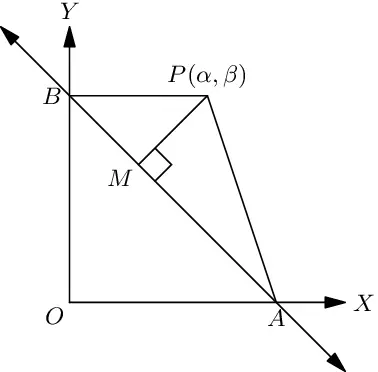
Let the given line be and given point be . We have to find the length of the perpendicular from the point on line .
We draw perpendicular to and join and . Let .
Putting y = 0 in the equation for the given line gives us .
Putting in the equation for the given line gives us .
Now
Again
Equating two obtained equations for gives us the length of the perpendicular, which is (3.23)
Aliter: Let make an angle with the positive direction of -axis, then the equation of in distance form is
Coordinates of any point on at a distance from will be .
Since , therefore coordinates of is , which will lie on the line , thus,
Now slope of slope of or (say)
. Similarly
Putting the values of and in the equation gives us
Since is positive, therefore, (3.24)
Aliter(Calculus Method):
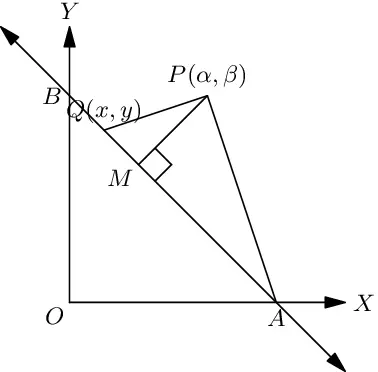
Let be any point on the line . Now will be the length of the perpendicular if is minimum. Hence, length of the perpendicular from on will be the least value of when the point varies.
Let . Also, will be least if and only if i.e. is least.
Now
Since lies on the line , therefore,
For maxima and minima of ,
Slope of line . Slope of line
Thus, when .
Since maximum length of is not possible as it will be (tends to ), and hence, gives the minimum length of .
Length of perpendicular,
But if , then
Note: Length of perpendicular from origin on line is .
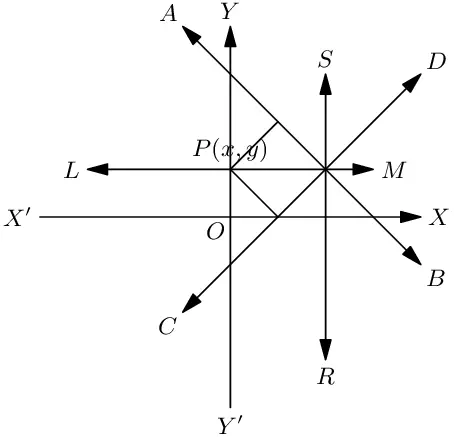
We will find the equation of the bisectors of the angles between the straight lines and .
Let the given lines be and whose equations are and .
Let and be the two bisectors of the angles between and . Let be the point on any bisector. Since lies on a bisector, therefore, the lengths of perpendiculars on two lines will be equal.
Thus, the length of perpendicular from to will be equal to the length of the perpendicular from to .
. Thus,
(3.25) are the equations of two bisectors.
Note: If is taken on the bisector of the angle which contains the origin then either and will lie on the same sides of two lines. Thus,
and or and will lie on the opposite side of the two lines i.e. and
Then equation of bisectors will be
i.e. , when both and are positive or , when both and are negative.
Thus, in both the cases equation of the bisector containing the origin when and are both positive is
(3.26)
When both and are positive, then the equation of the bisector of the angle between the lines which does not contain the origin is (3.27) The two bisectors are perpendicular to each other.
To find the bisector of the acute and obtuse angles take any line out of and and any of the bisectors obtained. Let 𝜃 be the angle between them. Find . The bisector considered will be the bisector of the acute angle or obtuse angle between the lines according as or i.e. according as or .
Aliter: Let the equations of the two lines be and , where and .
Then the equation is the equation of the bisector of the acute or obtuse angle between the lines according as or .
Slope of bisector and slope of first line is
Angle between first line and bisector is
Let and then
If and , therefore, , and hence, the bisector is the bisector of acute angle between the lines.
If and , therefore, , and hence, the bisector is the bisector of obtuse angle between the lines.
Similarly, we can show that the equation is the equation of the bisector of the acute or obtuse angles according as or .
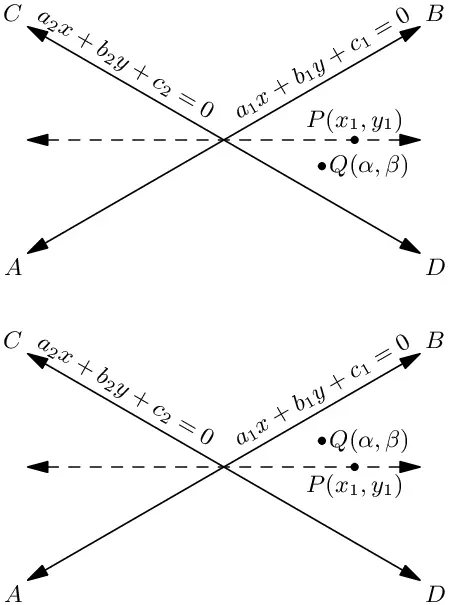
Let the equations of the lines be and .
Let be a given point. If and are of the same sign then equation of the bisector of the angle containing the point is (3.28)
Let be a point on the bisector then
Since and are both posiitive, therefore, and are of the same sign.
Case I: When both and are positive.
Since and are both positive, therefore, points and will lie on the same side of the line . Again since and are both posiitive, therefore, points and will lie on the same side of the line .
The figure will be like Figure 3.18, “Bisectors of angles between straight lines.”
Case II: When both and are negative.
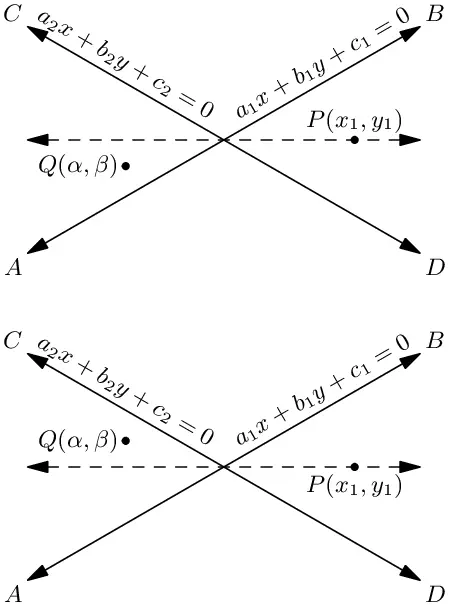
In this case and are of opposite sign, therefore, points and will lie on opposite side of the line .
Again since and are of opposite sign, therefore, points and will lie on opposite side of the line . Thus, in this case figure will like Figure 3.19, “Bisectors of angles between straight lines.”
Similarly, if and are of opposite sign then the equation of the bisector of the angle containing the point is (3.29)
Aliter: Let the equations of lines and are and , where and are positive.
These equations in normal form will be
and
Let , and
Now
will be acute or obtuse according as or .
Now will be acute or obtuse according as is obtuse or acute.
But contains the origin, therefore, origin will be contained in the acute or obtuse angle according as or .
Hence, bisector of the angle between the lines will be bisector of the acute or obtuse angle according as origin lies in the acute or obtuse angle.
- Find the equation of the straight line cutting off an intercept from the positive direction of -axis, and inclined at angle to the -axis.
- Find the equation of the straight line passing through the point and cutting off intercepts, equal but of opposite signs from the two axes.
- Find the equation of the straight line which passes through the point and is such that the portion of it between the axes is doivided by the point in the ratio of .
- Find the normal form of the equation .
- Find the equation of the straight line which passes through the points and .
- Find the equation of the straight line cutting off intercept unity from the positive direction of the -axis and inclines at to the -axis.
- Find the equation of the straight line cutting off intercept from the -axis and being equally inclined to the axes.
- Find the equation of the straight line cutting off intercept from the negative direction of -axis and inclined at to .
- Find the equation of the straight line cutting off intercept from the -axis and inclined at an angle to the -axis.
- Find the equation of the straight line cutting off intercepts and from the axes.
- Find the equation of the straight line cutting off intercepts and from the axes.
- Find the equation of the straight line which passes through the point and has intercept on the axes equal in magnitude and both positive. Find the equation if intercepts are equal in magnitude but opposite in sign.
- Find the equations of the straight lines which passes through the point and cut off equal distances from the two axes.
- Find the equation of the straight line which passes through the point and is such that the given point bisects the part intercepted between the axes.
- Find the equation of the straight line which passes through the point and is such that the portion of it between the axes is divided by the point in the ratio .
- Find the equation of the straight line passing through the points and .
- Find the equation of the straight line passing through the points and .
- Find the equation of the straight line passing through the points and .
- Find the equation of the straight line passing through the points and .
- Find the equation of the straight line passing through the points and .
- Find the equation of the straight line passing through the points and .
- Find the equation of the straight line passing through the points and .
- Find the equation of the straight line passing through the points and .
- Find the equation of the straight line passing through the points and .
- Find the equation of the straight line passing through the points and .
- Find the equations of the sides of the triangle the coordinates of whose angular points are respectively and .
- Find the equations of the sides of the triangle the coordinates of whose angular points are respectively and .
- Find the equations of the diagonals of the rectangle the equations of whose sides are and .
- Find the equation of the straight line which bisects the distance between the points and and also bisects the distance between the points and .
- Find the equations of the straight lines which go through the origin and trisect the portion of the straight line which is intercepted between the axes of coordinates.
- Find the equation of the straight line which makes an angle of with the positive direction of -axis, and which cuts an intercept of length on the negative direction of -axis.
- Find the equation of the straight line which cuts off an intercept from the -axis and makes an angle of with the -axis.
- Find the equation of the straight line which passes through the point and makes an angle with the positive direction of 𝑥-axis where .
- Find the equation of the line joining the points and .
- A line through the point which makes an angle of with the positive direction of -axis is rotated about in clockwise direction through an angle of . Find the equation of the straight line in the new position.
- Find the equation of the internal bisector of the of the whose vertices are respectively.
- A rectangle has two opposite vertices at the point and . If the other vertices lies on the line , find the equation of the sides of the triangle.
-
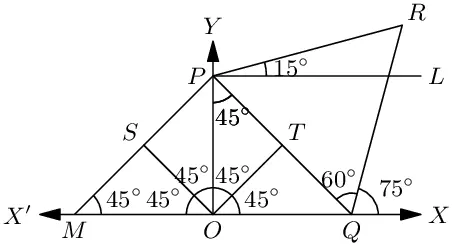
In the given figure is an equilateral triangle and is a square. If units, find the equation of lines and .
- If are three points on the sides and of a such that and are concurrent, then show thta .
- Find the coordinates of the vertices of a square inscribed in a triangle with vertices and ; given that two of its vertices are on the side .
- Transform equation to the slope intercept form and also find the angle, which this straight line makes with the -axis.
- Find the equation of the straight line which cuts of an intercept of on -axis and has the slope .
- Find the equation of the line, which makes an angle of with -axis and cuts an intercept of length on the positive direction of -axis.
- Find the equation of the straight lines which cuts off an intercept from the -axis and makes an angle of with the -axis.
- Find the equation of the straight line which is parallel to -axis at a distance of units from it.
- Find the equation of the straight line which is parallel to -axis at a distance of units from it towards negative side of -axis.
- Find the equation of the straight lines which pass through and are respectively parallel and perpendicular to the -axis.
- Find the equation of the straight line which intercepts a length of on the positive direction of -axis and is inclined at with the positive direction of -axis.
- Find the equation of a straight line which cuts off an intercept on the -axis and has the slope .
- Find the equation of the straight line passing through and making an angle of with the positive direction of -axis.
- Find the slope of the line passing through the points and . Also find its equation.
- Find the equation of the straight line passing through the points and .
- If is a point on the straight line joining and show that .
- Prove that the points and are collinear. Also, find the the equation of this straight line.
- If the points and are collinear, show that the line joining them passes through the origin.
- Find the value of for which and will be collinear. Also find the equation of the straight line.
- Show that the straight line passing through the points and also passes through the point .
- Find the equation of the straight line passes through the point which divides the line segment joining the points and externally in the ratio and the point .
- Find the equation of the side of the whose vertices are respectively. Also find the equation of the median through .
- The vertices of a triangle are and . Find the equation of its medians.
- In what ratio does the line divide the line segment joining the points and ?
- Find the ratio in which the line segment joining and is divided by the line joining and .
- The vertices of a are and . is a point on such that . Find the ratio in which divides the median through .
- For the straight line , find the intercept on -axis and also the angle which the straight line makes with the -axis.
- Find the equation of the straight line which passes through the point and whose intercept on -axis is twice that on -axis.
- Find the equation of the straight line which passes through the point and is such that the portion of it intercepted between the axes is divided by the point in the ratio .
- Find the equation of the straight line whose intercepts on -axis and -axis are respectively twice and thrice of those by the line .
- Find the equation of the straight line passing through the origin and the middle point of the intercept of the straight line between the axes.
- Find the equation of the straight lines which pass through the origin and trisect the intercept of the line between the axes.
- A straight line cuts intercepts from the axes of coordinates the sum of the reciprocal of which is a constant. Show that it always passes through a fixed point.
- If the equal sides and of a right angled isosceles triqangle be produced to and so that , show that always passes through a fixed point.
- Through the point , where the straight line is drawn so as to form with coordinate axes a triangle of area . If , find the least value of .
- Find the equation of the straight line upon which the length of perpendicular from origin is units and this perpendicular makes an angle of with the positive direction of -axis.
- Find the equation of the straight line upon which the length of the perpendicular from the origin is and the slope of the perpendicular is .
- A canal is kms from a place and the shortest route from this place to canal is exactly north-east. A village is kms north and kms east from the place. Does it lie on the canal?
- Find the equation of the straight lines which makes a triangle of area with the axes and perpendicular from the origin to it makes an angle of with -axis.
-
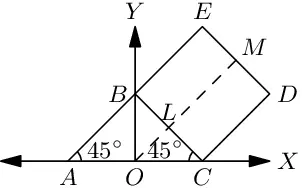
In the given figure is a right-angled iscosceles triangle and is a
square. If , find the equation of the sides and of
and side of the square.
- Find the coordinates of the point where the line meets the coordinate axes and also find the length of the perpendicular from the origin upon this line and the angle which this perpendicular makes with the -axis.
- Find the equations of the straight lines which pass through the point and cut off intercepts and on the and -axes such that .
- Find the equation of the line which passes through and meets the axes at and respectively such that , where is the origin.
- Find the equation of the straight line which passes through the point and cuts the axes at the points and respectively such that .
- Find the equation of the straight line whose intercepts on the axes are twice the intercepts of the line .
- Find the equation of the straight line passing through and bisecting the portion of the straight line lying between the axes.
- Find the equations of the straight lines which pass through the origin and trisect the portion of the straight line which is intercepted between the axes.
- Prove that the points and lie on a straight line and find its intercepts on the axes and between the axes.
- Find the intercepts on the axes of the straight line passing through the points and .
- The lnegth of the perpendicular from the origin to a line is and the line makes an angle of with the positive direction of -axis. Find the equation of the line.
- Find the equation of the straight line upon which the length of the perpendicular from the origin is and this perpendicular makes an angle of with the positive direction of -axis.
- Find the equation of the line which is at a distance from the origin and the perpendicular from the origin to the line makes an angle of with the positive direction of -axis.
- Find the equation of the straight line upon which the length of the perpendicular from the origin is and the gradient of the perpendicular is .
- Find the equation of the line joining the points and . Find its intercepts on the axes. If be the length of the perpendicular from the origin to the line, find the value of .
- Find the equation of the straight line which passes through the point and whose gradient is . Find the coordinates of the points on the line that are units away from the point .
- Find the direction in which a straight line must be drawn through the point so that its point of intersection wth the line is at a distance from the point .
- f the straight line drawn through the point makes an angle with the -axis meets the line at . Find the length of .
- Find the coordinates of the points at a distance units from the point in the direction making an angle of with the positive direction of -axis.
- A line joining two points and is rotated about in anticlockwise direction through an angle . Find the equation of the line in new position. If goes to in the new position what will be the coordinates of ?
- The extremeties of the diagonal of a sqaure are . Obtain the other two vertices and the equation of the other diagonal.
- Show that if any line through the variable point meets the line at respectively and are in H.P.
- The center of a square is at the origin and one vertex is . Find the coordinates of other vertices of the square.
- Show that if are the vertices of a triangle, then the equation of the internal bisector of angle is given by , where and .
- Find the coordinate of the point at a distance units from the point in the direction making an angle of with the positive direction of -axis.
- Find the distance of the line from the point in the direction whose slope is one.
- The straight line through inclined at an angle with -axis meets the line in . Find the length of .
- A line through the point which makes an angle of with the positive direction of -axis is rotated about in anticlockwise direction through an angle . Find the equation of the straight line in the new position.
- The straight line turns about the point on it where the ordinate is equal to the abcissa through an angle of in the anti-clockwise direction. Find the equation of the line in the new position.
- The straight line is translated parallel to itself by units in the sense of increasing and is then rotated by in the clockwise direction about the point where the shifted straight line cuts the -axis. Find the equation of the new straight line in the new position.
- is a side of regular hexagon and is of length a with as the origin and and as the -axis and -axis respectively. Find the equation of lines and .
- A straight road is at a distance of miles from a place. The shortest distance of the road from the place is in direction. Do the following villages which (i) is miles East and 4 miles and 4 miles North from the place, lie on the road or not. (ii) is miles East and miles north from the place, lie on the road or not?
- A straight line cuts the -axis at . This line is rotated about in the clockwise direction by . Fine the equation of the new straight line.
-
Find the equations of all sides of the isosceles and the side and
of the square in the figure where units.
- The mid-point of the line segment joining and is shifted by two units(in the sense of increasing ) perpendicular to the line segment. Find the coordinates of the point in the new position.
- The point is translated parallel to the line in the first quadrant through a unit distance. Find the new position of the point.
- The point is translated parallel to the line by a distance of units. If the new position of the point is in the (i) first quadrant (ii) third quadrant then find .
- Two particles start from the same point , one moving units along the line and the other units along the line . If the particles move towards increasing , find their new positions and the distance between them.
- One end of a thin elastic straight string is fixed at and the other end is at in the unstretched condition. If the string is stretched to triple its length, find the coordinates of the other end in this stretched position.
- The line 𝐴𝐵 whose equation is cuts the -axis at and is . The line is rotated about through in the anticlockwise direction. Find the new position of and the equation of the line in new position.
- Let plane be vertical. A particle dropped gently from in the plane rebounds on the floor returns to rd of the height from which it has fallen. The equation of the line of intersection of plane and the floor is . Find the highest position of the particle after one rebound.
- A line is drawn through parallel to the line . Find the coordinates of the two points on this line which are at a distance of units from .
- Find the distance of the point from the line measured parallel to the line .
- Find the distance of the point from the line measured parallel to the line .
- The point and are two opposite sides of a rectangle and the other two vertices lie on the line . Find and other vertices.
- A line is drawn from in the direction with the -axis, to meet . Prove that the lengeth is .
- Find the equation of the line passing through the point cutting the lines and at and respectively such that the H.M. of and is . Given that lie on the same side of .
- A straight line through the point cuts the line and at and respectively. Find the equation of the line if .
- A line which makes an acute angle with the positive direction of -axis is drawn through the point to cut the curve at and . Show that the lengths of the segments and are numerical values of roots of the equation .
- Show that if and be the vertices of a triangle then the equation of the median through is given by .
- Find the angle between the lines and .
- Find the angle between the lines and the line joining the points and .
- Find the value of so that the straight line is perpendicular to the line .
- Prove that the line joining the middle points of the two sides of a triangle is parallel to the third side.
- Find the values of and for which and are the vertices of an isosceles trapezium in which .
- Prove that the straight lines and form an isosceles triangle whose vertical angle is .
- Find the angle between the lines and .
- Find the tangent of the angle between the lines which have intercepts of and on and axes respectively.
- Prove that the lines and are perpendicular to each other.
- Show that the line joining and is perpendicular to the line joining and .
- A line passing through the points and is perpendicular to the line ; find the value of .
- Show that the lines and are parallel.
- Prove that the line is perpendicular to the line for all real values of .
- For what value of is the line parallel to the line .
- Prove that the lines and form a parallelogram.
- Find the value of between and if is perpendicular to the line .
- If the line , where 𝑘 is arbitrary, is perpendicular to the line , then find 𝑘 and the equation of the first line.
- Prove that the median of an equilateral triangle is perpendicular to the corresponding side.
- Prove that the diagonals of a rhombus are at right angles.
- Find the equation of a line through and parallel to the line .
- Find the equation of the straight line through and perpendicular to the line .
- Find the equation of the straight line which has intercept equal to and is perpendicular to the line .
- Find the equation of the perpendicular bisector of the line segment joining the points and .
- The line meets the axes of and at and respectively. A is inscribed in the ( being the origin) with right angle at . respectively lie on and . If the area of the triangle is th of the area of the , then find .
- Find the slope of the lines which make an angle of with the line .
- Find the equation of the lines through the point which makes an angle of with the line .
- A vertex of an equilateral triangle is and the equation of the opposite side is . Find the equation of the other sides of the triangle.
- A line through the point meets the line whose equation is at the point . Find the equation of the line , so that .
- Find the equation of straight lines passing through and having an intercept of length between the straight lines and .
- Find the equation of the straight line parallel to and passing through the point .
- Find the equation of the straight line which passes through the point and is parallel to the line .
- Find the equation of the straight line parallel to and passing through the middle point of the line segment made by and .
- Find the equation of the straight line passing through the point and parallel to the line joining the points and .
- Find the equation of the straight line passing through the point and parallel to the line .
- Find the equation of the straight line passing through the point and perpendicular to the line .
- Find the equation to the straight line which passes through the point and is perpendicular to the line .
- Find the angle between the straight lines and .
- Prove that the equation of the straight line which passes through the point and is perpendicular to the line is .
- Find the equation of the straight line through perpendicular to the line .
- Two consecutive sides of a parallelogram are and . If the equation of one of the diagonal is , find the equation of the other diagonal.
- Show that the area of the triangle whose sides are and is .
- Show that the area of the triangle formed by the lines is .
- Show that the area of the triangle whose sides are is , where and are the cofactors of and respectively in the determinant .
- Show that the lines make equal intercepts on any line of gradient .
- Find the coordinates of the foot of the perpendicular drawn from point to the line .
- Find the image of the point with respect to the line mirror .
- If the image of the point with respect to the mirror be , show that .
- A ray of light is sent along the lines . Upon reaching the line , the ray is reflected from it. Find the equation of the line containing the reflected ray.
- A man starts from the point and will reach the point touching the line at . Find on the line sho that he will travel the shortest distance.
- A ray of light is sent along the line . After refracting across the line it enters the opposite side after turning by away from the line . Find the equation of the line along which the refracted ray travels.
- Find the equation of the straight line which passes through the point and the point of intersection of the lines and .
- Find the equation of the straight line which passes through the point of intersection of the lines and and is parallel to the line .
- Find the equation for the straight line which passes through the point of inter- section of the lines and and is perpendicular to the line .
- Find the equation of the straight lines passing through the point of intersection of the lines and and equally inclined to the axes.
- The equation of two sides of a triangle are and and the orthocenter is . Find the equation of the third side.
- Show that the diagonal of the parallelogram whose sides are where and and which passes through the points of intersection of lines and is given by .
- Show that the straight lines pass through a fixed point for different values of and .
- If , where are variables is the equation of a variable line and are connected by the relation , where are constants, show that the line passes through a fixed point.
- A variable line cuts given concurrent straight lines at , such that is a constant. Show that it always passes through a fixed point. is the point of intersection of the lines.
- Prove that the straight lines and are concurrent.
- Prove analytically that medians of a triangle are concurrent.
- Show that the lines and are concurrent.
- If the lines and 𝑝3𝑥 + 𝑞3𝑦 = 1 be concurrent, show that the points and are collinear.
- For what value of , the line will pass through the point of intersection of the lines and ?
- Find the point of intersection of the lines and .
- If the straight line passes through the point of intersection of the lines and and is parallel to the line , find .
- Find the vertice and area of the triangle whose sides are and .
- Find the area of the triangle which is formed by the lines and .
- Show that the area of the triangle formed by the three straight lines and is equal to , where are the roots of the equation .
- Find the coordinates of the foot of the perpendicular drawn from the point on the line .
- Find the projection of the point on the line joining the points and .
- If perpendiculars are drawn from origin to the straight lines and , then find the equation of the line joining the foot of these perpendiculars.
- If is the foots of the perpendiculars from to prove that .
- find the image of the point with respect to a line mirror .
- If the image of the point with respect to a line mirror be , find the equation of the mirror.
- Find the equation of the straight line which passes through the point and the point of intersection of the lines and .
- Find the equation of the straight line which passes through the point and the point of the intersection of the lines and .
- Find the equation of the straight line passing through the point of intersection of the lines and and making with the coordinate axes a triangle of area .
- The sides and of a parallelogram are and respectively and is the point . Find the equation of the diagonals and .
- Prove that the lines and are concurrent.
- Find the value of 𝑚 for which the two lines and intersect at a point on 𝑦-axis.
- Find the value of so that lines and may be concurrent.
- If the three lines and are concurrent, show that at least two of the three constants are equal.
- Find the condition that the lines and may be concurrent.
- Show that the straight lines and are concurrent.
- Prove analytically that the right bisectors of the sides of a triangle are concurrent.
- Prove that perpendiculars drawn from the vertices to the opposite sides are concurrent.
- Prove that the family of lines represented by being arbitrary, pass through a fixed point. Also find the fixed point.
- Prove that the line passes through a fixed point for different values of and .
- Find the centroid and incenter of the triangle whose sides are and .
- Find the coordinate of the orthocenter of the triangle whose vertices are and .
- Find the coordinate of the orthocenter of the triangle whose sides are and .
- Two vertices of a triangle are and and its orthocenter is origin, find the coordinate of its third vertex.
- A triangle has the lines and for two of its sides, where and are the roots of the equation . If is the orthocenter of the triangle, show that the equation of the third side is .
- A triangle is formed by the straight lines and . Show that that straight line passes through the orthocenter of the triangle.
- The three sides of a triangle are . Show that the orthocenter of the triangle is given by .
- Find the centroid and incenter of the triangle whose sides have the equations and .
- The coordinates of the vertices and of the taken in anti-clockwise order are respectively and . Prove that the is acute or obtuse according as or . Also find the condition for the triangle to be right-angled at .
- Show that the four lines and form the sides of a cyclic quadrilateral.
- Find the condition for the quadrilateral to be cyclic whose sides are taken in order.
- Show that the lines and cut the coordinate axes in concyclic points.
- Find the equation of the sides of a triangle having as a vertex, and as the equation of two of altitudes not passing through .
- The straight line is perpendicular to the line . The area of the triangle formed by and the coordinate axes is . Find the equation of the line.
- The line meets the -axis at and -axis at . The line through perpendicular to meets the axes and at respectively. If is origin of axes then find the area of .
- A square has its center at origin and one vertex at . Find the equation of its sides.
- is an equilateral triangle. is its altitude through . If and , find the equations of the sides of the triangle.
- The equation of one side of an equilateral triangle is and one vertex is . Prove that second side is , and find the equation of the third side.
- A diagonal of a square lies along the line and one vertex of the square is . Find the equations of the lines of the square passing through this vertex.
- Find the equation of the lines which pass through andd make equal angles with the lines and .
- Two equal sides of an isosceles triangle have the equations and and its third sides passes through the point . Determine the equation of the third side.
- Prove that area of the triangle formed by the three straight lines and is .
- Find the area of a triangle formed by the 𝑦-axis, the straight line passing through the points and and the straight line perpendicular to the line and passing through .
- Find the coordinates of the feet of the perpendicular from the point to the sides of the triangle whose vertices are at the points . Prove that the points so determined lies on a straight line and find its equation.
- Obtain the coordinates of the foot of the perpendicular from the origin to and show that .
- Find the equation of the diagonal through the origin of the quadrilateral formed by .
- The altitudes of a are respectively . If the points have the coordinates , find the coordinates of other vertices of the triangle.
- Prove that the lines cut off equal intercepts on the transversal are in H.P.
- A line is such that its segment between the lines is bisected at the point . Obtain its equation.
- If the lines and cut the coordinate axes in cyclic points, prove that .
- A rectangle 𝐴𝐵𝐶𝐷 is inscribed in a circle with a diameter lying along the line . If and are the points and respectively, then find the area of the rectangle.
- From the point rays of light are sent at with the line . Find the equation of the lines of the reflected rays if the rays reflect from .
- A ray of light is sent along the straight line . On reaching the -axis it is reflected. Find the point of incidence and the equation of the reflected ray.
- From the point a ray of light is sent at an angle to the positive direction of -axis. Upon reaching the -axis the ray is reflected from it. Find the equation of the reflected ray if .
- A light beam emanating from the point reflects from the straight line and then passes through the point . Find the equations of the incident and reflected beams.
- The line meets 𝑦-axis at and 𝑥-axis at . The perpendicular bisector of 𝐴𝐵 meets the line through parallel to -axis at . Find the area of the .
- Find the condition that the real line and are concurrent.
- Find the condition that the lines and are concurrent.
- Prove that the determinant . What geometrical property does it imply for a triangle whose vertices are ?
- Prove that all lines represented by the equation pass through a fixed point for all values of . Find the coordinates of that point and its reflection in the line .
- Prove that the orthocenter of the triangle formed by the three lines is .
- If the coordinates of the point satisfy the relation , show that the orthocenter of also satisfies the relation.
- and are two fixed points and respectively. is equilateral and is situated on the side of remote from the origin. Find the coordinates of and the orthocenter of the .
- Vertices of a triangle are and . If the circumcenter coincide with the origin and the orthocenter is then prove that , where have the same sign.
- Find the area and the orthocenter of the triangle formed by the lines and .
- If the equation of the sides of a triangle are respectively and and whose orthocenter is the origin, prove that .
- Prove that the has the same centroid as , where are the middle points of the sides of the later triangle. Also prove that the orthocenter of the coincides with the circumcenter of the .
- The circumcenter of a triangle with vertices and lies at the origin , show that its orthocenter lies on the line .
- Show that the line passes through the orthocenter of the triangle formed by the lines and .
- Find the position of the points and with respect to the line .
- Show that the four points and are in the four different compartments made by the two straight lines and .
- Find the position of the origin w.r.t. the triangle whose sides are .
- Show that the line segment joining the points and is cut by the line in the ratio . Explain the minus sign.
- A line intersects three sides and of a in and respectively. Prove that .
- Derive the condition to be imposed on so that should lie on or inside the triangle having sides and .
- A rhombus has two consecutive vertice at and and two of the sides are parallel to . Find the other vertices of the rhombus if is an interior point of rhombus.
- Examine wheher the points and are on the same side or opposite sides of the line ?
- Prove that the points and are on the opposite sides of the straight line .
- Find the position of the points and w.r.t. the line .
- Prove that the points of intersection of the line with the parallel lines and are on the opposite sides of the line .
- Find the distance of the point from the straight line .
- Find the distance of the point from the straight line with slope and passing through the point of intersection of and .
- The equation of the base of an equilateral triangle is and the vertex is . Find the length of the side of the triangle.
- If and are the intercepts of a straight line on the and axes respectively and be its perpendicular distance from the origin, prove that .
- If and be the lengths of perpendiculars from origin to the lines and respectively, show that .
- Find the equation of straight line which cuts off intercepts on -axis twice that on -axis and is at a unit distance from the origin.
- Find the distance between the parallel lines and .
- Prove that the length of the perpendiculars from points and to the line form a G.P.
- A straight road passes through two towns, one km east and the other km north from a tower. Where should a rest house be constructed by the side of the road so that it may be nearest to the tower.
- A straight line is such that the algebraic sum of the perpendiculars upon it from any number of fixed points is zero. Show that the line always passes through a fixed point.
- The coordinates of the extremeties and of a rod are and respectively. is a point source of light. The rod is parallel to the wall and is at equal distance from and the wall. If is the shadow of on the wall, find the coordinates of and D and the lnegth . and are planar.
- Prove that the diagonals of the parallelogram formed by the lines and are at right angles.
- Find the area of the parallelogram whose sides are and .
- Find the distance of the point of intersection of the lines and from the line .
- Find the length of the perpendicular drawn from the origin upon line joining the points and .
- Find the length of the perpendicular from the point to the line joining the origin and point of intersection of the lines and .
- Find the equation of two straight lines which are parallel to , and at unit distance from the point .
- Find the equations of the two straight lines parallel to at a unit distance from it.
- Find the equation of two lines through which are at a distance 𝑎 from the point .
- Find the equation of the line through the point of intersection of the lines and and whose distance from origin is .
- Find the equation of the straight line passing the point of intersection of the lines and and at a distance from the point .
- If the length of the perpendicular from the point to the line be , show that .
- Show that the product of the perpendiculars on the line from the points is .
- Prove that the perpendicular distance between the lines is is .
- Prove that the lines and are equidistant from the line .
- Find the distance between the lines and .
- The equation of two sides of a square whose area is square units are and . Find the equation of the other two sides of the square.
- how that the parallelogram formed by and will be a rhombus if .
-
For the straight lines and , find the equation of
the
- bisector of the obtuse angle between them,
- bisector of the acute angle between them, and
- bisector of the angle which contains the origin.
- Prove that the length of the perpendiculars drawn from any point of the line to the lines and are equal.
- Prove that the internal bisectors of the angle of a triangle meet in a given point.
- Find the coordinates of the incenter of the triangle whose sides are and .
- Two opposite sides of a rhombus are and . If one vertex is and the angle at that vertex be , find the vertex opposite to given vertex.
- Two sides of a rhombus 𝐴𝐵𝐶𝐷 are parallel to the lines and . If the diagonals of the rhombus intersect at the point and the vertex is on -axis, find the possible coordinates of .
- Find the equations of the bisectors of the angle between the lines and .
- Prove that the line is a bisector of the angle between the lines and .
- Show that each point on the line is at equal distance from the lines and .
- Find the locus of the point equidistant from the lines and .
- Find the equations of the bisectors of the angles between the lines and and state which of them bisects the acute angle between the lines.
- Prove that the bisector of the acute angle between the lines and is .
- Find the equation of the line which bisects the obtuse angle between the lines and .
- Show that the four points and lie in the four compartments made by the lines and .
- Determine whether the origin lies inside or outside the triangle whose saides are given by the equation and .
- Sides of a square lie on the line and . Find the area of the square.
- The equation of two sides of a square are and . The third side has a point on it. Find the equations of this and the remaining side of the square.
- The equation of one side of rectangle is and the coordinates of two of its vertices are and . Find the area of rectangle and the equation of that diagonal of the rectangle which passes through the point .
- Prove that the lines enclose a rhombus whose area is .
- If be the lengths of perpendiculars from the vertices respectively of the on any straight line, then prove that , where is the area of the triangle and length of the sides opposite to angles respectively.
- Prove that no line can be drawn through the point so that its distance from will be equal to .
- The vertices of are and . Find the equation of the line parallel of and intersecting with and , whose perpendiculars distance from is .
- The point is the center of a square, one of whose sides lies on the line . Find the equation of the straight lines which contain the remaining sides of the square.
- The equation of two sides of a parallelogram are and and the point of intersection of its diagomals is . Find the equation of other two sides and its diagonals.
- Given three parallel lines and . Show that the first of them lies between the other two. Also find the ratio in which the line divides the distance between the other two.
- The three lines form the three sides of two squares. Find the equation of the fourth side of each square.
- Find the equation of the internal bisectors of the angled of the triangle whose sides are and .
- Find the incenter of the triangle whose sides are and .
- Show that the reflection of the line in the line is the line , where .
- A man at the corssing of two roads and starts walking along the bisector of the acute angle between the roads and after covering a distance of km reaches the bank of a straight river at right angle to its path. Find the equation of the bank and the coordinates of the point where the path meets the bank.
- A rhombus has two of its sides parallel to the lines and . If the diagonals cut at and one vertex is on the -axis find the possible coordinates of that vertex.
- A straight line segment of length 𝑙 moves with its end on two mutually perpendicular lines. Find the locus of the poitn which divides the segment in the ratio .
- Find the locus of the middle point of the potion of the line which is intercepted between the axes given that remains constant.
- A variable straight line, drawn through the point of intersection of the straight line and , meets the axes at and . Show that the locus of the mid-point of is the curve .
- If the line moves in such a way that , where is constant, prove that the foot of perpendicular from the origin on the straight line described the circle .
- A straight line passes through a fixed point ; find the locus of the foot of the perpendicular on it drawn from the origin.
- and are two straight lines at right angles to one another. On a fixed point is taken and on any point . On an equilateral triangle is described, its vertex being on the side away from . Show that the locus of the triangle is a straight line.
- A point is such that its perpendicular distance from the line is equal to its distance from the origin. Find the equation of the locus of the point . Prove that the line meets the locus in two points and such that the origin is the mid-point of .
- A line drawn through the origin intersect the lines and in and . Find the locus of the mid-point of segment .
- is a fixed point and and are two fixed parallel straight lines. is perpendicular to both and is a right angle. Prove that the locus of the foot of the perpendicular from on is a circle, whose diameter is .
- Two fixed points and are given. is a variable point on one side of the line such that is a positive constant . Find the locus of point .
- A variable straight line passes through the points of intersection of the lines and 1 and meets the coordinate axes at and . Find the locus of middle point of .
- Let and be two fixed lines. A variable line is drawn through the origin to cut the two lines at and . is a point on the line such that . Show that the locus of is a straight line through the point of intersection of the given lines are on the same side of origin.
- Given straight lines and a fixed point . Through a straight line is drawn meeting these lines at the points and a point is taken on it such that . Show that the locus of is a straight line.
- The base of a triangle passes through a fixed point and its sides are respectively bisected at right angles by the lines . Determine the locus of its vertex.
- Having given the bases and the sum of the areas of a number of triangles is constant, which have a common vertex, show that the locus of this vertex is a straight line.
- If are the vertices of a , find the locus of centroid if varies.
- The position of a moving point in the -plane given at a time is given by , where are constants. Find the locus of the moving points.
- A straight line passing through the point is terminated by the axes of coordinates. Show that the locus of the mid-point of the line has the equation .
- Find the locus of the middle point of the intercepts made by the axes on the lines drawn through the point .
- A straight line moves such that the sum of its intercepts on the axes is . Find the locus of the middle point of the portion of the line intercepted between the axes.
- A line of constant length meets the -axis at and -axis at . If and the line slides with its extremities on the coordinate axes, show that the equation of the locus of the point is .
- A variable line through the point cuts the coordinate axes at points and . If the point divides internally in the ratio , show that the equation of the locus of is .
- A straight line moves in such a way that the length of the perpendicular upon it from the origin is always . Find the locus of the centroid of the triangle which is formed by the line and the axes.
- Two fixed points and have coordinates and . A point moves such that is perpendicular to . Show that the locus of is .
- A point moves so that the square of its distance from the point is numerically equal to its distance from the line . Find the equation of its locus.
- A point moves such that the sum of its distance from two fixed points and is always . Prove that its locud is .
- Find the locus of the middle point of the intercept on the line made by the line and being a parameter.
- If a line of length moves with end always on -axis and the end always on the line . Find the equation of the locus of the mid-point of .
- is the point . A variable line through cuts the coordinate axes at and respectively. is a point on such that are in H.P. Show that the locus of is the line . ( lie on the same side of ) Also show that in general locus of is the rhombus whose sides are and excluding the vertices.
- If is the origin, is the point , is any point on the plane, find the locus of the point of intersection of the perpendicular bisectors of and .
- Two fixed points and are taken on the two axes such that and . Two variable points and are taken on the same axes respectively, find the locus of the point of intersection of and if .
- is any point on the line . If is the fixed point and , the bisector of the angle , meets the -axis in , find the locus of the foot of the perpendicular from to .
- A right-angled having a right angle at , and moves such that the angular points and slide along -axis and -axis respectively. Find the locus of .
- Show that the locus of a point which moves such that the square of its distance from the base of an isosceles triangle is equal to the rectangle under its distance from the other sides, is a circle.
- A variable straight line is drawn through a given point to cut two fixed straight lines in and ; on it is taken a point such that , show that the locus of is a third fixed straight line.
- If and from two infinite arithmetic sequences with common difference and respectively then find the locus of the point where and .