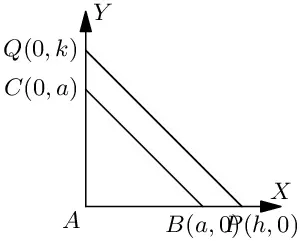
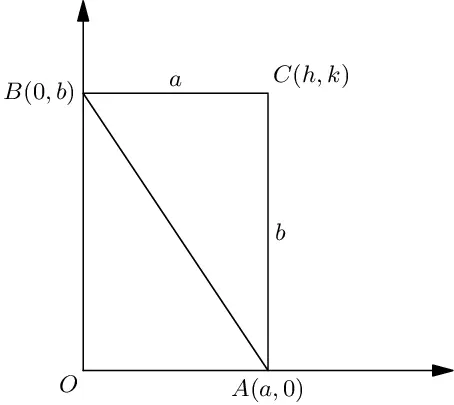
Since the intercept and angle with -axis is given, therefore, we can represent this line
using slope intercept form i.e. .
and . Therefore, the required equation is .
Let the interecepts be for the two axes. So we can represent the line as . Since it passes through .
Thus, the required equation is .
Let the required straight line be , which will meet the axes
at and .
The coordinate of the point dividing the line joining these points in the ratio is
and i.e. and
.
Thus, and .
Thus, the required equationis .
Comparing the equation with we have
Dividing the given equation by gives us
.
The equation of straight in two-point form is given by
So the equation becomes .
Since the intercept and slope is given we can represent it as . Given that and .
Therefore, the required equation is .
Since the intercept and slope is given we can represent it as . Given that . Since the line is equally inclined to the axes so angle of inclination is .
Thus, , and thus, the required equation is .
Since the intercept and slope is given we can represent it as . Given that . Since the line is inclined at to so .
Thus, required equation is .
Since the intercept and slope is given we can represent it as . Given that . Since the line is inclined at an angle , therefore .
Thus, required equation is .
Since intercepts are given so we can use the intercept form i.e. . Given that ande .
Therefore, the equation of the line is .
Since intercepts are given so we can use the intercept form i.e. . Given that and .
Therefore, the equation of the line is .
Let the intercept be on both the axes. Then the equation of the line would be
. Since the line passes through , therefore, . And thus, the equation of the straight line is .
In the second case let the intercepts be . Then the equation would be . Since the line passes through ,
therefore, . And thus, equation of the straight line would be .
First let the intercepts be , then the equation of the line would be . Since the line passes theough , therefore,
. And thus, the equation fo the straight line is or .
Now let the intercepts be , then . So, the equation
would be .
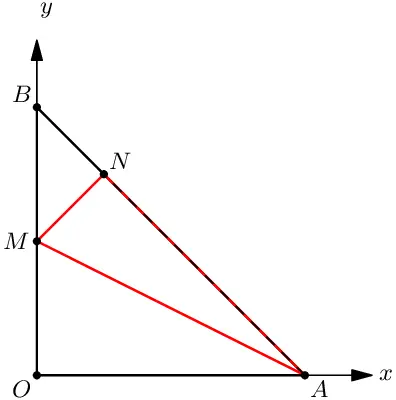
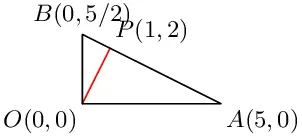
Let are the intercepts with -axis and -axis respectively. Since
bisects it therefore , and
similarly, . The equation of line would be .
And thus, the required equation of the line in question is .
Let are the intercepts with -axis and -axis respectively. Since
divides the intercept in the ratio , therefore, and .
And thus equation of line is .
We will make use of two point form. The equation of the line is given by
.
We will make use of two point form. The equation of the line is given by
.
We will make use of two point form. The equation of the line is given by
.
This problem can be solved with intercept form. Intercept on -axis is and on
-axis is . Thus, equation of the line is .
We will make use of two point form. The equation of the line is given by
.
The equation of the given line is given by
.
The equation of the given line is given by
.
The equation of the line is given by
.
The equation of the line is given by
.
The equation of the line is given by
Now
Simplifying gives us the equation of the line as
.
Let the vertices of the triangle be and .
We find the equations of the sides and .
Slope of
Equation of so
Slope of
Equation of so
Slope of
Equation of so
Hence, the equations of the sides are: and
Let the vertices of the triangle be and .
We find the equations of the sides and .
Slope of
Equation of so
Slope of
Equation of so
Slope of
Equation of so
Hence, the equations of the sides are: , and .
Intersection of will give the point and opposite to it will be
intersection of the lines and i.e. . Equation of
this diagonal would be .
Intersection of will give the point and opposite to it will
be intersection of the lines and i.e. . Equation of
this diagonal would be , simplification of which is left to
you.
Point which bisects the distance between and is given by
, and point which bisects the distance between
and is given by .
The equation of the line passing through these points obtained is given by
.
Intercepts of the line are and . The points
which trisect these lines are and
i.e. and .
Line passing through origin and is , and line passing through origin and
is .
Slope of the line
Intercept on -axis is . Therefore, the equation of the line is .
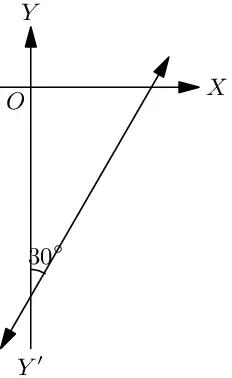
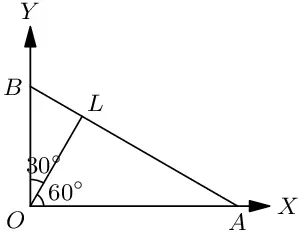
From the diagram it is clear that angle made with positive direction of -axis is
. Thus, slope of the line is , and the
intercept with -axis is .
Thus, equation of the line is .
Given that , which is slope
of the line. Thus, the equation of the line is given by
.
Equation of the line is given by .
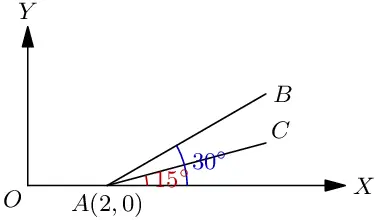
Given , and is the initial position, and is the final
position after rotation.
Given , and
Slope of line
Therefore, equation of line is .
Let be the internal bisector of the which meets the side
at .
Now , and
Since is the internal bisector, therefore,
Now equation of is .
Let be a rectangle such that and . Clearly,
vertices and lie on the line . Let them be
and .
Since and bisect each other, therefore, their middle-points will be same.
Thus, .
Also,
or . So the other vertices are
and . Let represent and
represent .
Equation of side is .
Equation of side is .
Equation of side is .
Equation of side is .
Equation of Slope of and it passes through .
Thus, equation is .
Equation of Slope of and it passes through .
Thus, equation is .
Equation of Given .
Also, slope of the line is .
Thus, equation is .
Equation of Given .
Slope of line .
Thus, equation is .
Equation of . Slope of line .
Thus, equation is .
Equation of and .
Thus, equation is .
Let and meet at . We take as origin. Let the
coordinates of points and be and respectively.
Let divide in the ratio i.e. then
Also, equation of line is
Since lies on , therefore,
Similarly, , and
Thus, .
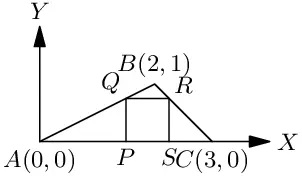
Let be the square inscribed in the . Let and
length of each side of the square be then .
Equation of the line is .
Equation of the line is .
Since lies on , therefore, .
Again lies on , therefore, .
Hence, and .
Equation of the given line is ,
which is of the form .
Slope of the line is . Thus, the given line makes an angle of
with the -axis.
Since slope and intercept are given, therefore, slope-intercept form can be used. Given that , therefore, equation of the straight line is .
Since slope and intercept are given, therefore, slope-intercept form can be used. Given that
, and .
Therefore, the equation of the line is .
Since slope and intercept are given, therefore, slope-intercept form can be used. Given that
and
Therefore, the equation of the line is .
Since the line is parallel to -axis, therefore, it will make an angle of
with -axis i.e. . Also, since its distance from
-axis is units, therefore, the intercept on -axis is ,
which makes intercept .
Thus, equation of the line would be .
Since it is not given that intercept is from positive or negative direction of -axis,
therefore, the other line would be .
Since the line is parallel to -axis therefore the equation would be , where
is the intercept on -axis, which is given as . Therefore, the
equation of the line is .
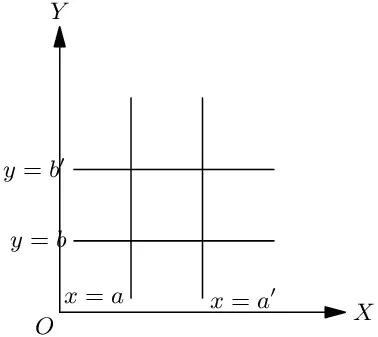
Lines parallel and perpendicular to -axis are given by and ,
where and are distance of the line from the -axis and
-axis respectively.
Since these lines pass through , therefore, and are the
desired equations of the straight lines.
Since the line makes an angle of with positive direction of the -axis,
therefore, it makes an angle of with positive direction of the
-axis. Thus, slope of the line is .
Also give that it cuts an intercept of from positive direction of the -axis,
which means that it passes through .
Thus, equation of the straight line would be .
Since the slope is and the line cuts an intercept of on -axis
i.e. it passes through the equation of the line would be
.
Since the line makes an angle of with the positive direction of the
-axis, therefore, it would make an angle of with the positive direction
of -axis. Therefore, the slope of the line is .
Also given that the line passes through , thus the equation of the line would be
.
Slope is given by .
The equation of the line would be .
The equation of the line is given by
.
The equation of the straight line is given by .
Equation of the straight line passing through and is given by
.
Now we put in this equation which gives us , which is
true. Thus, the point also lies on the same line making the points collinear. We
could have found the equation between and which would also give
the same equation.
Another way would be finding the area of the triangle whose vertices are the given three points and
we will find that area of the triangle is zero; making the points collinear.
Line passing through and is given by
Now also lies on this point, therefore, it should satisfy the above
equation.
Thus, .
Thus, the equation of the line becomes , which clearly passes
through the origin.
The equation of the straight line which passes through and is given
by
.
For the points to be collinear has to be on this line. Thus,
.
The equation of the straight line which passes through and
is given by
.
If the line passes through then it would satisfy the obtained equation of the
line. Putting the point in the obtained equation we have
, which is true. Hence, proved.
Point dividing the line segment joining the points and externally
in the ratio is given by
.
The equation of the line passing through and is given by
.
The equation of is given by .
The vertex is and median passing through it will bisect
i.e. it will pass through the point .
Thus, equation of the median is given by
.
The mid-point of and is . The equation of the median passing through and
is given by
.
The mid-point of and is . The equation of the median passing through and
is given by
.
The mid-point of and is . The equation of the median
passing through and is given by
.
Let the line segment joining and be divided by the line in the ratio .
Using the section formula, the point of division is .
Since lies on , substitute:
Hence, the line divides the segment externally in the ratio , i.e.
externally.
Let and . Let the line through and
divide in the ratio at point .
Point .
Slope of line through and is .
Equation of this line: .
Substituting
Simplifying LHS:
RHS:
So, .
Hence, the line divides the segment internally in the ratio .
Let mid-point of is then .
Equation of is given by
Equation of is given by
The point of intersection of two obtained equations is given by .
Let this point divide in the ratio of , then
. Thus ratio is .
The equation of the the line can be written as . Comparing it will gives us and .
Thus, slope of the line . Thus, the line makes an angle of
with the positive direction of the -axis.
tells us that the intercept on -axis is in positive direction.
Let the equation of the line be .
It is given that which makes the equation of the line .
Since it passes through , therefore, , which
makes the equation .
Let the equation of the line is so the point on
-axis where this line meets is and on -axis it is .
Given that divdes the line segment joining and in
the ratio of , therefore,
and
Thus, equation of the line is .
The line can be written as so the
intercept of -axis is and the intercept on -axis is .
Thus, according to the question the required line makes an intercept of on
-axis and on -axis. Thus, the required line is
.
can be written as . Thus, intercept on -axis is and on -axis is
.
Let the equation of the line be , but since the line passes through origin .
Now mid-point of the intercept is given by . Putting this point in the line
, which makes the line .
Given line is . Let this line cut
and axes at and respectively. Then
and .
Let and be the points which trisect such that and
and
Equation of the line passing through origin and is given by .
Equation of the line passing through origin and is given by .
Let the line be , which will cut intercepts and
. According to question
, where is a constant. Thus,
, which passes through the point
.
Let be a right angles isosceles triangle in which . We take
as the origin and and as and axes respectively. Let
.
Also, let . The equation of the line is
Given that , which shows that passes through the point .
Given that and the equation of the line .
The line will cut the axes at and . Given that , where is the origin.
Since the line passes through , therefore
, which is a quadratic equation in
. However, is real, therefore
Thus, the least value of is .
The equation of the line will be given by
Now and
So the equation of the line is .
Slope is given as so if then
can lie in first or third quadrant. Thus, and
.
Equation of the line will be
or .
We can treat this place as origin, east direction as -axis and north direction as
-axis. Then the angle made by perpendicular from the place to the line will be
as the direction of the canal is north-east.
Thus, equation for this canal would be .
The coordinate of the village is given by ; putting this in the equation for the
canal gives us
, which is false. Hence, the village does not lie on the canal.
Let the reuired line be and is perpendicular from the origin to
. According to the question makes an angle of with
-axis i.e. it will make an angle of with -axis.
Let , so the equation of the line will be .
Intercept on -axis is and intercept on -axis is
.
Also given that
Thus, equation of the line is .
Given and
, and
Let be perpendicular to . , therefore,
equation of will be
Also, equation of will be
and
Thus, equation of is .
Given equation is , which will meet and axes at and .
The equation can be rewritten as , which is the equation in normal form.
The length of perpendicular on this line from origin is and it makes an angle of
with the -axis.
Let the equation of a line in intercept form be .
Since it passes through , we have: .
Given , so .
Substitute into the first equation: .
Multiplying by
Solving: . So, or .
Then gives: If , then . If , then
.
Thus, the required lines are: and .
Let be and be , then the equation of line will
be given by .
Since it passes through , therefore,
Also given that
Putting the value of from above we get and
Thus, equation of the line is .
Let be abd be , then the equation of line will
be given by .
Since it passes through , therefore,
Also given that
Putting and solving gives us and
Thus, equation of the line is .
Given line is . Thus,
intercepts on axes are and respectively.
Double of these intercepts is and . Thus, equation of line which makes these
intercepts is
.
Given line is . Thus, points of
interception are and . Midpoint of intercepted portion will be
.
The required line also passes through , hence in two-point form equation of the line
will be
.
The given line is , thus points of
interception are and .
Let the points be and which divide the intercepted points
in the ratio of and respectively.
Thus, and .
Since these lines also pass through origin so the equations are given by and .
Equation of the line in two-point form is given by
Putting in the obtained equation for the line , which is
true, so all points lie on the line .
Thus, intercepts on the axes are and and
intercepts between the axes is .
Equation of the line in two-point form is given by .
Thus, intercepts on the axes are and respectively.
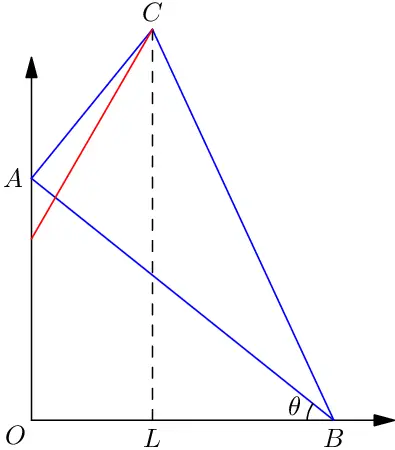
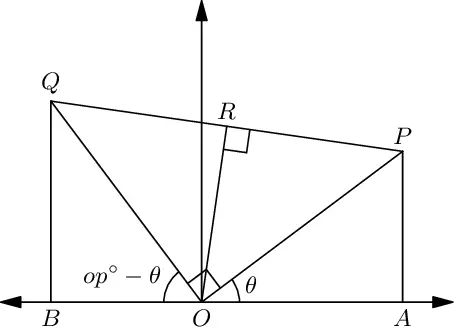
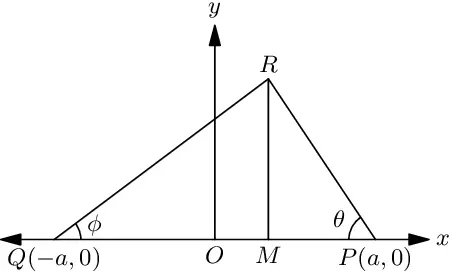
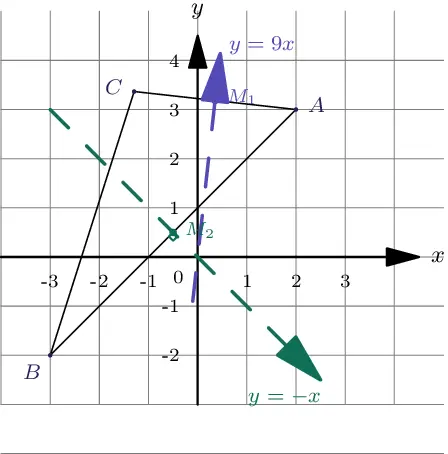
There are two possibilities as shown in the diagram because length is a scalar quantity.
Since the line makes an angle of with positive direction of -axis so it
will make an angle of with positive direction of -axis.
Thus, angle made by perpendicular with -axis would be or
with positive direction of -axis.
Thus, equation of the line is and .
Thus, lines are given by .
Since the perpendicular makes an angle with positive direction of -axis with
it will make an angle of with positive direction of
-axis. Also, given that length of the perpendicular from origin is . Therefore,
the equation in normal form is given by
.
The equation of the line in normal form is given by
.
Given that where is the angle made by the
perpendicular with the positive direction of -axis. Thus, can also be
i.e. in third quadrant.
and the equation in
normal form will be
.
The equation of the line joining the points and is given by
, which can be written as
.
Thus, intercepts on axes are and .
.
Let and let the required line make an angle with the positive
direction of -axis.
Given .
So the equation of the line is .
Coordinates of the points which are at a distance of units from are or .
Let . Let be the given line .
Let the line through makes an angle with the -axis cuts the line
at and at a distance from
. Then
Since lies on the line therefore
.
Given line is and . Let the line through
making an angle of with the -axis meet the libe at
. Let , then
However, lies on the given line, therefore,
.
Let . We know that the coordinates of points on the line making an angle
with the positive direction of -axis at a distance from a point
are .
Thus, required coordinates are
i.e. and .
Given and . Slope of the line .
Thus, slope of the line
Therefore, equation of the line is .
Thus, .
Let and then ,
which is mid-point of and .
Slope of , therefore, slope of because diagonals of a square are perpendicular to each other.
Thus, is an obtuse angle. and
Also, , therefore,
Thus, coordinates of and are
i.e. and .
Let the line through making an angle with the positive direction at
-axis. Let and .
. Since lies on , therefore,
Also, . Since lies on the line , therefore,
Again and lies on the line , therefore,
.
Hence, are in H.P.
Let be the square whose center is . Now and slope of
and
Coordinates of the points of which are at a distance
from will be
i.e. and . Thus, .
But . So slope of (say)
or
and or
and
Since and are on at a distance from ,
their coordinates(in some order) will be
i.e. .
Let be the internal bisector of then
Thus,
Let the equation of the line be , then we observe that
and lie on this line. Therefore
and
Eliminating gives us
.
The required points are
i.e. and .
The equation of the line passing through and slope is given by .
Putting in the given equation and .
Distance between and is
.
Let the line through inclined at angle with the -axis
have slope . Its equation is .
Rewriting, .
The given line is .
If is the intersection point, the distance measured along the direction
making angle with the -axis is .
Give that the line makes an angle of with positive direction of -axis
and rotated in anticlockwise direction so the line will now make
with the positive direction of -axis.
Thus, slope of the line is . Also, the line passes through
so the equation of line is
.
Given the line . Substitute into the equation: .
So the point of rotation is . Slope .
After rotation by , the new slope is: .
Using the identity: , we get:
.
Using point-slope form: .
The given line is . The line is translated by units in the direction
of increasing . So replace with :
.
Now the shifted line cuts the -axis at (): . So the pivot
point is .
From , so slope .
Angle of inclination satisfies .
After clockwise rotation by , new angle is .
New slope:
.
. So, .
Using point-slope form with point
.
Let the regular hexagon be with side length , and as origin
. Given lies along the -axis and along the
-axis.
Since along -axis:
Since along -axis:
In a regular hexagon, each interior angle is , so directions change by
.
Direction makes with .
Equation of and ,
For and ,
Equation of
For and
.
Let the place be the origin . The road is at a perpendicular distance
from , and the shortest distance is in the direction, i.e.,
along a line making with the axes.
So the normal to the road has slope , hence the road has slope .
Thus, equation of the road is of form:
Distance from origin to this line:
Given distance is
Since direction is , take positive value:
So road equation:
(i) Check point . So, village lies on the road.
(ii) Check point So, village does not lie on the road.
Given line: so slope
Point of rotation (on -axis): so
Angle of inclination:
After clockwise rotation by : new angle
New slope:
Equation using point-slope form at .
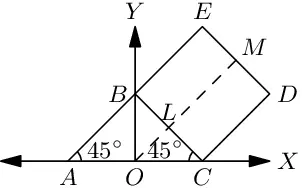
The diagram is smae as problem 77. is units therefore
units. From the diagram we see that extended makes an angle of with
-axis.
Slope: . Equation is intercept form: .
will have same slope but passes through . Equation in slope-point form:
.
The midpoint is
Slope:
A line perpendicular to this will have slope equal to the negative reciprocal of , which
is .
Let the required point be . Since it lies on the perpendicular line passing through
, its equation is:
Also, the distance from to is , so:
. Substitute :
Then gives:
Since the shift is in the sense of increasing , we take the positive value:
The given line is , i.e. .
So, the slope of the line is . A direction along this line can be taken as .
Now, its length is
So, the unit direction along the line is
Since the translation is in the first quadrant, both coordinates increase.
Add this to the point :
New point .
We are given and the line .
Let the required point be . Since the translation is parallel to the line, the
slope of the line joining and must be equal to the slope of .
Rewrite the line: , so slope .
Hence, .
Now use the distance condition: Distance between and is
.
So, .
Substitute .
So, . Then, .
Thus the two possible points are: and
.
Both particles start from . First particle moves along the line .
Rewrite: , so slope .
Let its new position be . Since it moves towards increasing , we take
direction where increases.
Using slope condition: .
Distance moved is , so .
Substitute .
So, . Then .
Since must increase from m we take , hence .
So first particle's position: .
Second particle moves along . Rewrite: , so slope
.
Let position be .
Slope: .
Distance moved is , so .
Substitute .
.
So, multiply by .
. Then .
Since increases from , take , so .
Thus, second particle's position: .
Distance between the two new positions:
.
We are given fixed point and the other end . Let the new position
of after stretching be .
Since the string remains straight, points , and are collinear.
Slope of .
So equation of line through .
Length of .
Since the string is stretched to triple its length, .
Thus, .
Substitute .
So, or . Then : If . If
Now, since the string is stretched beyond , the point lies in the same
direction from as .
From to , decreases and increases, so we
choose .
On -axis, . So . Given .
Slope of is . So line is
The line is rotated anticlockwise by about .
Angle between original line and new line is . So the new angle will be
i.e. line is parallel to and passes through so new line is
parallel to -axis i.e. .
After rotation, lies on .
Distance .
So: . Since
Since rotation is anticlockwise from slope , the point moves upward from . So
:
.
Put in floor equation: . So impact point is
.
The floor is a straight line, so we use the property: Angle of incidence = angle of reflection.
Incoming path is vertical, so it makes an angle of with the x-axis.
Now find slope of floor: . So slope of floor is
.
A line perpendicular to floor has slope .
Since incidence is vertical, we consider how a vertical direction reflects across a line of slope
.
The reflected direction must satisfy symmetry about the floor, so we construct it geometrically
using slope relation:
If one direction is vertical, the reflected direction must make equal angle with the floor on the
other side. This gives the new slope:
. So rebound path passes through with slope
.
Equation of rebound path:
Height fallen
Rebound height So maximum after rebound:
Substitute into line:
Since motion is constrained by slanted floor , the actual highest point must also
satisfy proportional displacement along the reflected line segment above the floor.
Scaling the displacement from in ratio consistent with the rebound
rule along the oblique direction gives:
.
Line parallel to through is:
Substitute
So line is .
Let a point on it be and distance from be
From line: . Substitute:
. So or
For
For
We measure distance from to the line along a direction
parallel to .
So we move from along a line parallel to until we meet .
A line parallel to has form:
Through
So required line through is:
Now find intersection with .
From
Substitute:
Then:
So intersection point is .
Now distance .
We measure the distance from to the line along a direction
parallel to .
A line parallel to is:
Through . So .
Hence required line through is:
Now find its intersection with .
From
Substitute into
Then: . So intersection point is .
Now distance .
Let and be opposite vertices of a rectangle.
Midpoint of diagonal: . So centre
is .
Let other vertices be and on line .
Since diagonals bisect each other, and are symmetric about .
So if is on the line, then is also on it.
For . For
Substitute
So line is . Let , then so .
The other two vertices must lie on this line and must be symmetric about the
midpoint .
So if we pick any point on the line, its opposite vertex is automatically fixed by
midpoint symmetry:
Now both and will always satisfy the line equation, so we are free to choose
any value of that makes calculations simple.
We chose because it avoids fractions and gives:
So is an easy clean point on the line, and then: .
Thus, .
Let the line through make an angle with the
-axis. Its parametric form is:
, where is the distance measured along the
line.
Substitute into :
Solve for
Since length is absolute value of displacement: Length
Length .
Let the required line through be
Parametric form: . So at .
Intersection with
Intersection with
Since A and B lie on the same side of
Scale factor along the line is
Harmonic mean condition:
, where
Sum:
. Substitute :
Solve:
Required line: .
Any point on the line is . Let and .
Then and
and
Given that
. So the possible lines are .
Let the line through making angle with the positive -axis
be
Substitute into
.
The midpoint of is .
So, the equation of the median from is the line passing through and
:
Using linearity of determinants:
.
Slope of is and slope of is .
If is the acute angle between them then .
So the acute angle between them is and obtuse angle is .
Slope of is . Slope of the line passing through
and is .
If is the acute angle between them then .
So the acute angle between them is and obtuse angle is .
Slope of is and slope of the line is .
Since the lines are perpendicular so .
Let and be the three vertices of a
. Let and represent the mid-points of the sides
and respectively.
and
Slope of line
Slope of line .
Slope of . Slope of .
Since , therefore, .
Since the trapezium is isosceles, therefore, .
Slope of the given lines are and
respectively.
If angle between first and third line is then .
If angle between second and third line is then .
Since both the angles are same we have an isosceles triangle. Let be the vertical
angle.
Then
.
Slope of is and slope of the line is is
. Thus, angle between the two lines is .
Equation of the line whose intercepts are is given by and has a slope of .
Equation of the line whose intercepts are is given by and has a slope of
The angle is given by then .
Slope of the line is and slop of
the line is .
Clearly, , and thus, the two lines are perpendicular to each other.
Slope of the line joining and is .
Slope of the line joining and is .
Clearly, , and thus, the two lines are perpendicular to each other.
Slope of the line joining and is .
Slope of the line is .
Given that lines are perpendicular to each other therefore
.
Both the lines have the same slope of , thus lines are parallel to each other.
Slope of the line is .
Slope of the line is . Clearly, product of the slopes is
i.e. lines are perpendicular to each other.
Slope of the line is .
Slope of the line is .
Because the lines are parallel the slopes will be equal. .
First and third lines have same slope, and, second and fourth lines have same slope. Thus, they will
form a parallelogram.
Slope of the line is .
Slope of the line is .
Since the lines are perpendicular .
Slope of the line is . Slope
of the line is .
Since the lines are perpendicular .
Thus, equation of the first line becomes .
Let . (You can get these
points by rotating the line moving by a distance along that line)
Midpoint of
Slope of
Since , the line is vertical.
A vertical line is perpendicular to a horizontal line . Hence .
Place the rhombus with vertices for .
Each side has length , and by
symmetry all four sides are equal, confirming is a rhombus.
The diagonal runs from to , so its slope is
.
The diagonal runs from to , so it is a vertical line
with undefined slope, meaning it is parallel to the -axis.
A line with slope is horizontal, and a vertical line is perpendicular to every horizontal
line. Therefore .
Equation of the line parallel to the given line is . Also, given that this
passes through ; putting the point in the equation
.
Thus, equation of the required line is .
The line perpendicular to the line is given by .
Given that it passes through ; putting this point in the equation
.
Thus, equation of the required line is .
Since the intercept is on -axis, therefore, the line passes through
. Also lines perpendicular to the line
is given by
. Putting gives us .
Thus, required line is .
Mid-point of and is . Equation
of the line passing though these two points is
.
Line perpendicular to this wll be , which passes through the mid-point. Thus,
.
Thus, equation of the line is .
Given line is , which cuts the and axes at and
respectively. and .
Let , then .
Since line is perpendicular to and it passes through , therefore,
This line cuts the -axis at . THus,
.
Thus, and
Thus, but if then lies outside of . Thus, .
Slope of the line is . Let the slope of the required line is
then
.
Slope of the given line is . Let be the slope of the line passing
through and making an angle of with the line.
.
Thus, equations of required line are and i.e. and .
Given line is , its slope, .
Let the slope of the line which makes an angle of with this line be ,
then
.
Thus, equation of two other sides of the triangle are
and .
Given that equation of is and the equation of is
.
Since , therefore, (say)
Slope of the line and slope of . Let slope of .
Thus,
Thus, equation of is .
Equation of line through is given by . This line cuts the given lines at and respectively. Solving the
equations gives
and
According to question .
.
When both sides become tend to i.e. line may be
perpendicular to -axis.
Thus, equations of the required lines are and .
The line parallel to is given by . Since it passes through
, therefore,
. Hence, equation of the required line becomes .
The line parallel to is given by . Since it passes through
, therefore,
. Hence, equation of the required line becomes .
Equation of the straight line parallel to is given by . It passes through the mid-point of the line segment made by and i.e. .
Thus, . Hence, the equation of the required line is
.
Euation of the line joining the points and is given by
A line parallel to above line wil be . Since it passes through ,
therefore,
. So the required line becomes .
Equation of the line parallel to the line is given by .
Since it passes through , therefore, .
Thus, equation of required line is .
Equation of the line perpendicular to the line is . Since it passes through , therefore,
. So the required line is .
Any line perpendicular to the given line is . Since it passing through
, therefore,
. Thus, required line is .
Slope of the first line is x, and the slope of the second
line is .
Let be the angle between these lines then
.
Any line perpendicular to the line is given by
, however, the line passes through , therefore,
Thus, the given line becomes .
Any line perpendicular to the line is
given by . Since this new line passes
through , therefore,
. Thus, equation of
the new line becomes
.
Let the parallelogram be .
Let the equations of sides and of the parallelogram be
and . Solving these equations gives .
Equation of one of the diagonals of the parallelogram is , which does not pass
through so it must be the diagonal .
Solving and and and gives us and .
Thus, mid-point of diagonals is . Thus, equation of
the other diagonal which passes through and is .
Solving the three equations pairwise gives us three coordinates
and .
Putting these points in the formula for area of triangle gives us
.
Let the three lines be and whose equations are and .
Let the lines and meet -axis at and
respectively. From figure
Proceeding like previous problem we have the required result.
Let be the point of intersection of first two equations,
that of second and third, and that of first and last equations.
satisfied the above equation and also and
Let
Thus, eliminating from these equations gives us
, where
is cofactor of . Similarly, and
Thus, area of the required triangle is
The equation of any line with gradient is given by . This line will
intersect with given lines at and .
Clearly, is the middle point of . Thus, intercepts are equal.
Let be the foot of the perpendicular. Then . Also, line
perpendicular to it will have the equation .
Since will pass through , therefore, . Also,
will lie on this line so .
Solving the two equations gives us .
Equation of the line mirror is . Let and
be the image of in the line mirror . Then and .
Thus equation of would be . Since it passes through , therefore,
. So the equation of is . Solving
the equations . So the equation of is . Solving the equations .
Since is mirror image of so will be midpoint of . Thus,
.
Slope of and that of .
Since (say)
Like previous problem is the midpoint of i.e. and it also lies on the line , therefore
From previously obtained equation
Thus, .
Given equation of horizontal line is and equation of is .
Solving these two equations gives us .
Let slope of . Slope of horizontal line is and slope of .
Let then .
Thus, . So slope of , and hence, equation of
is given by
.
Since the light travels through the shorted path must be the incident ray and
should be the reflected ray. If be the image of w.r.t. line mirror
, then .
Thus, will be least when will be least i.e. when point are collinear.
Given equation of the line is . Equation of would be
, which passes through so
Solving the two equations gives . Let then
and
Equation of is .
is the refracted ray. According to question, . From given
equations we get .
Slope of , so slope of . Slope of
Let , then .
Let slope of . .
Any line passing through the point of intersection of given lines is given by .
Given that this line passes through , then .
So by putting back in the equaiotn to obtain .
Equation of the line passing through the point of intersection of given lines is
Slope of this line is . Given that this new line is parallel to
Thus, . Putting this
value of in the equation above gives us the required equation as .
Equation of the line passing through the point of intersection of given lines is
Slope of this line is . Given that this new line is perpendicular to
so the new line's slope must be equal to .
Thus, . Putting this
value of in the equation above gives us the required equation as .
Equation of the line passing through the point of intersection of given lines is .
Slope of this line . We know that slope of the lines equally inclined
to axes are .
Equating:
Thus, required lines are and .
Let the equation of line and be and .
Since passes through the orthocenter and is perpendicular to
, therefore, equation of will be
Similarly equation of will be
Solving and gives us and
solving and gives .
Thus, equation of will be .
Let be a parallelogram such that is is is , and is .
Equation of , which passes through the point of intersection of lines
and is
Let , then lies on , therefore,
but and
So the line becomes
.
We can write the given equation as . Clearly, both
and cannot be zero at the same time. Let , then
. This line passes through the point of
intersection of and , i.e. .
Thus, all given straight lines pass through the fixed point .
Given that . Putting this in the equation of line
Clearly, both and both can be zero because in the equation of straight line
coeff. of both and cannot be zero.
Thus, the give equation represents straight lines which passes through the intersection of lines
and i.e. through the point .
Let the point of intersections of the lines be origin then we can represent the equations
as .
Let the variable line be . Solving gives us and
Thus, passes through the fixed point
.
.
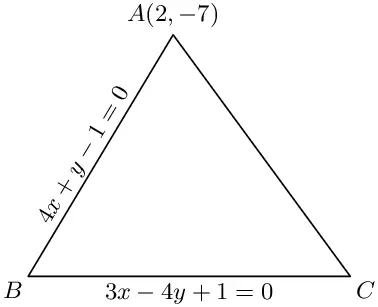
Let be a triangle with vertices and .
The median through will pass through and . The median through will pass through and
. The median through will pass
through and .
Equation of is given by
Similarly we can find the equation of and .We find that sum of equations is
. Thus, medians are concurrent.
By trial we observe that
Thus, first three lines are concurrent. We also see that
.
Thus, last three lines are concurrent making all four lines concurrent.
The lines are concurrent, therefore, , and hence, the three points are
concurrent.
Subtract the first equation from the second equation
Substitute into
So the intersection point is .
Now substituting into the line .
Subtracting yields .
From , we get . Substitute into the second equation,
Then . So the point of intersection is .
Now the line is and it passes through :
Rewrite the line: . So slope
.
Given it is parallel to , whose slope is :
Substitute into the earlier equation: . Then .
Intersection of and
Intersection of and
Intersection of and
Vertices:
Area .
From and
. Substituteing, . Point: .
From and
From second: . Substituting:
. Point: .
From and . Point:
Area .
Intersection points: and give
with gives
with gives
So triangle vertices are , .
Take as base: Base length:
Height . Area
Now are roots of:
Sum: . Product:
Difference:
So area: .
Line perpendicular to is given by . Since
lies on this perpendicular, therefore,
. So the equation of the perpendicular is . This line
intersects with the given line.
Solving both the equation we find the coordinate of the foot of the perpendicular as .
Slope: . Equation using point
Let foot of perpendicular be .
Since is perpendicular to , slope of is , so
slope of is .
Equation of through
Now solve with line
Substitute
.
Line perpendicular to is but it passes through origin so
. Now intersection of and is
.
Line perpendicular to is but it passes through origin so
. Now intersection of the two line is .
Now line passing through these points is given by .
Let be the foot of the perpendicular from to the line.
Since lies on the line:
Slope of given line is . So slope of perpendicular is .
Hence, slope of line joining and is :
. So:
Rearranging (2):
Now multiplying (1) by
Multiplying (1) by
Now solving for and using (3),(4),(5).
Hence:
So dividing: .
Let image of be . Let the foot of perpendicular be from
to the line.
Slope of given line is , so perpendicular slope is .
Equation of perpendicular through
Now solving with give us the foot foot as .
Since is midpoint of and :
.
Let and its image be . The mirror line is the perpendicular
bisector of segment .
Midpoint of is
Slope of is
So slope of mirror line is negative reciprocal is .
Equation of line through with slope is
given by .
The point of intersection of the lines and is . Equation of the line passing through and is given by .
Given that . Putting it in the line .
Equation of the line passing through and is given by .
From first equation,
Then . So intersection point is .
Let required line cut axes at and .
Equation in intercept form is given by
Since it passes through
Area of triangle formed with axes is given by
or
If , then . If , then .
Hence, equations are and
.
Let is . Let is
Substitute into
So and Midpoint of .
So is midpoint of also Let direction of . Let direction
of .
So and
Midpoint condition:
. So and .
Slope of is and slope of is
Equation of is
Equation of is .
From
Substituting into gives us
Now . So intersection point is .
. Substitute gives us
Since it satisfies the third equation, all three lines are concurrent at .
Since the point lies on the -axis, .
Substituting in first line gives us
Substituting in second line gives us
Equating both values of gives us .
Substituting into gives us
Simplifying gives us . Solving gives us so .
Finding gives us
So the point of intersection being obtained is
Substituting into gives us .
Multiplying the first equation by is giving us
Multiplying the second equation by is giving us
Subtracting gives us
. So either or .
If , then at least two constants are already being equal.
If , then .
Substituting into gives us
Simplifying gives us
So is .
Substituting the same point into the third equation gives us a condition
relating
After simplification it gives us
So either or . Therefore, at least two of are equal.
Equating gives us
So is . Finding gives us
The third line also passes through this so
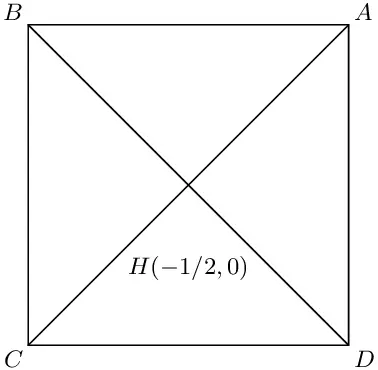
.
Multiplying by gives us
Multiplying by gives us
Subtracting the equations gives us
So either or .
If , then two of the lines are already being identical in structure and concurrency is
satisfied.
Assuming , finding gives us
Substituting into the first equation gives us
Solving for yields
So
Substituting this point into the third equation yields
Multiplying by yields
Simplifying yields an identity equal to zero. So the same point is satisfying all three equations.
We consider a triangle with vertices and .
We take the perpendicular bisector of side . The midpoint of is
and the slope of is
.
So the slope of its perpendicular bisector is .
Hence, the equation of the perpendicular bisector of is
Similarly we form the perpendicular bisector of side . Its midpoint is
and its equation is
Now we solve these two equations simultaneously and obtain a point .
This point satisfies both equations, so it lies on the perpendicular bisectors of
and . Hence it is equidistant from and , and also from
and .
Thusm we get and so we conclude .
This shows that the point also lies on the perpendicular bisector of .
Let be the vertices of a .
Let lie on the perpendicular bisector of , then
This is the perpendicular bisector of
Similarly for ,
The two linear equations intersect at a unique point and that point is equidistant from , and ie.
Therefore, the perpendicular bisectors of a triangle are concurrent.
Given equation is , which can be written as
The above equation represents two lines and to be
concurrent. Solving the two equations we find the fixed point as .
can be rewritten as ,which represents two equations and , which are
concurrent.
Solving the two equation yields the fixed point ,
which is independent of and .
Solving first two equation gives , Solving first and last gives and solving last two gives
If be the centroid then .
Using the formula for the incenter we have .
Let and . Let then
equation is .
Let , then equation of is . Solving the equation
of two perpendiculars we get orthocenter as .
Consider a triangle with sides and .
Solving first and last we get , and solving first two gives us .
Let then equation of is given by , and if
then equation of is given by .
Solving and gives us the orthocenter as .
Let be the given triangle and and . Let
be the orthocenter of the .
Given that . Since passes through and is
perpendicular to the line equation of is . Similarly
equation of is .
Solving the two equations gives us .
Consider a such that is and is
. We also let equation of as .
Clearly, will be .
Since (say)
Coordinates of and are and .
Equation of perpendicular bisectors through and are
and
Thus, coordinates of are
and
Thus,
Thus, equation of is
.
Consider the such that equation of is
and that of is .
Equation of any line passing through these lines is given by . Slope of this line is .
Slope of is . Let be the perpendicular through
on , then .
Thus, equation of is .
Let the equations of the sides and of the are
and .
Let and are perpendiculars through and on opposite
sides.
Equation of is given by
Slope of is
Slope of is . Product of these two slopes
would be .
Thus, equation of becomes
And we proceed similarly for another perpendiculars to obtain the desired equation.
from and
from and
from and
Centroid is
Length of the sides are,
Incenter is .
Let .
, and
Consider
Thus,
We know that if is acute if and obtuse if and for right angle should be equal to zero.
Given lines are , and
Let be the intersection of and be the intersection of
and be the intersection of and , and be
the intersection of and .
Intersection of and is and
From , we get is
Similarly we find that other points are , and
We find the slopes as , and
Now we check angle relations using:
We find that . Hence, the quadrilateral is cyclic.
Let the four sides of the quadrilateral taken in order be , and .
Let the vertices be
A quadrilateral is cyclic iff opposite angles are supplementary i.e.
For a line , slope is
Angle between two lines and is
For cyclic quadrilateral,
.
Show that the lines and cut the coordinate axes
in concyclic points.
Let the given lines be , and .
For -intercept: put . So is
-intercept: put . So
is
Similarly we find and for as and
Now we check concyclicity using the condition that four points are concyclic if the angle subtended
by the same chord is equal.
Consider chord on the -axis.
Slope of is
Slope of is
So angle at is angle between lines with slopes and
.
Now slope of is
Slope of is
So angle at is angle between slopes and .
Now compute angle between two lines using:
For angle at is
For angle at is
Thus . Since equal angles subtend the same chord, the four points are
concyclic.
Let be a vertex of triangle .
is altitude from , so slope of is
. Equation of through is
is altitude from , so slope of is
.
Equation of through is
We find as intersection of and altitude
. So
is .
Similarly is
Equation of is
So the sides are: , and .
Equation of the line perpendiculars to is given by . This
will make an intercept of with -axis, and an intercept of
with -axis.
Thus, area of triangle, which is given as , is .
So the equation of the line is .
Clearly, and as given line is .
We rewrite the line as , so the slope of is
.
A perpendicular line has slope , so we form the line through as
.
Now we find point by setting , so . Thus .
We find point by setting , so .
Now we find point by solving intersection of and .
Thus, , and . So .
We compute the area by splitting the quadrilateral into two triangles and
.
We first compute the area of triangle . Since , we use the
determinant shortcut: .
.
.
Since the square is centered at the origin, we generate the remaining vertices by rotating the point
by repeatedly about the origin.
We rotate counterclockwise by using the rule .
So we obtain , and .
We first take line . We compute its slope as .
So we write and simplify it to .
Similarly we find remaining sides to be , and .
We first find the slope of as .
Since is perpendicular to , we take the slope of as
.
So the line passes through and we write x, which simplifies to , hence .
We note that the altitude in an equilateral triangle satisfies .
We compute the altitude as .
So the side length is .
Since lies on , we take direction vector of as
with magnitude , so the unit direction is .
Half the side length is .
So we move from to and using this direction
.
Therefore, and .
Now we find line using points and i.e. where .
Similarly we can find other sides.
We have one side so its slope is . In an equilateral triangle, the
angle between sides is . Hence slopes of the other sides satisfy
So or .
Using the given vertex and slope
Simplifying
So second side is .
For the third side take slope
.
We have diagonal so its slope is . Hence the other
diagonal has slope .
In a square, diagonals bisect at right angles. Let the center be on .
Since is a vertex, the midpoint lies on the line through with slope
Solving with gives .
Slope of side is perpendicular to diagonal slope , so slope of side is
or rotated by . Thus, side slopes are
and .
Through gives and
gives .
gives slope . gives slope
Let required line have slope . For equal angles
Solving gives or .
Since these lines pass through , therefore, gives and gives .
The two given lines are and . Solving them together
gives and , so , which gives and . Thus the vertex of the triangle is .
The angle bisectors are found from . Solving gives
the two bisectors and .
The internal bisector is , whose slope is . The base is
perpendicular to this bisector, so its slope is .
Since the base passes through , its equation is . Simplifying gives , hence the required equation is .
The three lines are , and
.
The intersection point of the first two lines is obtained by solving and . Using determinants, this gives and .
Similarly, the other two vertices are obtained by cyclic permutation of and .
The area of the triangle formed by three lines is given by .
Substituting the coordinates of the three intersection points and simplifying using the identity
, the expression is reduced.
The numerator becomes and the denominator becomes .
Thus, the area is .
The line passes through and , so its slope is . Hence its equation is , which simplifies to
.
A line perpendicular to has slope . Passing through , its equation is , so .
The three lines are , and .
The intersection of and is . The intersection of
and is .
The intersection of and is found by solving , which gives , so and
.
Thus, the vertices of the triangle are , and
.
The base along the -axis has length , and the perpendicular distance of
from the -axis is .
Hence, the area is .
The vertices of the triangle are , and , and the given point
is .
The side has equation . The foot of the perpendicular from to this line is clearly .
The side passes through and , so its slope is . Hence, its equation is , or .
The foot of the perpendicular from to is given by
and .
Since , this gives and , so the foot is .
The side passes through and , so its slope is
. Its equation is , or .
The foot of the perpendicular from to is and .
Since , this gives and , so the foot is .
Thus, the three feet are , and .
To check collinearity, the slope between and is , and the slope between and is , so the points lie on a straight line.
The equation of the line through with slope is , which simplifies to .
The line is , which can be written as .
The foot of the perpendicular from the origin to the line
is given by and .
Thus, and .
Now .
Also .
Thus .
Further .
Hence, .
Thus, .
The given lines are , and .
The vertices of the quadrilateral are obtained by pairwise intersections. The origin
is one vertex. The intersection of and is . The
intersection of and is found by subtracting the equations,
giving , so and . The intersection
of and is .
Thus, the quadrilateral has vertices ,
and .
The diagonal through the origin connects and the opposite vertex
.
The slope of this diagonal is , so its
equation is , or .
The given points are , and
. The points are the feet of the perpendiculars from respectively.
Since is perpendicular to , the slope of is the negative
reciprocal of the slope of . The slope of is , so the slope of is .
Thus, the equation of passing through
is .
Now lies on and is perpendicular to . The slope
of is , so the slope of is
.
Thus, the equation of is , or .
The point lies on both and . Solving and gives and . Hence .
Now lies on and is perpendicular to . The slope
of is , so the slope of is
.
Thus, the equation of is .
The point lies on both and . Solving and gives and . Hence .
Thus, the required vertices are and .
The lines are for , and the transversal is .
The point of intersection of the line with is obtained
by substituting into the line, giving . This
simplifies to , so and .
Thus, the three points of intersection correspond to parameters on the line
.
The intercept cut off between two such points along the transversal is proportional to the
difference of their -coordinates, since all points lie on the same straight line.
Hence equal intercepts imply , so .
Substituting , this gives .
For the intercepts to be equal for arbitrary , this condition reduces to , which is needed condition.
The given pair of lines are and .
Let the required line cut these two lines at and respectively, and let the
midpoint of be .
We know that that if a line through midpoint joins intersections with two lines
and , then its equation is for some
constant .
So the required line is which simplifies to .
Since lies on the line, we substitute to get .
This gives .
Substituting back, the equation becomes . So
is the required line.
The line cuts the axes at and . Hence the intercept form is
.
So the ratio of intercepts are on the -axis and on the -axis. Thus, .
Similarly, for , the intercept ratio is .
Since the lines cut the coordinate axes in cyclic points, the intercepts are in cyclic order, which
implies the ratios of corresponding segments satisfy .
Hence . Taking absolute values yields .
The rectangle is inscribed in a circle, so its diagonals are diameters of the circle.
The given line , i.e. , is therefore the line
containing one diagonal of the rectangle, so either or lies on this line.
The points are and , so is horizontal since both
points have the same -coordinate. Hence is a side of the rectangle and the
adjacent side is vertical, so the rectangle is axis-aligned.
Thus lies vertically above and lies vertically above , so
we take and for some .
The diagonal lies on the line , so and
satisfy the equation of this line.
Substituting is consistent since is false,
so and cannot both lie on that line. Hence the diagonal is
instead.
So and lie on .
For , the line gives , which is false,
so is not on that diagonal either. Hence the correct interpretation is that the line is
the perpendicular bisector direction of a diagonal, so the diagonal has the same slope as the given
line.
Thus, slope of diagonal is .
Now and lie on a line of slope , so
, giving , hence
and .
So is and is .
The base and the height is .
Hence, the area is .
From the point , rays are drawn making an angle of with the line
.
Slope of the given line: . Using the angle formula:
So, . Solving and
Equations of incident rays:
Reflecting these lines about , we get .
Given ray . Point of incidence lies on -axis so
. Point of incidence is
Slope of incident ray . Reflection from -axis changes slope to
.
Equation of reflected ray is .
Given point is and . Slope of incident ray .
Equation of incident ray
Point of incidence on -axis so
Point of incidence . Reflection from -axis changes slope to .
Equation of reflected ray is .
The point is reflected across the line where , and .
Compute and .
The reflected point is found using and
.
Thus, and , so the
reflected point is .
The incident beam is the line through and .
The slope is .
The equation of the incident beam is , which simplifies to .
The point of incidence is obtained by solving with .
Substitution gives , hence .
Thus, and , so the point of incidence is .
The reflected beam passes through and .
The slope is .
The equation of the reflected beam is .
and . Midpoint is .
Slope is . Perpendicular's slope is
.
Perpendicular bisector's equation is .
Line through parallel to -axis is
Intersection point is given by .
.
Condition for concurrency is
.
From the previous problem it is clear that these lines will be concurrent as the coefficients are
cyclic in nature.
Applying makes the determinant zero. This is the condition
for concurrency of the lines.
,
, and
.
Also from first line , which is the altitude
through .
Given equation is which represents
the following lines passing through a common point and .
Solving both the equations we get the fixed point as .
The line is
and .
The three lines are , and .
Assume that the orthocenter is . The altitude to the line has slope
. This gives
Similarly using other vertices and altitudes we obtain a symmetric system.
Substituting into each line gives , and .
Adding the three expressions
Using identity , .
.
Let the points be , and .
Given , and .
, and
The slope of is
The slope of altitude from is
Equation of altitude from is
Similarly altitude from is
Solving these gives the orthocenter and
Multiplying gives the desired result.
Given and . Let .
Since triangle is equilateral and .
and
Subtracting,
Substituting into first equation
Points are and .
Point away from origin .
In an equilateral triangle orthocenter coincides with centroid .
Given
Rewriting each point , where
Similarly and
Since circumcenter is origin, all vertices lie on a circle centered at origin
So .
Thus, , and
Orthocenter satisfies
So ,
Similarly
Both are equal. Hence, .
We find the point of intersection of first two lines and
Subtracting yields
So . Similarly and .
Slope of is
So altitude from has slope .
Similarly altitude from has slope .
From first , From second
.
Slope of line is . Slope of line is . Slope of line is
.
Vertex opposite first side is intersection of and .
Call this point . Altitude from passes through origin. So line joining
and is perpendicular to side
Slope of line equals slope of line through origin and .
Using property of perpendicular lines . So
Now find slope of . Point satisfies both equations
and
and
Similarly and
Slope of
Since is perpendicular to first side, therefore
Simplifying
Similarly by symmetry .
Let be vertices of a triangle. Let be midpoints of respectively.
So and .
Centroid of triangle
Centroid of triangle ,
Similarly
So centroid of is . Hence. both centroids are same.
Let circumcenter of be . Then, . So is
equidistant from .
Thus, is center of circle passing through .
Since are midpoints, triangle is medial triangle.
Each side of is parallel to corresponding side of .
So .
In medial triangle, each altitude is perpendicular to a side of .
But since sides are parallel to , these altitudes pass through midpoints and are
perpendicular bisectors of .
Thus, altitudes of pass through . So lies on all three altitudes
of .
Hence, is orthocenter of .
Let
Since the circumcenter is the origin, we write the points in polar form about the origin.
So we take , and
Hence, , and
Now orthocenter of a triangle with circumcenter at origin satisfies , and
So , and
Since , we use identities , and
Thus, ,
and
Now considering the expression in the required line
Substituting and :
First term is
Second term is
So the expression becomes
Simplification under , yields
Hence, the orthocenter lies on the line
Let be intersection of and
Let be intersection of and
Let be intersection of and
Let orthocenter be . Then is perpendicular to
So slope condition of perpendicular lines gives that the line through and
satisfies a linear relation obtained by replacing coefficients with in the direction condition.
Similarly, is perpendicular to and is
perpendicular to .
Solving the system of three altitude equations leads to a linear relation between
which is symmetric and reduces to
Hence, the point satisfies the given equation, so the line passes through the
orthocenter of the triangle.
Let and .
For we have and for it is .
Hence, the points lie on opposite side of the line.
Let the two lines be and
Evaluate the position of each point with respect to and .
For so sign is
For so sign is
For so sign is
For so sign is
Thus, the four points lie in four different compartments: .
Hence, the four points are in four different regions formed by the two lines.
We test the origin in each side equation.
For . For . For
So the origin gives signs with respect to .
. Add with
Substituting . So .
. So .
. So
Evaluating sign of origin w.r.t. each side
So origin lies in the region determined by .
Since all three vertices lie on consistent opposite half-planes and the origin satisfies one side
positive and two negative, the origin lies inside the triangle region formed by these lines.
Hence, the origin lies inside the triangle.
Let and . Let the line cut
at in the ratio .
So by section formula
Since lies on the line
Multiplying by
Grouping terms
Hence
The quantities and are signed values.
If the two points lie on opposite sides of the line, these expressions have opposite signs.
Thus their ratio is negative, and the minus sign ensures the ratio remains
positive for internal division.
If both points lie on the same side, the ratio becomes negative, indicating external division.
Hence, the minus sign accounts for the signed nature of the expressions and distinguishes internal
and external division.
Using the directed segment ratio result:
For point on where
Similarly and
where evaluated at point .
So .
Aliter: Let be the origin such that
and . Let .
Let and , where .
and
Since are collinear(they are on the same line ), therefore
. Hence proved.
Let the triangle be equation of whose sides and are
respectively and .
Let cut and axes at and respectively. Then
and .
Let cut x and axes at and respectively. Then
and .
Let cut and axes at and respectively. Then
and .
Clearly, point lies on the -axis. If this point has to be inside the
triangle then .
Let and be consecutive vertices of a rhombus. Given that
two sides are parallel to , so slope is .
So one pair of opposite sides has slope and the other pair has slope
from .
Slope of is .
So side directions are fixed. Equation of side through is .
Equation of side through is .
Distance condition for fourth vertex on line through . Let lie on
Rhombus has .
Substitute
Case 1:
Case 2:
Only the configuration consistent with convex ordering is
and .
For we have and for we have
.
Thus, the points are on opposite sides of the given line.
For we have and for we have
.
Thus, the points are on opposite sides of the given line.
For we have , and for we have
.
Thus, the points are on opposite sides of the given line.
Intersect with . From , we get .
Substitute into yields and . So the first
point is .
Next, intersect with . Again, .
Substitute into . Then . So the second point is .
For point For point
Since one point gives a value less than and the other greater than , the two
points lie on opposite sides of the line .
Length of perpendicular is .
Given lines are and . We solve the equations to get point of
intersection.
.
Substitute into yields .
So the intersection point is .
Equation of the required line with slope is .
Distance from point to this line is .
In an equilateral triangle, the perpendicular distance from the vertex to the base is the altitude,
and it relates to the side length by .
First find the distance from the vertex to the line .
Writing the line as .
Distance is . So the
altitude is .
Now use .
The equation of straight line in the intercept form is .
The length of the perpendicular drawn is .
.
Let be intercept on -axis then intercept on -axis will be
. Thus, equation of the line is
Length of perpendicular .
Hence, the equations are .
Let be any point on the first line. Then .
Distance of from the second line is given by .
Let be the length of perpendiculars from the points and to the line .
.
.
Clearly i.e. length of perpendiculars are in G.P.
Let the tower be at . The towns are at and .
Slope of the road is
Equation of line is
The nearest point on this line from the origin is the foot of perpendicular.
Using formula for foot from to is
. Here .
So, and . Thus, the rest house should be at
.
Let the line be and the fixed points be .
Given
Thus, the line passes through the fixed point .
Let be the wall and be the shadow of the rod on the wall, then
.
Equation of rod is , therefore, equation of is
Length of perpendicular from to .
Length of perpendicular from to
From the question . If then lies
on opposite sides of the rod and the wall, which is not possible. Therefore,
and is .
Equation of is and equation of is
Solving and we have and solving and
we have .
.
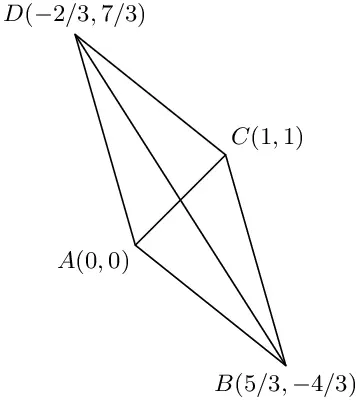
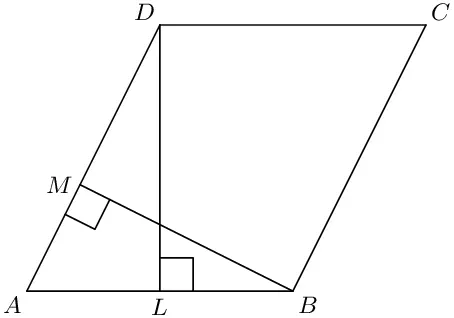
Let be the parallelogram and . Let then from the right angled
From right-angled
For this it is sufficient to show that it is a rhombus i.e. .
.
Let the given straight lines be respectively.
distance between parallel lines and and similarly
Thus, is a rhombus, and hence, the diagonals are perpendicular.
The diagram is same as one given in previous problem. Let be the given parallelogram
and the given sides are respectively.
and
If is the acute angle between and then
Area of
.
From first line . Substitute in second . Then
So point of intersection is .
Distance is . Substituting
.
Let the given points be and . Slope of is
So equation is
Distance from origin to this line is .
Multiply first by to get . Multiply second by to get
and
Line joining origin and has slope . So equation is
Distance from to this line .
Given line is . Any line parallel to it is .
Distance from point to this line is
So and
Hence required lines are and .
Given line . Let required parallel lines be .
Distance between two parallel lines .
So and or
Hence required lines are and .
Let a line through be . So .
Rewrite in standard form .
Distance from is
or
Case 1: gives
Case 2: gives .
From first . Substitute in second .
So point of intersection is . Let required line be . So
.
Distance from origin is . So
Substitute into line equation .
From first line . Substitute in second line
So the point is . Let required line be
Distance from is ,
or
Case 1: .
Case 2: .
Given that the distance from to the line is .
So
Squaring both sides
Divide throughout by
Rearranging yields .
Given line is
So
Distance from is
For
Product of perpendiculars
.
Given lines are and . Rewrite second line as .
So these are two parallel lines. Distance between parallel lines .
Given lines are and ; all have same
slope.
Write in standard form and .
Distance between parallel lines and is
Distance of from
Distance of from
Hence, both distances are equal, so the lines are equidistant from .
Distance between parallel lines .
Given sides are and .
These are perpendicular since . So they are adjacent sides meeting at
origin.
Area of square is , so side . Distance between each pair of parallel sides is
.
For line , required parallel side is
Distance from origin
So lines are or .
For line , required parallel side is .
Distance from origin
So lines are or .
Taking consistent pair forming a square, the other two sides are
and .
Given lines are , and
is parallel to and is parallel to , so they form
a parallelogram.
Length of one pair of opposite sides equals distance between and
Length of the other pair equals distance between and
Given . So both lengths are equal.
Hence, all sides of parallelogram are equal. Therefore, it is a rhombus.
Given lines are and .
Angle bisectors are given by
Case I:
Case II:
To identify angles, test origin
For . For .
So origin lies between opposite signs, hence lies in one of the angles.
Checking bisectors: For
For
The bisector that preserves sign relation corresponds to angle containing origin.
So angle containing origin is
Hence, acute angle bisector is and obtuse angle bisector is .
Given lines are and .
The locus of points equidistant from and is given by the angle bisectors:
. So we get two bisectors.
Case I:
Case II:
Now observe: The given line is exactly the angle bisector of
and .
We have already proven this in Chapter 1, Section, Incenter of a triangle.
Given triangle sides , and .
. From and
and . So .
and . So .
and . So .
, and
Incenter formula is .
Hence incenter is .
Let the given opposite sides be and .
Distance between the parallel sides is
Let the side length of the rhombus be . Height of rhombus
So
Direction vector of lines is . Unit vector
Vertex is . Adjacent vertex is
So and
Second side makes with first side. Rotating by
gives direction .
So adjacent vertex is and
Opposite vertex is given by
Case I:
Case II:
Sides are parallel to and . So slopes are and
.
Let . Let adjacent vertices be on line through
with slope and on line through with slope
So and
Thus, and
For rhombus, adjacent sides are equal:
Now
Diagonals bisect each other at i.e. Midpoint of is
So
Case I: and
Then
So
Case II: and
Then .
So .
We are given the lines and .
The angle bisectors are given by .
For the given lines, and .
So, .
Since .
Multiplying both sides by .
Case I: .
Case II: .
We want to prove that the line bisects the angle between the lines and .
The equation is
and
So,
Taking plus sign we see that it is the given equation.
Rewrite the given lines in standard form:
Let be any point on .
Distance from first line:
Distance from second line:
Now use the relation .
Then:
Also,
Thus,
and . Hence, .
We are given the lines and .
For a point equidistant from the two lines,
and
So,
Multiply:
Case I:
Case II:
Hence, the locus is or .
The given lines are and .
For we have and so the value is
.
For we have and so the value is
.
The angle bisectors satisfy
After simplification this becomes
First result
Second result
.
This simplifies to .
Taking the negative sign gives .
The slopes of the given lines are and , which form an
obtuse angle. Therefore, the bisector corresponding to the negative sign represents the acute angle.
Hence, the bisector of the acute angle is .
.
Taking the positive case gives .
Taking the negative case givesv .
The slopes of the given lines are and , which form an acute
angle. Therefore, the obtuse angle is the supplementary angle, and its bisector corresponds to the
negative case.
Hence, the equation of the bisector of the obtuse angle is .
The given lines are and .
These two lines divide the plane into four compartments depending on the signs of
and .
Evaluating both expressions at each point.
For and .
For and .
For and .
For and .
Each point gives a distinct sign combination for .
Thus, the four points lie in four different compartments formed by the given lines.
For .
For .
For .
Thus, the origin lies on the negative side of the first line, the positive side of the second line,
and the negative side of the third line.
Now consider a point clearly inside the triangle. Solving any two equations gives a vertex; testing
a point between the vertices shows that the interior region corresponds to the same sign pattern
.
Since the origin produces this same pattern, it lies inside the triangle.
Hence, the origin lies inside the triangle.
These lines are parallel and represent two opposite sides of the square.
The length of the side of the square is equal to the perpendicular distance between the two lines.
Thus, the distance between the lines is
.
So, the side of the square is . Hence, the area of the square is .
The given sides of the square are and .
These two lines are parallel, so they represent opposite sides of the square.
So the side length is .
Since the third side passes through and is perpendicular to the given sides, its
equation has the form .
Substituting gives .
So one side of the square is .
The opposite side is parallel to it and is at a distance equal to the side length .
So the parallel line is .
Using distance formula between and ,
. Thus or .
Since lies on one side, the opposite side is .
Hence, the equations of the remaining two sides are and .
The given side of the rectangle is , and two vertices are
and .
First, observe that the line joining and is , since
both points have the same -coordinate.
So one side of the rectangle lies on .
Now find the distance between the parallel sides and the given line .
Taking any point on , for example , the distance is
.
So the height of the rectangle is .
The length of the rectangle is the distance between and .
Hence, the area of the rectangle is .
One diagonal joins to the opposite vertex. The opposite side to is
parallel to it, so the opposite vertical line is or
.
Since lies on one side, the opposite vertex to is
.
Now find the equation of the diagonal through and .
Slope is .
Equation is .
Hence, the area of the rectangle is and the required diagonal is .
The four lines are , and .
Opposite sides are parallel since each pair differs only in the constant term. Hence the figure
formed is a parallelogram.
Intersect and .
We get and .
Adding gives , so . Substituting gives . Thus one vertex is .
Similarly, other vertices are ,
and .
The diagonals are the lines joining opposite vertices, so they lie along the coordinate axes.
Hence the diagonals are perpendicular, so the parallelogram is a rhombus.
Diagonal 1 has length .
Diagonal 2 has length .
Area of a rhombus is .
So area is .
This simplifies to .
We choose a coordinate system such that the given straight line is the -axis. Then become the signed -coordinates of . So we write , and .
Now we use the formula for the square of the area of a triangle in coordinate form:
.
The second bracket simplifies as follows: .
So we get .
Now consider the squared side lengths using distance formula:
.
Now we expand the required expression:
.
Substitute .
We separate terms into two groups: those involving and those involving only .
The pure part simplifies to zero due to the identity
.
So the expression reduces to .
Now expand and regroup in terms of : This becomes .
But earlier we showed that .
Hence, .
Let the required line pass through with slope . Then its equation is
, which gives .
The distance of the point from this line is .
Given that this distance equals , we write .
Squaring both sides gives .
The discriminant is .
Since , there is no real solution for . Hence, no line passing through
can have distance from .
Slope of is .
So equation of is .
A line parallel to has the form .
The perpendicular distance from origin to this line is .
Given this distance is , we write .
So , hence .
Thus, the required lines are or .
Now check which line intersects segments and .
Line : slope is , so equation is .
Line : slope is , so equation is .
On , substitute gives
a negative intersection point for , so it lies on segment .
On , substitute gives another valid
intersection point on segment .
Thus the required line is .
The center of the square is and one side is .
Distance from to this line is .
So the side length of the square is .
The opposite side is parallel to the given line, so it is .
Distance between parallel sides equals , so , giving .
Thus or , so opposite sides are and .
Now the other two sides are perpendicular to these, so have form .
Distance from center gives , so .
Thus, or . Hence the remaining sides are
and .
The given sides are and , and the diagonals
intersect at , which is the center of the parallelogram.
Opposite sides are parallel to the given ones.
For , using distance from .
This equals the distance to , so , giving or .
Hence other side is .
For .
This equals the distance to , so , giving or .
Hence, other side is .
Intersect and to get . Diagonal
through and is .
Intersect and to get . Diagonal
through and is .
Hence, other sides are , and diagonals are .
The given parallel lines are , and .
Since all have the same part, their relative positions depend only on constants and .
Clearly , so the line lies between and .
Now find the ratio in which it divides the distance between the other two lines.
So total distance between and is proportional to
.
Distance from to is proportional to .
Distance from to is proportional to .
Hence, the required ratio is .
Therefore, the line lies between the other two and divides their distance
in the ratio .
The given lines are , and .
The first two lines are parallel, so they form one pair of opposite sides of a square.
Their distance is the side length: .
Now the other pair of sides is parallel to , so write .
Distance between parallel sides is , so , hence .
Thus or .
Therefore, the fourth sides are or .
The sides of the triangle are , and .
Between and , giving , which simplifies to .
Between and , giving , which simplifies to .
Between and , giving , which simplifies to .
Hence the internal bisectors of the triangle are , and
.
From and , we get .
From and , we get .
From and , we get .
Now the side lengths are computed: .
The incenter is given by where .
So and .
. This simplifies to .
. This simplifies to
.
Let a point reflect to in the line .
For reflection in , the formula gives
and .
Here , so .
Thus, and
So the transformation is .
Now the given line is .
Substitute:
Hence, the reflection of the line is .
The roads are and .
Their intersection point is found from and , giving .
The direction of the angle bisector is obtained from normals and ,
giving , hence direction .
So the bisector through is .
A direction vector is with magnitude , so unit vector is
.
After moving km, the displacement is , so the
point reached is .
The river bank is perpendicular to the path, so its direction is .
Through , its equation is .
Thus, the river bank is and the point of contact is .
The sides of the rhombus are parallel to and , so their
slopes are and .
Hence adjacent sides have slopes and , and the diagonals are along the angle
bisectors of these directions.
The diagonals intersect at , which is the midpoint of both diagonals.
So if a vertex is (since it lies on the -axis), its opposite vertex
satisfies midpoint condition:
and . So and .
Thus, . Now slopes of sides must match and .
Take adjacent vertex from such that has slope or
.
Case I: slope of
Since rhombus is symmetric about diagonals, solving consistently gives:
Case II: slope of . Similarly:
So possible vertices on -axis are: and .
Let two mutually perpendicular lines be and . be the variable
line segment of constant length whose ends and move on the lines
and respectively.
Let and then and .
Let divide the line segment in the ratio of . Let , then
and . Also,
. Thus, locus of is .
Let the line cut the axes at and . Let
be the middle point then .
Thus, and
Hence, lcous of the point is .
The point of intersection of the given lines is given by .
Equation of line passing through this point is given by .
and .
Let be the mid-point of . We have to find its locus
i.e. eliminate .
and .
.
Equation of any line perpendicular to the given equation passing through the origin is given by
Let foot of the perpendicular from the origin to the given line is intersection of the two
lines. Let it be , then
and
Squaring and adding .
Here is a constant and are parameters .
Hence, the locus of is .
Equation of a straight line passing through is .
Equation of the straight line perpendicular to the above line passing through origin is .
Let be the foot of the perpendicular from the origin to first
line. Clearly, will be point of intersection of the two lines. Since
lies on both the lines, therefore,
and .
Let , then , where is a constant. Let , then
and
Thus, we get
Thus, locus of is , which is a straight line.
Let
For
Points: and
Midpoint: .
Equation of any line through origin can be written as .
Solving it with the two equations we have and .
Let the coordinate of the mid-point be . Then and
Thus,
Thus, locus is .
Take and . Let be a fixed point.
Let be a line through and such that .
So
Equation of line is: where .
Foot of perpendicular from to is , satisfying,
Also lies on , so:
Eliminating gives:
Using condition and simplifying yields:
Hence: . This is a circle with center and radius .
Therefore, the locus of is the circle with diameter .
Let be taken as -axis and its middle point is , the origin and
as -axis.
Let then and . Let . Also let and .
Given that . Let be perpendicular to -axis.
Here and are variables and and are
constants.
and
Putting these values in yields
Hence, locus of is .
Equation of the line which passes through the point of intersection of the given lines is given by
, where is a parameter.
This line cuts and axes at
and respectively.
Let be the mid-point of , then
Putting back in we get .
Let the variable line through make an angle with the positive direction
of -axis. Any point on this line will be .
Let the fixed lines be and .
Let and , then according to question
Since and lies on the fixed lines, therefore, and
Let , then
Thus,
The locus of is .
Clearly locus of is a straight line passing through the point of intersection of the two
fixed lines.
We take as the origin Let the lines be represented by , where .
Let make an angle with the -axis and cut the given
lines at diferent points.
Let
Hence, locus of is a straight line.
Let the base of the triangle be which passes through a fixed point . Let and
Since are collinear, therefore,
Let . We have to find the locus of the point .
Given lines are and .
Let these lines be perpendicular bisectors of and . Since is
perpendicular to line , therefore,
Since mid-point of
lies on , therefore,
Thus,
Proceeding similarly for we get and
and and
Putting these in first equation we get locus of as
.
Let the coordinates of the vertex be , and let the lengths of the bases be
respectively , and their equations be respectively
etc.
The length of the perpendiculars from on the bases will be
etc.
From the given condition sum of areas is constant. Thus,
, which is a straight
line.
Let .
Centroid is given by .
So, .
Now, .
Hence, .
Given position: and
From
Substitute into
Hence, the locus is:
Let the line through meet the axes at and .
Equation of line in intercept form is
Since it passes through , therefore,
Let midpoint of be . Then,
Substitute into to get
Hence, the locus is .
Let the line through meet the axes at and .
Equation in intercept form: .
Since it passes through : .
Let midpoint be with . So .
Substitute to get .
Hence, . Multiplying by gives .
Let the line cut the axes at and .
Then its intercept form is
Given condition is
Midpoint of is , so
Substitute into gives
Hence, the locus is .
Let the line meet the axes at and .
Since and , the total length is constant, therefore
Point divides internally in the ratio, thus,
Using section formula:
So, and
Since and are intercepts of the same line, therefore,
Substituting values yields
Dividing by gives .
Let the variable line cut the axes at and .
Since the line passes through , therefore
Substituting yields
Point divides internally in ratio
Using section formula: and
So,
Substitute into gives us
Hence, .
Let the moving line cut the axes at and .
Equation of the line is
Perpendicular distance from origin is given as is
Squaring yields
Centroid of triangle is
Substitute into distance condition to get
. Hence the locus of centroid is .
Let be the moving point. Given .
Slope of and slope of
Since lines are perpendicular, therefore,
Hence, the locus is .
Let be the moving point.
Square of distance from is
Distance from line is
Given condition is
Multiply both sides by gives
Squaring both sides yields .
Let be the moving point. Fixed points are and .
Given
This is the definition of an ellipse with foci and constant sum .
Squaring and simplifying gives .
Let the line intersect at and at .
For . Substituting in gives
For
Midpoint and
Eliminating From
Substitute into yields .
Let the point be on the -axis and the point be
on the line .
The length of is , so using the distance formula we get .
The midpoint of is , so and .
From this we obtain and .
Substituting these values into the length condition gives .
This simplifies to .
Dividing by gives .
Let the variable line through meet the -axis at and the
-axis at .
The equation of the line in intercept form is .
Since it passes through we get .
This gives the relation .
Let lie on . Then divides in some ratio .
Using section formula we get and .
Hence and .
Since are such that are in harmonic progression we use
.
This gives the relation .
Using coordinate distances we obtain after simplification that .
Hence the locus of is the line .
Hence, the locus is a rhombus bounded by these four lines excluding the vertices.
Let be a variable point.
The perpendicular bisector of passes through the midpoint of and
, which is , and has slope
perpendicular to .
Equation of perpendicular bisector of is
The midpoint of , where and , is .
Slope of is , so the perpendicular bisector of
is
The point of intersection satisfies both equations.
Eliminating and from the two equations gives a relation between
and .
After simplification, we obtain .
Let be the origin and let and be fixed points on the
axes.
Let and be variable points on the axes.
The given condition is .
Let be the point of intersection of the lines and .
The equation of the line is .
The equation of the line is .
At the intersection point we have .
This simplifies to .
Rearranging gives .
Using the given condition we rewrite
it as .
This gives .
On solving the system and eliminating and we obtain .
Therefore, the locus of the point is .
Let . Since is the bisector of , therefore,
Let be the foot of the perpendicular from to .
Now are collinear.
Again
Putting the value of we get locus as .
As shown in the diagram
We have two equations and two unknowns. Solving thes gives locus of as
.
Let the isosceles triangle have base on the -axis with and
, and vertex .
Let be the moving point.
The distance from to the base is , so the square of the distance is
.
The equation of line is , so the distance from to
is .
The equation of line is , so the distance from to
is .
The given condition is .
This simplifies to .
Expanding the product gives .
Substituting gives .
Rearranging gives .
Dividing by gives .
Rearranging into standard form gives .
Therefore, the locus of is a circle.
Let be the origin. A variable line through meets two fixed straight lines at
and .
Let lie on this line such that .
Since are collinear, let , and .
The given condition is .
This gives .
Multiplying by gives .
Hence .
Let the variable line through have direction ratio so that , and .
The points and lie on two fixed straight lines, so and
satisfy linear equations depending on .
Eliminating and between these two linear relations and the condition removes the parameter .
The resulting relation between and is linear.
Therefore, the locus of is a straight line.
The -th terms are and .
The mean of the first terms of an arithmetic sequence is the average of first and last
terms.
Hence .
Substituting gives .
So .
Similarly .
Eliminating from both equations gives .
Hence, i.e. the locus is .